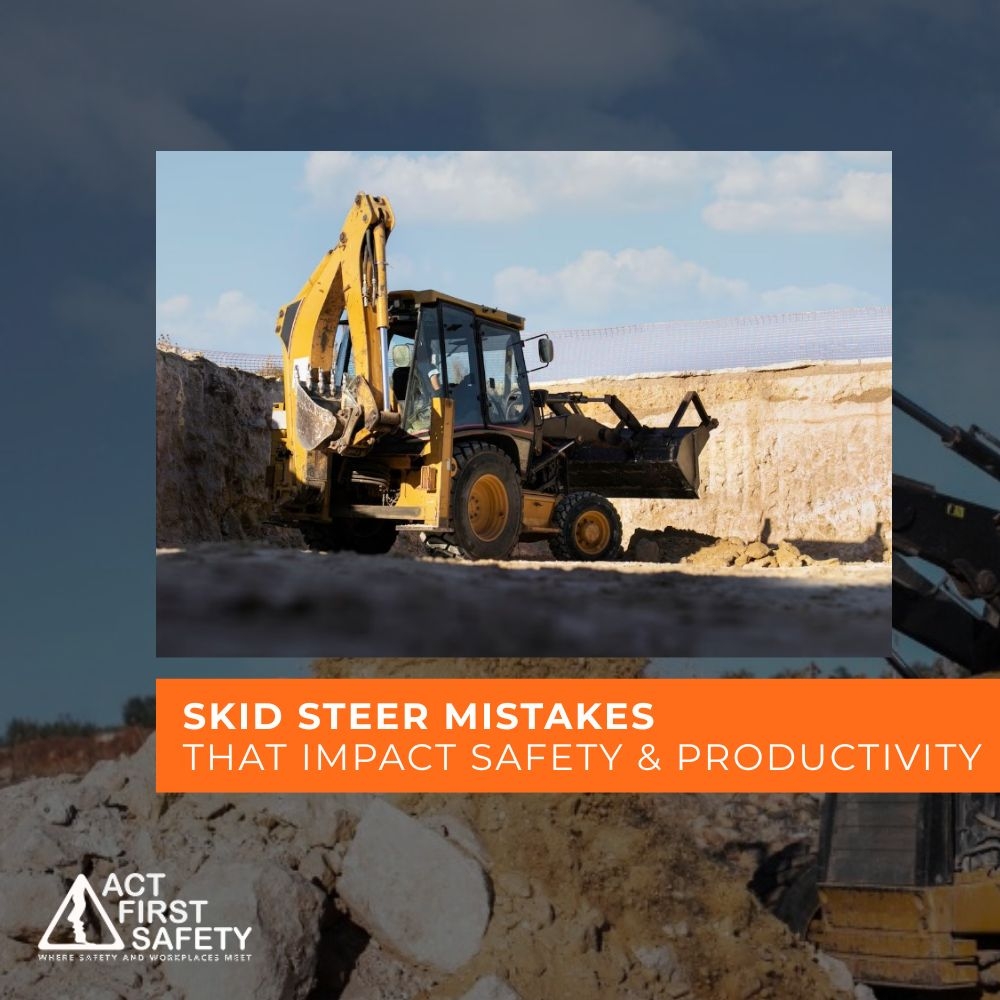
A skid steer is a compact powerhouse of a machine that can handle all sorts of demanding jobs on farms, construction sites, and industrial settings – especially if appropriate attachments are used. However, their versatility can turn into a double-edged sword if they are not used the right way.
That’s why, whether you’re new to the machine, a seasoned pro, or anyone in between, you need to watch out for skid steer mistakes that can get you into trouble. Today’s blog from Act First Safety, Ontario’s most trusted worker safety training course provider, is here to rescue you.
We will discuss eight common skid steer mistakes that serve as an effective reminder for safe operational practices. Especially if your goal is to be a competent operator. Avoiding these mistakes is imperative to preventing accidents, equipment damage, downtime, and expensive repairs.
Mistake 1: Giving Seatbelts A Miss
What operators often do: The number of drivers who skip wearing a seatbelt because it’s annoying or because they only have to travel short distances with a skid steer is shocking! But the truth is, these machines can easily throw you off balance, causing you to hit a bump or a hole and roll over. If you're not buckled up, you could end up in a world of pain.
Why it’s a problem: A skid steer may be a compact machine, but it’s plenty powerful and capable of inflicting severe damage if you're not careful. If you're not wearing a seatbelt, you're rolling the dice with your safety. Things can go really wrong, really fast.
Best Practices: Before you turn on the engine, make sure your vicinity is clear of any bystanders. You must also follow the training protocol when entering or leaving the cab. When you're ready to go, lower the safety bar, make sure all the controls are off until you're buckled in, and click that seatbelt into place. Lock yourself in good and tight, as you would in a car, and make it a habit to do it every time. It's the only way to guarantee your safety.
Mistake 2: Navigating A Skid Steer On Sloping Ground
What operators often do: Driving straight up or down a steep hill, or sideways on a slope, is a recipe for disaster. Even though your skid steer can turn in its own tracks, it’s not the kind of maneuverability you need to stay safe on inclined ground conditions.
Why it's a problem: A skid steer is tall and narrow. Because of its design, it is likely to roll over – especially if you're carrying a load or moving too quickly. That’s why driving on slopes is always a risk. However, driving sideways or carrying a load pushes the risk factor further.
Best Practices:
- Moving up and downhill: Keep the heavy end downhill, always. If you're going up, make sure the attached bucket is uphill as you drive slowly and carefully. If you're going down, drive backwards with the bucket downhill.
- Working on slopes: Don't drive sideways across slopes. If you have to, go extremely slowly. Remember, a skid steer may have good traction and be easy to handle, but slopes are still risky. So keep the bucket low to maintain stability.
- Understanding the angle: Your skid steer’s instruction manual contains all the details about the maximum safe slope. Make sure you do not exceed it. If a hill looks too steep, it probably is. In such ground conditions, it is better to play it safe than to risk it.
Mistake 3: Exceeding Load Capacity & Lifting High While Moving
What operators often do: Driving around with a full bucket raised high or lifting it to dump the material it contains without stopping can cause serious accidents. With work pressures mounting on some sites, this maneuver has become common. Frankly, it's a wonder and a blessing that more accidents don't happen.
Why it's a problem:
- Risk of rollovers: We’re not talking about cute dog tricks. Lifting the load too high can disturb the machine's centre of gravity, which means even a single bump on the road can cause it to flip.
- Potential accidents: If you're carrying a loose load like gravel or rebar, it can fall while you're driving. Raised loads are more hazardous and are likely to cause accidents, minor or major, depending on impact.
- Damage to goods or property: The risk of hitting a physical object like a car or a building is omnipresent. Damage to property costs employers in repair and replacement. These extra expenses can be avoided by investing in professional skid steer training and reinforcing safe driving habits with competent supervision. Think of it as any other vocational safety course, such as forklift operator training, for example.
Best Practices:
- Keep the bucket low while driving: Ensuring the bucket is no more than 8-12 inches off the ground is a simple way to avoid any nasty bumps or dips in the ground. If you're working in tight spaces, keep the load low to avoid any additional risks.
- Stop before lifting: Park the machine, set the parking brake, and then - and only then - lift the bucket. When you're done, lower the bucket again before driving away.
Mistake 4: Ignoring Rough Terrain
What operators often do: Entering the working area with low awareness or driving too fast without checking ground conditions could result in careening into a mud pit or a patch of sharp debris like rocks or site materials.
Why it's a problem:
- Loss of control: Getting stuck is bad enough on a good day, but when you're on soft ground or sand, it can be a real nightmare to get out of. Driving into a mud pit or a sandbank will leave you spinning your wheels, which might cause you to sink even deeper.
- Machine damage: Running over sharp objects like rocks, rebar, or glass can break your skid steer’s tires or tracks, resulting in productivity loss and expensive repairs.
- Risk or rollover: Hitting something like a big rock or a deep hole affected by speed, load weight or high centre of gravity could result in a rollover.
Best Practices:
- Conduct a pre-use site inspection: Before you start the job, look for hazards on-site. Continue to develop awareness skills to quickly identify emerging hazards throughout the length of your shift. Before you begin driving, check if the soil conditions will support your skid steer.
- Travel at a safe speed and stay alert: Use the tools available to you in the cab to ensure you are not just looking straight ahead. Use your peripheral vision, mirrors, and backup cameras to observe your surroundings and be mindful of environmental changes or altering ground conditions.
Mistake 5: Mistakes Made With Attachments
What operators often do: The popular 1980s TV show, ‘MacGyver’, focused on the main character’s ability to patch materials together to solve the problem of the day. When it comes to picking the right tool or attachment for your skid steer, using that concept as a guiding principle is a very bad idea. Attaching old equipment, patching pieces together, not selecting the right accessories, and improvising could result in some very costly mistakes.
Why it's a problem:
- Tool damage: Overloading the wrong attachment or using it for something it's not meant for can cause it to crack or break, making the day’s job more complicated.
- Machine damage: Overloading can also put a strain on the skid steer itself. And before you know it, you may end up with a busted cylinder, or a torn hydraulic hose, or even a broken quick coupler. Each of these is very expensive to repair.
- Overall impact: Breakdowns result in wasted time and effort, along with delays and added expenses. These can hinder the success of your project.
Best Practice:
- Pick the right tool for the job: Understand the scope of work and select the right attachment(s) for it. Understanding the limitations and uses of each attachment type ensures the selection of the most appropriate type for the task at hand.
- Affix it properly: Test the attachment before using it, and don't forget to make sure it's locked in securely.
Mistake 6: Driving Without Spatial Awareness
What operators often do: Operators often drive a skid steer without checking potential blind spots, which are several in number.
Why it's a problem:
- Potential for damage or accident: Lack of spatial awareness can create many opportunities for damage to people or property.
Best Practices:
- Look before moving: Make sure the area is clear of people, vehicles, and other hazards.
- Give a warning: Before you start driving, give a quick honk on the horn or flash the car’s lights as a warning.
- Go slow and watch constantly: You must abide by this rule if you are operating in tight spaces or busy areas. Spatial awareness is crucial for safe operation.
- Use a spotter: It is always safer to use a spotter on challenging worksites than to make a drastic mistake.
Mistake 7: Ignoring Machine Maintenance
What operators often do: Not completing a full pre-shift inspection is perhaps dangerous. Whatever the reason may be – lack of proper training, pressure to get the job done or assurances from another worker that the machine is fine- pre-use inspections must not be skipped.
Why it’s a problem:
- Shortens lifespan: Equipment like skid steers, lift trucks, and mobile elevating work platforms needs to be maintained for optimal operation and equipment longevity. Consider them as critical as aerial lift training for safe operations as well.
- Causes breakdowns: Equipment failure, due to low oil, for example, mid-way through a job, can be costly both in manpower and repair costs. It might even cost you your next project.
Increases repair bills: Ignoring small performance issues can cause them to snowball into operational failures, which can be incredibly expensive to fix.
Best Practices:
- Carry out pre-shift Inspections: Conduct all the necessary checks as per the manufacturer’s instructions. This includes checking items like engine oil, hydraulic oil, coolant, lights, and horn. Everything should be in good working condition with no leaks or visible damage.
- Maintain your machine well: All points that need attention, like greasing and lubing, or changing oil and filters, should be performed as scheduled.
- Report problems promptly: Let your employer or supervisor know of any faults or problems with the machine. Inoperable equipment should be decommissioned until it has been serviced.
Mistake 8: Letting Anyone Get Behind The Wheel
What operators often do: It may look easy and fun, but operating a skid steer requires proper operator training to ensure legal compliance. When an operator doesn’t show up for their shift, it may be tempting to allow an inexperienced, untrained worker to operate the machine, but this is strictly not recommended.
Why it's a problem:
- Legal liability: Professional skid steer training outlines several critical operational aspects, including hazard identification, legal obligations of both the operator and the employer, safe operation techniques, and more. Allowing an inexperienced worker to operate equipment is equivalent to handing the keys of a car to a teenager who has only ever been a passenger. It is simply too dangerous and could cause supervisors and employers to face hefty fines and even jail time in Ontario.
Best Practices:
- Training is unskippable: You cannot put an operator behind the controls without ensuring they have the right training first. A verifiable certificate is a good start. However, ideally, operators should gain expert command over the machine’s controls before they start working on a real job. Practice and knowledge go hand-in-hand.
- Know your machine inside-out: Read the operator’s manual carefully before driving a skid steer. Since they are heavy-duty machines, proper operation is a must to prevent damage or accidents.
- Keep an eye on new operators: New operators need someone with experience to show them the ropes. They must learn how the machine behaves under normal use, and the types of tasks it's suited for - such as construction, farming, landscaping, and of course, maneuvering tight spaces. Oversight by experienced operators and supervisors is critical – especially in the early stages of a new operator’s progress.
Steer Clear Of These 8 Mistakes To:
- Get home from work every day, all in one piece. That’s priceless!
- Save yourself a small fortune on repairs and replacements by keeping your machine in tip-top shape.
- Get the job done more efficiently and effectively by supporting the skills learned in skid steer operator safety training.
- Support overall safety by encouraging best operating practices on all jobs.
Conclusion
Skid steer safety is a critical issue that deserves every bit of attention it gets. By following protocol and the best operational practices, certified drivers can maximize onsite productivity and safety while minimizing inefficiencies, damages, and injuries. Needless to say, proper training is essential, and that is where we come in.
Act First Safety’s worker training courses are well-known in Ontario for their comprehensive syllabi, practical examinations, and verified professional certifications. Our skid steer training program is no different and can be availed of at either our facility, which is located off Highway 401 in Scarborough, or at your premises. Contact us to set up a training program for your crew.
FAQs
Why is it called a skid steer?
It’s called a “skid steer” because the machine turns by skidding. Instead of having a traditional steering mechanism, each side’s wheels or tracks move at different speeds or in opposite directions, causing the machine to pivot or “skid” in place. This gives it incredible maneuverability, especially in tight spaces.
How much can a skid steer lift?
The lift capacity of a skid steer depends on its model. Typical ranges include:
- Small skid steers: 700 – 1,750 lbs
- Mid-size models: 1,750 – 2,200 lbs
- Large-frame units: 2,200–3,500+ lbs
Just as with lift trucks and scissor lifts, always check the rated operating capacity (ROC) when comparing models and determining what size is best suited for the type of work that is being done.
What should a skid steer pre-use inspection include?
It should include a complete 360-degree visual inspection along with an engine compartment check and cab test. The hydraulics should be checked for leaks, and the tires for wear and tear. Refer to the instruction manual for a detailed inspection checklist.