Construction Safety Through the Lens of the CDR 2026-Part 5: The Role of Age, Experience and Employment Status
The Construction Death Review 2026 provides more than statistics about how construction workers lost their lives. It also provides an opportunity to look at who was involved—including gender, employment status, and other factors that may influence a worker's experience of their workplace.
In this article, Act First Safety, a highly-regarded CPO-approved safety training provider in Ontario, will take a closer look at the CDR's findings related to male and female workers under temporary or contract employment, along with workers who may face additional challenges when entering or working within the construction sector.
Please note that this blog in no way indicates that a worker's gender, employment status or background determines their level of risk. Rather, it analyzes these factors to provide important safety considerations for employers, supervisors and those responsible for workplace safety.
A safe workplace depends on more than identifying hazards. Workers need appropriate orientation, safety training, communication, supervision, and an understanding of the work they are expected to perform. These considerations can become particularly important when they are new to a site, working temporarily or seasonally, or may not yet be familiar with the hazards and expectations of a particular workplace.
Employment Status: Temporary and Contract Workers
Employment status provides another perspective on the fatalities reviewed by the CDR. The majority of the men included in the review were full-time workers, although eight were working under temporary or contract arrangements.
Of the three women included in the review, one was a full-time employee, and two were contract workers. The circumstances of the latter two were very different. One of them had worked as a summer seasonal employee over a three-year period, while the other was on her first day onsite as a general laborer.
Although these numbers are small and do not allow for broad conclusions, the report’s findings still highlight an important consideration for employers and supervisors: being new to a workplace can create additional safety challenges.
Workers who are temporary, seasonal, contractual or new to a site may be unfamiliar with the workplace, its equipment, hazards, procedures, and expectations.
Effective orientation, appropriate safety training and competent supervision are therefore important safeguards—particularly when a worker is unfamiliar with the worksite or is performing a task for the first time.

Source: Construction Death Review, 2026
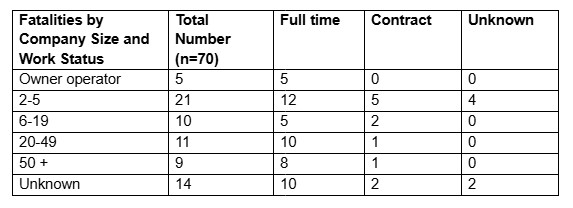
Statistics by company size have not been provided here in full, but the report clearly indicates that the size of the company has some bearing on the nature of the work and the employment status of workers. The report also revealed that smaller companies had a greater number of contractual or temporary workers. Conversely, medium and larger companies tended to be staffed with full-time workers.
Company Size by Number of Workers
Source: Construction Death Review, 2026
As per the report’s findings, men of various age groups were found working on a temporary or contractual basis, with half of them being 50 years or older. As for women, the two of them reported working under temporary or contract arrangements were between 30 and 50 years old.
Although this dataset is small enough to conclude age or employment status as predictors of workplace fatalities, the findings, nonetheless, provide another reminder that temporary and contractual workers can come from a wide range of ages and experience levels.
Safety orientation, training and supervision should therefore be based on the hazards and work being performed—not assumptions about a worker's age, experience or employment status.
Work Experience
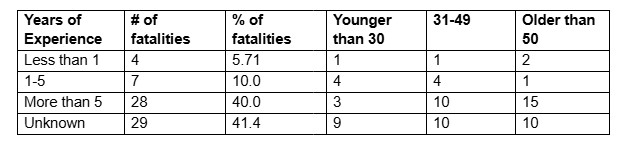
Experience is another factor worth considering when looking at the fatalities reviewed. It was confirmed that at least four workers had less than one year of experience in the construction sector. However, the actual number may have been higher, as the years of construction experience could not be determined for 29 of the workers that lost their lives in the period covered by the report.
Among the workers for whom experience could be confirmed, most had more than five years of experience in the construction sector. This is an important reminder that experience alone does not eliminate workplace risk. Even experienced workers can encounter unfamiliar equipment, changing conditions, new worksites, or hazards that require specific training and supervision.
For employers and competent supervisors, the lesson is to avoid assuming that a worker's years in the industry automatically translate into familiarity with the hazards of a particular job or worksite. Site-specific orientation, appropriate safety training, and active supervision remain important regardless of how long a worker has been in the construction sector.
For example, even if a worker is used to elevated work, making sure they have working at heights training before hiring them can be instrumental in preventing fatalities. Another good example is aerial lift training. Orienting workers with the machines present on-site can help them get familiar with the controls and safety protocols of brands/manufacturers they haven’t worked with before.
Fatalities by Years of Experience and Age
Source: Construction Death Review, 2026
Time on Site: When Experience Does Not Mean Familiarity
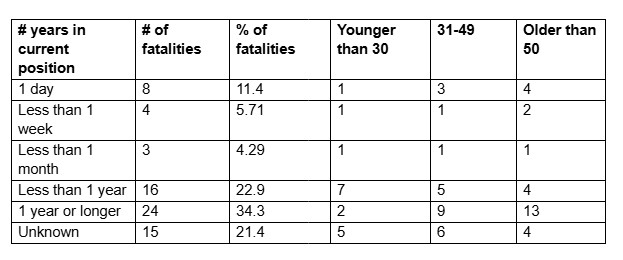
A second significant factor was how long workers had been at the site where the fatal incident occurred. While many of the workers reviewed had been in their positions for some time, eight workers died on their first day at the site. Fifteen workers, more than one-fifth of those reviewed, died within their first month at a new site.
These findings highlight an important distinction between experience in the construction industry and familiarity with a particular workplace. A worker may have years of experience and still be unfamiliar with a new site's layout, equipment, hazards, procedures, emergency arrangements, or safety expectations.
Of the 70 fatalities reviewed, 16 occurred within the first year in the worker's current position, while 24 involved workers who had been in their position for one year or longer. The length of time in the position could not be determined for 15 workers.
The number of fatalities involving workers who were new to a site reinforces the importance of effective site orientation, hazard communication, and competent supervision. A new worker should not be expected to know the hazards and procedures of a workplace simply because they have experience elsewhere in the construction sector.
Being experienced does not necessarily mean being familiar. Every new worksite requires workers to understand its specific hazards, controls and expectations.
Fatalities by Years in Position
Source: Construction Death Review, 2026
Key Takeaways
Patterns revealed by the CDR 2026 indicate potential areas of improvement. For example, 47 of the 56 workers for whom we have employer information, 84%, worked in small- to medium-sized companies with fewer than 50 employees. Meanwhile, 26 of those 47 employees, or roughly 55%, worked in companies with fewer than five employees. Furthermore, smaller and mid-sized companies are over-represented across all categories of death.
Falls from height are the largest cause of death in companies with fewer than five employees, representing almost 74% of deaths. Small companies experienced more wall, trench, and ceiling collapses than other companies. Crushing and interaction with heavy equipment are the most common categories of death in companies with 6-49 employees.
The prevalence of smaller companies in this review raises the need for consideration of potential issues that may limit their ability to provide a safer working environment, including limitations on supervision, the need for each individual employee to perform multiple tasks, and expeditious completion of tasks based on potentially limited resources.
Case Study: What Led to the Unfortunate Fatality of PANG, Xiuyuan
CDR 2026 backs each of its statistics with a fatality that truly reveals its impact. The story of Xiuyuan Pang is a particularly important reminder in this regard of the role that effective safety systems and supervision play in construction and maintenance work.
His fatality raises critical considerations around proper safety training, in this particular case boom lift training, working in isolation, effective supervision, worksite orientation including equipment orientation like MEWPs, and the effective presence and use of equipment operator manuals.
PANG, Xiuyuan
On March 13, 2020, 55-year-old Xiuyuan Pang was working as a part-time seasonal labourer for a refrigeration company.
The project in question consisted of renovating an industrial building space into a warehouse facility and included the construction of a walk-in cold storage room.
Mr. Pang was working by himself and had climbed aboard an elevating work platform (EWP). At some point, Mr. Pang activated the joystick for controlling elevation. The platform rose and Mr. Pang became trapped between the EWP’s guardrail and an overhead beam used to support electrical wires.
Two coworkers attempted to free Mr. Pang, first by unsuccessfully attempting to use the EWP’s emergency lowering valve, and then by using another EWP to reach Mr. Pang. Mr. Pang was trapped for several minutes before being released, at which point he was unresponsive. He was transported to hospital, where he ultimately died as a result of his injuries, eleven days later on March 24, 2020.
It was determined that Mr. Pang had not been provided with training or instruction on the operation of an EWP, including with respect to the owner’s manual.
An individual was convicted and sentenced under the OHSA.
Conclusion
CDR 2026 continues to reveal just how important it is to implement safety protocols relevant to each type of construction site. While this involves the identification and effective management of workplace hazards, it also includes providing workers with proper orientation, safety gear, and training. We can help you with the latter.
Act First Safety provides a wide array of certified safety training programs in Ontario with the single purpose of improving worker safety and site compliance. Available on your premises or at our facility located off Highway 401 in Scarborough, our courses can be clubbed together for efficiency and practicality. Contact us to learn about upcoming training programs and their details.
FAQs
What can employers do to create safer workplaces for contractors and seasonal workers?
Employers provide all workers on-site with orientation and instructions for the tasks and equipment they will be expected to perform or operate. Effective safety training and competent supervision are particularly important when a worker is new to the workplace, unfamiliar with the equipment, or working with limited supervision.
How can worksite orientation keep workers safe around machinery and mobile equipment?
A worksite orientation helps workers understand the hazards, rules, procedures and emergency arrangements that are specific to the workplace. It can help them identify restricted areas, traffic patterns, overhead hazards, communication requirements and other conditions that may not be familiar to someone who is new to the site.
However, a general site orientation is not a substitute for equipment-specific training. Workers who operate or work from mobile equipment, including mobile elevating work platforms (MEWPs), need appropriate instruction on the equipment they will be using, including its controls, limitations, hazards, emergency procedures and the manufacturer's operating instructions.
Does previous experience with similar equipment mean a worker is trained to operate a MEWP?
No. Familiarity with similar equipment does not necessarily mean a worker has received the appropriate instruction for the specific equipment, workplace or task. Equipment can differ in controls, operating characteristics, limitations, and emergency procedures. Workers need appropriate training and instruction before operating the equipment they are assigned to use.
Why are equipment operator manuals important?
The operator's manual provides equipment-specific information that workers and supervisors need to understand how the equipment is designed to operate, its limitations, warnings, emergency procedures, and other important safety information. The manual should be readily available and incorporated into appropriate training and instruction rather than simply being kept with the equipment.
What should supervisors consider when a worker is operating equipment alone?
Before allowing someone to work alone, supervisors should consider the hazards of the task, the equipment involved, the worker's training and experience, communication methods, emergency response, and whether assistance or monitoring is required. Working alone can change the risk associated with a task and should be addressed during planning.
What does the Xiuyuan Pang case teach us about MEWP safety training?
The case reinforces that workers should receive appropriate training and instruction before operating a mobile elevating work platform (MEWP). Training should address the equipment's controls, hazards, limitations, emergency procedures, and manufacturer's instructions. Workers and supervisors should also understand the conditions in which the equipment will be used, including overhead hazards and the need to maintain appropriate clearances.
What does this fatality teach us about competent supervision?
Competent supervision ensures that workers are trained, instructed, equipped, and appropriately supervised, particularly when they are working alone or operating unfamiliar equipment.