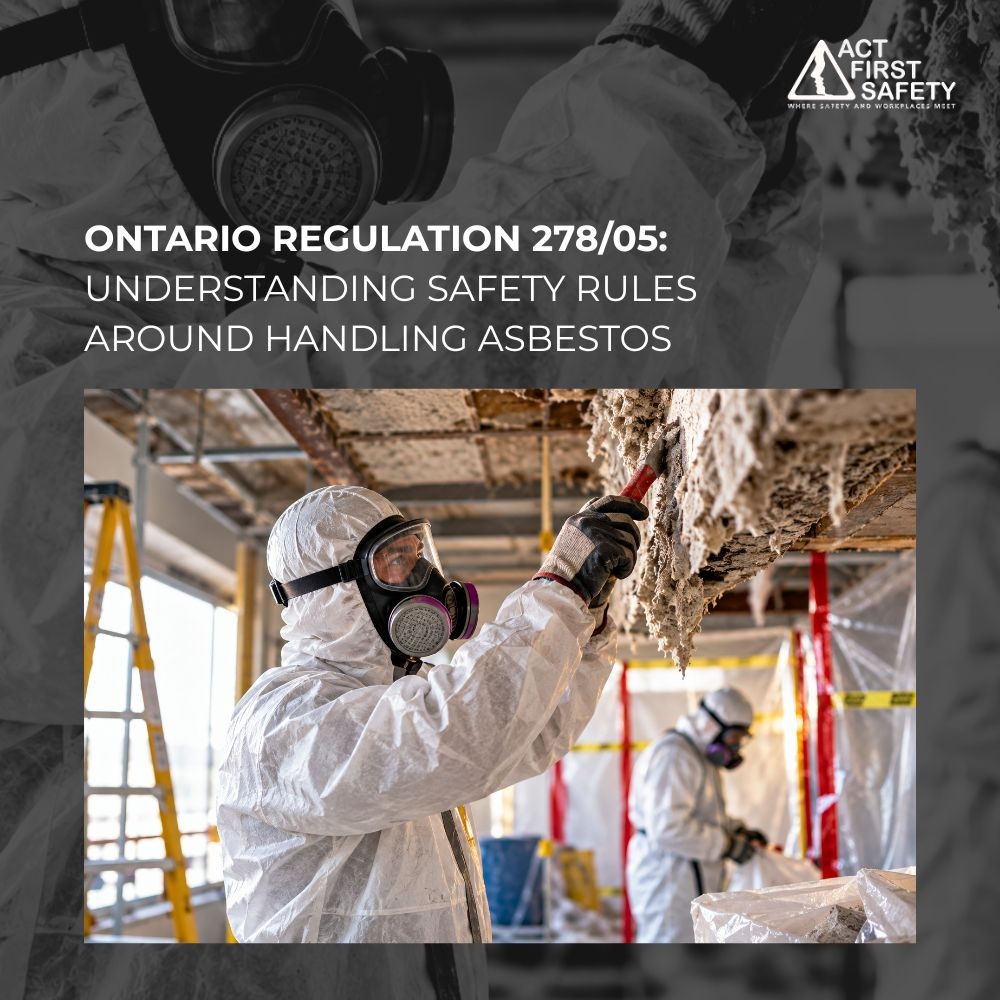
Touted as a miracle mineral, asbestos was used in thousands of products in both the workplace and the home. However, its harmful effects on human health prompted a firm ban that only came into effect in 2018 in Canada. In fact, the complete cessation of all new use of asbestos in the country will not end till the year 2029. That means it continues to be a major hazard for all workers until then. Respirators for asbestos work can help, but understanding the regulations surrounding safe asbestos work is key to preserving worker health in the long run.
Today’s blog from Act First Safety, providers of the most popular and certified safety training courses in Ontario, will discuss Ontario Regulation 278/05 in detail to understand who is responsible for asbestos safety.
The Prevalence of Asbestos on Common Worksites
People often don’t realize how common asbestos was in manufactured goods. Asbestos products were widely used in building materials and in commercial goods. In fact, their popularity only started to wane in the 1980s and 1990s as their dangers became more apparent and well-known. However, it continues to be a part of the structure of several buildings across Ontario.
Building owners are often surprised by the discovery of asbestos in their properties, while sellers are required to disclose the presence of any known dangerous asbestos in products they sell.
Which brings us to the question: What are the expectations when tendering or arranging for work in a building with asbestos? Ontario Regulation has something specific to say about it:
Ontario Regulation 278 Asbestos on Construction Projects and in Buildings and Repair Operations clearly outlines how asbestos operations should be followed in this province.
Who Does The Regulation Apply To?
Ontario Regulation 278 Asbestos on Construction Projects and in Buildings and Repair Operations applies to every project and its owner. As per the regulation:
“An ‘owner’ is defined as: a trustee, receiver, mortgagee in possession, tenant, lessee, or occupier of any lands or premises used or to be used as a workplace, and a person who acts for or on behalf of an owner as an agent or delegate.”
It also applies to every constructor, employer and worker engaged in or on the project to which the regulations apply.
Additional situations where the regulation applies are:
- The repair, alteration, or maintenance of a building, the owner of the building and every employer and worker involved in it
- Every building in which asbestos-containing material has been used and its current
- The repair, alteration, or maintenance of machinery, equipment, aircraft, ships, locomotives, railway cars, and vehicles, as well as any building that is necessarily incidental to the repair, alteration or maintenance of the aforementioned where it is likely that asbestos-containing materials may be handled, dealt with, removed or disturbed and every employer and worker to which regulation 837
- Designated Substances does not apply
- The demolition of machinery, equipment, aircraft, ships, locomotives, railway cars and vehicles containing asbestos and every employer and every worker engaged in this task including contractors and subcontractors who work for or supply services to the employer
It seems pretty clear in the case of a workplace that if there is asbestos in it, the regulations apply. But what does the asbestos regulation say about residences containing asbestos?
While it does not apply to a private home occupied by the owner or any residential buildings with no more than four units, one of which is occupied by the registered owner, it does apply to a larger residential building and any residential building in which the owner and their family reside.
This means many landlords and condo corporations come under the regulation’s purview. They must follow the same requirements for notification and examinations as any workplace is required to. This is to protect both the occupier(s) and any workers who are present during repair, alteration or maintenance work in the building from exposure to asbestos dust or disturbance.
What is an ACM report?
Before an owner requests tenders, arranges for, or draws contracts for the demolition, alteration or repair of a building, machinery, equipment, aircraft, locomotive, railway car, ship or vehicle, they must determine if the friable or non-friable materials in it meet the definition of an asbestos-containing material (0.5% or more asbestos content by dry weight).
The requirements for this examination are set out in Ontario Regulation 278/05. The owner must then prepare a report that is provided to all potential constructors so they are all aware of what they are dealing with.
ACM means Asbestos Containing Material and is any product or material that contains asbestos.
Once the owner chooses a contractor for the work, the contractor is responsible for providing the report to all potential contractors. Selected contractors, in turn, must share it with all potential sub-contractors and so forth. This report must include the following:
- Whether the material is an ACM or whether the work will be done as though the material is an ACM
- A description of the material and its condition, including whether or not it is friable, as applicable for each instance
- Whether the work will be done as if the material is an asbestos other than chrysotile
- Drawings, plans and specifications, as appropriate, showing the location of the material in question
In situations where the material is discovered to be an ACM after work has begun, the constructor must immediately notify the MLITSD, the owner, any contractors and the JHSC or health and safety representative, if any
What is an Asbestos Management Program?
For the ongoing management of any asbestos-containing material, the owner must develop an asbestos management program. This ensures the safety of any occupants and workers while the building is in use and during any future work. This program must include the following provisions:
- A record of the location and conditions of ACMs and materials that may be ACMs, or are to be treated as if they are ACMs, including whether or not they are friable. In the case of sprayed-on material, the report must mention if it is to be treated as if it contains any asbestos other than chrysotile
- This record must be updated every 12 months or whenever the owner becomes aware of new information
- Inspections of any material mentioned in the record must be performed at reasonable intervals
- Periodic examination of friable material used as building fireproofing or acoustical insulation that has fallen and is being disturbed – meaning that exposure is likely to occur. Unless the exposure arises out of any work that is being carried out as if the material is an ACM.
- Written notification shared with workers, occupiers, and employers that contains information pertaining to ACM and its management
- Asbestos training for crews working in environments containing asbestos, including the use, care and disposal of protective equipment and clothing, personal hygiene, and the diligent practice of the measures and procedures described in the regulation
- Cleanup of fallen ACM or fallen friable material that’s treated as an ACM
- Removal, sealing or enclosure of deteriorated material if it is established as ACM or treated as an ACM where it is apparent that it will continue to fall unless enclosed by a false ceiling
In case of workplaces containing asbestos, a Joint Health and Safety Committee can be instrumental in enforcing the rules of the regulation on asbestos handling to ensure worker safety. However, for that to happen, appointing a member with formal JHSC training as a representative is important. This ensures workers and their concerns are sufficiently represented to management.
Conclusion
Asbestos is a major risk in construction in Canada that workers and owners are often unaware of. Care must be taken to evaluate the workplace for the risk of asbestos exposure. Owners must also do their duty and develop a comprehensive asbestos management program so that work in their building can be done both efficiently and safely.
But real safety starts with the right training. Act First Safety equips Ontario crews with the knowledge and practical skills they need to work safely in environments containing asbestos. Contact us to learn how our courses, such as asbestos training and JHSC training, contribute to worker safety.
FAQs
Are asbestos regulations applicable to landlords who live in rented houses?
Yes, asbestos regulations apply to landlords if they are the owner of a building containing ACMs, unless the occupier of the building is a member of their family.
The work involves working with an ACM, but there is disagreement over what type of asbestos operation work will be conducted. How is it determined which asbestos operation will be classified: type 1, type 2, or type 3, so the correct procedures can be followed safely
Whenever there is a disagreement or uncertainty on the type of asbestos operation to follow, the MLITSD must be contacted. They can help in deciding the operation type so that people involved know which procedures outlined in the regulations concerning asbestos must be followed.
Is an examination of materials always required before tendering or arranging for work to be done on a building?
No, exceptions exist if:
- The owner already knows the material is not an ACM
- The owner already knows the material is an ACM, and in the case of sprayed-on friable material, knows the kind of asbestos it is, or:
- The work is contracted and set up in accordance with the regulations concerning the handling of an ACM, or, in the case of sprayed friable material, the owner concurs to handle the material as if it contains asbestos of a type other than chrysotile.