Construction Safety Through the Lens of the CDR 2026-Part 4: Understanding Worker Demographics
In our multi-part series on the Construction Death Review 2026, we have covered multiple facets and insights from the report. We have given a broad overview, discussed key safety lessons, and uncovered fatality patterns.
Today, Act First Safety, provider of certified safety programs that have contributed to the skills and well-being of 100,000 workers across Ontario, will take a deep dive into what the CDR has to say about worker demographics when it comes to fatalities. The agenda is to recognize patterns that can be used to formulate more effective safety protocols. Let’s begin!
Who is working in construction today?
Construction is a multi-generational and increasingly diverse industry. Workers enter the sector at different stages of their careers, bring different levels of experience, and may have very different backgrounds, skills, and training needs.
The Construction Death Review 2026 provides an opportunity to look beyond the circumstances of individual incidents and consider who was represented among each of the 70 fatalities reviewed. We will tap into the report’s findings to examine if the worker’s age and sex had a role to play in these fatalities.
Please bear in mind that these statistics do not establish that age or sex causes workplace fatalities, nor can they be used to predict which individual workers are most likely to be injured. They do, however, provide useful information for considering how safety training, communication, supervision, and hazard controls can support today's construction workforce.
The goal is not simply to understand who was represented in the fatalities, but to consider what these findings can teach us about preventing the next one.
Fatalities by Age
According to the workforce information cited in the CDR, approximately one-fifth of Ontario’s current construction workers are 55 years or older, while the largest proportion of workers falls within the 25–54 years age group.
The CDR 2026 findings show that older workers represented a significant proportion of the fatalities reviewed. Of the 70 deaths examined, 42 (or 60%) involved workers over the age of 40, while 28 workers (or approximately 40%) were 50 or older.
Average Worker Age Range In The Construction Sector
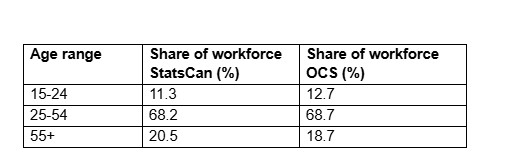
Source: StatsCan and the Ontario Construction Secretariat (OCS)
If you take the above statistics into account, you can notice a pattern between age range and fall-related fatalities. In fact, CDR 2025 makes it amply clear. It found out that approximately 69% of workers who died as a result of a fall were over 40, while approximately 27% were over 60.
Fatalities by Age
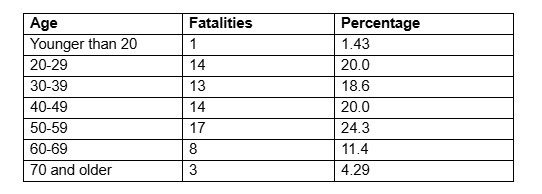
Source: Construction Death Review, 2026
Despite what the table might indicate, these findings should not be interpreted in a way that signifies age creates a greater risk of fatal injury. They do, however, provide an important opportunity to consider how factors such as the type of work, physical demands, working at heights, experience, equipment, and individual circumstances may affect workers differently.
Fatalities by Sex
Men represented approximately 86.5% of Ontario's construction workforce in 2024 and accounted for 95.7% of the fatalities reviewed. Women represented approximately 13.5% of the workforce and accounted for 4.3% of the fatalities.
Only three female fatalities were included in the CDR, involving workers between 26 and 46 years of age. The male fatalities were distributed across a much wider range of ages, with 28 (or approximately 41%) involving workers over 50.

Source: Construction Death Review, 2026
Because the number of female fatalities reviewed is small, the CDR’s findings do not support broad conclusions about gender-specific risks. Instead, the data provides an opportunity to consider the changing composition of the construction workforce and how safety training, communication, and supervision can support all workers.
Fatalities by Sex and Age

Source: Construction Death Review, 2026
The distribution of fatalities by sex and age provides another perspective on the findings as indicated.
A Changing Workforce, An Unchanging Need for Safety
The construction workforce includes workers with different ages, backgrounds, levels of experience, and career paths. While the CDR data cannot tell us how individual workers received or understood safety information, they provide an opportunity to consider whether our approach to training and supervision reflects the workforce we have today.
These figures should be considered in the context of workforce representation and should not be interpreted as evidence that sex itself determines workplace risk. They are meant to reinforce the importance of effective safety communication and training that recognizes the diversity of today's workforce.
Safety Training for a Changing Workforce
For employers and supervisors, the CDR’s numbers indicate that simply delivering the same information to everyone might not be enough to ensure worker safety.
Effective safety training needs to be understood, relevant to the work being performed, and accessible to workers with different levels of experience, backgrounds, and learning needs.
Competent supervision plays an equally important role in ensuring that workers understand expectations and that safe work practices are actually being followed on-site.
One thing is clear. Our workplaces are evolving, and when it comes to health and safety, we will continue to be challenged by their dynamic nature, making worker safety paramount.
For employers and supervisors, this means considering whether training is clear, relevant, accessible, and actually applies to the workers who will be doing the job.
It also means that assuming experienced workers do not need refresher courses when site conditions change, or new equipment is introduced, can be risky. Training is a must, irrespective of age or experience.
Competent supervisors, with their experience and sensibility, can help here. They can translate training into safe work habits by openly communicating with workers, keeping an eye on what’s going on, staying on top of any changes, and making sure that critical safety measures are being followed. This is particularly crucial with high-risk activities such as working at heights, when you not only need training but also the right equipment, careful planning, hazard assessment, effective supervision, and the right fall protection controls in place.
Working at Heights: A Lesson Beyond the Numbers
Speaking of working at heights, the CDR's findings on age and fall-related fatalities paint a stark picture. The truth is that falls are still a massive construction hazard, and the data from the 2025 review shows just how big a problem it is for older workers in particular.
The appropriate response to this isn't to assume that older workers are somehow less capable or that age is the only thing that influences fall risk.
Instead, the takeaway is that every job should be properly planned and performed by workers with certified working at heights training. Plus, the right fall protection equipment and specific worksite knowledge should be provided to carry out the task safely and efficiently.
For supervisors, this includes considering the work environment, access and egress points, equipment selection, changing conditions, and whether workers are following established fall protection procedures.
What Can Employers and Supervisors Take From the CDR Findings?
The CDR 2026 findings confirm that age and sex are not the only factors that influence whether a workplace accident will be fatal. They suggest that employers need to get a better understanding of who is working for them and what their working environment is like.
Different workers bring different levels of experience, backgrounds and familiarity with the tasks and workplaces they will be operating in. If your safety programmes are going to be effective, they need to take account of this diversity, while still consistently controlling hazards.
In this regard, supervisors must ensure new workers go through the most appropriate orientation and training for the job at hand. Everyone must also be made aware of the hazards onsite and how they can be safely managed, irrespective of their age or experience levels.
The goal is not to identify which workers are “more vulnerable.” The goal is to make sure that every worker has the knowledge, resources, supervision, and protection needed to go home safely.
Case Study: The circumstances surrounding the fatality of Paul Dawson
While statistics can paint an alarming picture, they cannot convey the impact of the loss of a life. Real-life stories relay the full impact of workplace fatalities, and how they could have been avoided if pepper safety measures were in place.
The story of Paul Dawson is a particularly important reminder of the role that work experience, age, safety training, worker orientation, and supervision play in all work practices. His fatality raises critical considerations about the long-term effects of workplace injuries.
DAWSON, Paul
On July 13, 1994, 24-year-old Paul Dawson was working as a dump truck driver for a company subcontracted to haul materials during construction of a flood reduction project. He had about a year of driving experience, and it was his first day with this employer and on this job.
Late in the afternoon, he was instructed to position the truck to remove soil stuck to the bottom of the dump box. He parked his truck on a vacant company lot where he raised the box and disengaged the tailgate so his employer could scrape it with a backhoe bucket.
Mr. Dawson and another worker were standing to the side of the truck and backhoe. During the cleanout, he briefly positioned his head between the tailgate and the dump box to see if the box was clean.
The boom of the backhoe struck the tailgate, which moved and crushed his neck between the tailgate and box. He was taken to hospital by ambulance, where he was found to have quadriplegia from a fracture/dislocation of the cervical spine.
Mr. Dawson went on to develop complications of quadriplegia including urinary and bowel dysfunction, skin breakdown, and recurrent pneumonia.
On April 5, 2021, he was admitted to hospital with pneumonia and respiratory failure. He initially improved with treatment but subsequently deteriorated and died on April 9, 2021, at the age of 51.
Conclusion
Learning from these tragedies is probably the most meaningful thing we can do. These life-saving takeaways can help employers revise their safety strategies and make training a default part of the program to prevent fatalities from taking place. Courses such as fall protection training can be particularly useful in preventing accidents related to working at heights, for example.
Act First Safety provides comprehensive, engaging, and certified safety training programs in Ontario that can help employers enforce stronger worker safety protocols for crews of all ages and genders. Contact us to learn more about inclusive courses and the role they play in keeping workers out of harm’s way.
FAQs
Does age play a role in construction site accidents?
Not necessarily. The CDR review of fatal incidents did turn up some disturbing statistics about older workers being involved in fatal falls, but the data does not establish that age itself caused or predicted a fatal incident. Instead, it usually came down to the job they were doing, the conditions they were working in, and how well they were being supervised.
Why is working at heights a concern when it comes to age?
The CDR's findings on fall-related fatalities show a significant representation of workers over 40 among those who died from falls. This reinforces the importance of effective working at heights training, appropriate fall protection, equipment selection, and competent supervision for everyone involved, irrespective of their age.
Does a worker's experience eliminate the need for safety training?
No. The CDR’s findings show that workers with industry experience are still vulnerable to accidents if they don't know the specifics of the job they are on. Employers and supervisors must ensure that everyone gets the training and support they need before they start working.
What does a good supervisor do to keep their workers safe?
A good supervisor communicates with their workers, keeps an eye on what's going on, and makes sure that everyone follows safety rules - especially during high-risk jobs. They must promptly respond to unexpected problems and ensure that their workers have all the right information and equipment to get the job done safely.
Why do you need to do site-specific orientation even for experienced workers?
Site-specific orientation is necessary for workers as it provides them with details on what they can expect on the job and what they need to be careful about.
What can employers and supervisors do with the CDR’s findings?
The CDR's findings give employers and supervisors a chance to review their safety protocols, find gaps, and mitigate them by providing their workers with appropriate training, safety gear, supervision, and equipment needed for safe work.