We recently published two blogs examining the Construction Death Review 2026. While Part 1 covered major risk areas and hazards in Ontario’s construction sector, Part 2 focused on key takeaways from the CDR, 2026.
In the third and final instalment of this series, Act First Safety, Ontario’s most highly reviewed and trusted safety course provider, will provide you with a lowdown on construction fatality patterns and how they can be used to improve worker safety.
Together, these findings provide employers, supervisors, and workers with important information that can support stronger prevention strategies to create safer workplaces.
Understanding The Patterns Behind Construction Fatalities
Today, we are looking beyond the types of hazards identified in the report to examine when fatalities occurred in terms of the month, day of the week, and time of day.. We will also examine where they took place (concentration by geographic region) to discover if it has an impact on worker safety.
Please bear in mind that these numbers do not predict when the next fatality will take place. But they reveal critical patterns that employers can take note of when devising worker safety strategies. They might also reveal areas that warrant additional attention, communication, planning or safety controls.
For competent supervisors, this kind of information can be helpful when they're planning work, figuring out how to tackle unexpected issues that come up on site, or while providing safety training and supervision to their workers.
The valuable role of having such information over the course of a whole project, and across a workforce that's getting more and more diverse and multi-generational, is undeniable.
Fatalities by Geographic Distribution
The CDR didn't find enough statistically significant results to help us figure out where most of the fatalities were concentrated in Ontario. In other words, it did not reveal clear regional fatality occurrence trends, which is very enlightening in its own right.
It’s a good reminder that workplace hazards don't discriminate based on provincial regions, and that we all need to be on top of our game when it comes to safe working practices, effective supervision, and proper hazard controls, regardless of location.
Fatalities by Month, Day and Time of Day
By Month
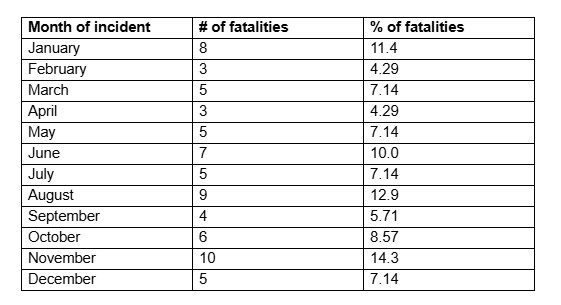
Overall, 39 of the 70 deaths reviewed – just under 56% – occurred between the months of April and October. This time period is often referred to as the so-called “peak building season”. However, what’s interesting to note here is that the peak season months were not the only ones that recorded high fatality rates. Some months witnessed noticeably more fatalities than others.
In fact, fatal incidents occurred throughout the year, which is consistent with construction being a year-round industry.
That said, November stands out for the most fatalities at 14.3%, then comes August at 12.9% followed by January at 11.4%. A few patterns start to emerge when you analyze the causes behind these fatalities.
While you would still hear of instances involving falls or getting caught in heavy machinery at pretty much any time of the year, crushing incidents seemed to be more of a problem between the months of November and March. Similarly, trench and ceiling collapses peaked in August.
Fatalities by Month
Source: Construction Death Review, 2026
These findings reinforce an important point for employers and supervisors: high-risk work does not have an “off-season.” Safety planning, competent supervision, and effective controls need to remain in place throughout the year, while also adapting to seasonal conditions and changing work demands.
They also indicate that complacency shouldn’t be the norm in off-seasons. Key workplace stakeholders, including workers, should adhere to safe practices and hazard controls throughout the year to remain safe on the job. This includes regular refresher courses, including aerial platform training, hoisting and rigging training, and more.
By Day of Incident
Source: Construction Death Review, 2026
By Day of the Week
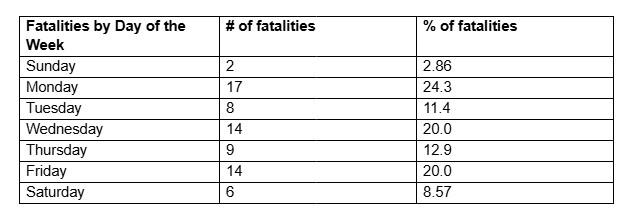
The 2025 edition of the CDR found that fall-related deaths were a lot more likely to happen on four specific days of the week, namely Friday, Saturday, Sunday, and Monday. These four days combined accounted for 13 of the 26 fall-related deaths during that period. When you look at the five other categories of death alongside falls from height, it becomes clear that working on those four days was a real killer.
Out of the 70 deaths reviewed in the context of fatality by day of week, a whopping 39 of them, or 55 percent, took place on these four days, with the majority happening on Mondays or Fridays.
Monday accounted for the highest number of all fatalities at 24 percent, or 17 fatalities. Wednesday was the next most significant day of the week, matching the same number of fatalities as a Friday, with approximately one-fifth of all workers having an incident that resulted in their deaths on each of these days.
As for the major causes of these deaths, falls and interaction with heavy equipment are the only two that don't fit a weekend pattern. Falls from a height happened regularly around the weekend, but also took place on Wednesdays. On the other hand, deaths caused by heavy equipment were more likely to happen early in the week, and fewer of them seemed to happen at the end of the week. All other categories of death seemed to take place more often on the weekends.
No matter which day of the week they took place, falls from height were found to be one of the major causes that emphasized just how important it is to have working at heights training.
By Time of Day
41 deaths, or approximately 59 percent of the total fatalities under review, occurred in the afternoon.
Time of incident

Source: Construction Death Review, 2026
Furthermore, it was found that about 57% of incidents occurred during traditional starting times, and peak times like lunch period or at the end of a workday. For reference, 29 incidents took place at the start of the day.
There are a few standout stats worth noting here, though. For example, 21 percent of morning fatalities, i.e., 6 of them in total, took place between 8:00 am and 8:30 am – just one hour into a worker's shift.
A further 21 of them, almost a third of the total under review, occurred between 11:30 am and 1:30 pm – the traditional lunchtime for most people. The remaining 18 incidents were split into two time slots – 9 between 11:00 am and 11:45 am, and 9 more between 12:45 pm and 1:30 pm.
Statistics by type of work have not been provided here, but the full report indicates that there wasn’t a clear pattern to falls or getting caught up in heavy machinery, which are likely to happen at any time of the day. But wall, trench, and ceiling collapses plus elemental exposures almost all happened after midday.
While even distribution of deaths across the day may speak to the randomness of the hazard and the potential for something to go wrong at any time, the concentration of certain deaths at a specific time is indicative of issues with a specific process or a general waning of concentration during certain time periods.
Key Takeaways
The Construction Death Review (CDR) 2026 provides insight into when and where workplace fatalities occur in Ontario’s construction sector, with particular attention to geographic distribution, seasonality, time of day, and age and gender (to be explored in a future article). While the report did not identify sufficient evidence to draw meaningful conclusions about regional differences in fatalities, several patterns emerged in the timing and demographics of fatal incidents.
Fatalities occurred throughout the year, reflecting the year-round nature of construction work. However, November recorded the highest number of deaths (14.3%), followed by August (12.9%) and January (11.4%). Certain types of incidents showed seasonal patterns: crushing fatalities were more common from November to March, while wall, trench, and ceiling collapses peaked in August. Overall, 39 of the 70 deaths reviewed – nearly 56% – occurred between April and October, the traditional peak construction season.
The day of the week also showed notable patterns. Mondays had the highest number of fatalities at 24.3%, followed by Wednesday and Friday at 20% each. Nearly 45% of all deaths occurred on either Monday or Friday, while 55% occurred between Friday and Monday. Falls and heavy-equipment incidents showed somewhat different patterns, while other categories of fatalities demonstrated stronger associations with the weekend.
Time of day was another significant factor. Approximately 59% of fatalities occurred in the afternoon, although incidents were recorded throughout the working day. A notable number occurred around common transition periods, including the start of the workday, lunch, and the end of the day. 29 incidents occurred before noon, including 6 between 8:00 and 8:30 a.m. 21 occurred around the traditional lunch period of 11:30 a.m. to 1:30 p.m. The concentration of certain types of incidents during particular times may point to changes in work processes, fatigue, or reduced concentration. Falls and heavy-equipment incidents, however, were relatively evenly distributed throughout the day.
Overall, the findings demonstrate that construction fatalities do not occur at a single predictable time, season, or location. Instead, patterns emerge around particular periods, work activities, and worker demographics.
The results reinforce the importance of maintaining strong safety controls throughout the entire workday and year, with particular attention to changing conditions, high-risk activities, worker experience and age (not discussed within), and periods when concentration or supervision may be reduced. These findings can help employers, supervisors, and workers identify potential warning signs and strengthen prevention measures aimed at reducing construction fatalities in Ontario.
Case Study: The circumstances leading to the death of Shogo Minami
A statistic can tell us how many workers died. It cannot tell us who they were, what they were doing, or what happened in the moments before their lives were lost. That is why statistics alone are not enough. Real-world incidents allow us to examine the circumstances behind a fatality and ask an important question: What could have prevented it?
The Ontario Construction Death Review reports valuable information about the causes and circumstances of workplace fatalities. In keeping with the report's emphasis on learning from these tragedies, each article in this series concludes with the story of a worker whose life was lost. These stories are not presented simply to recount what happened, but to identify the hazards, gaps and missed opportunities that may help prevent another worker from suffering the same fate.
The story of Shogo Minami is a particularly important reminder of the role that effective safety systems and supervision play in electrical work. His fatality raises critical considerations around electrical hazards, lockout/tagout, working in isolation, supervision, worksite orientation, safety training, and work performed during off-hours. Here is his story:
On August 30, 2017, 27-year-old Shogo Minami was working as an electrical technician for a Japanese engineering company specializing in automation equipment. Mr. Minami, a Japanese citizen, was in Canada to support the installation of a new metal stamping press and feeder system at a manufacturing facility.
Mr. Minami and a coworker chose to perform the work after hours, when the equipment was not being operated by press technicians. The power to the press machine was turned off, but a piece of equipment known as a “de-stacker feeder” remained powered and operational. The de-stacker feeder contained a small, mechanized cart called a “bucket car” that moved along a set of rails. There was fencing surrounding the loading area for the bucket car, which had an opening that allowed the car to enter and leave the loading area.
Mr. Minami’s coworker briefly left the work area in the early hours of August 31 and observed Mr. Minami performing diagnostic testing at the de-stacker feeder control panel. When the worker returned, he found Mr. Minami on the opposite side of the machine, pinned between the edge of the bucket car and a frame of the fencing.
It was determined the bucket car had likely been unintentionally activated and had moved along the rail while Mr. Minami was inside the fenced area. The safety interlock circuits installed around the bucket car were overridden for an undetermined reason. If the fence door to the loading area was opened or not present, the safety interlock circuits would be triggered, and the bucket car would be prevented from moving.
An employer was convicted and sentenced on one charge in a prosecution under the OHSA.
Source: Construction Death Review – A Review of 44 Deaths in the Construction Sector, June 2026
Conclusion
Death in the workplace is not an easy experience for anyone to go through. While employers have to deal with the consequences of workplace fatalities (such as fines, legal liabilities, and even imprisonment), workers have to come to terms with the loss of a fellow crew member. Not to mention the unimaginable grief the victim’s family has to go through. That is why safety measures in the workplace should never be taken lightly.
From the use of the proper PPE to the use of properly functioning equipment and the right training – workers have the right to access anything that protects their lives in the workplace. Just like our safety training courses do.
Act First Safety’s CPO-approved and expert-led training programs have helped over a 100,00 Ontario workers learn and implement safe work practices onsite. Contact us to know more about our highly practical and certified public, private, and online safety training programs.
FAQs
What can the Shogo Minami fatality teach us about lockout/tagout safety?
The unfortunate case of Shogo Minami highlights why shutting off a machine is not the same as controlling hazardous energy. Though the power to the press had been turned off, the de-stacker feeder remained powered and operational. Effective lockout/tagout training can help workers identify and control all hazardous energy sources associated with equipment before work begins.
Why is lockout/tagout training important for electrical and maintenance workers?
Electrical and maintenance work can require workers to interact directly with machinery and equipment where unexpected movement or energization can result in serious injuries or death. Lockout/tagout safety training helps workers understand how to identify hazardous energy sources, isolate equipment, apply appropriate locks and tags, verify isolation, and safely perform the work.
What role does a competent supervisor play in preventing workplace fatalities?
Competent supervision involves more than being present at a worksite. Supervisors must recognize the hazards associated with the work, implement appropriate procedures, confirm only trained workers have been hired, and ensure critical safety controls are being followed. Work performed outside normal operating hours may require additional planning and supervision, particularly when fewer workers or supervisors are present.
Why can working after hours create additional safety risks?
Working after hours may change the conditions under which a task is performed. There may be fewer workers available, reduced supervision, limited access to assistance, and less opportunity to obtain immediate support if something goes wrong.
Why is verification an important part of lockout/tagout?
Applying a lock or tag is only part of the energy-control process. Workers must confirm the isolation of hazardous energy and the inability of the equipment to start before work begins. This determines the effectiveness of the isolation procedure.
How can a supervisor identify weaknesses in a lockout/tagout procedure?
A competent supervisor can help in identifying all energy sources, clearly defining isolation points, assigning people responsible for applying and removing locks, addressing testing and verification, and monitoring the actual equipment and work being performed. This ensures everything works as per protocol.
What should a supervisor consider before allowing work to be performed in isolation?
They must account for on-site hazards, equipment involved, workers' training and experience, communication requirements, emergency arrangements, and whether another person needs to be available to monitor or assist with the work. Working alone or with limited supervision should not become a reason to reduce the level of safety controls.
How can safety training help in fatality prevention?
Effective safety training gives workers and supervisors the knowledge to recognize hazards and understand the controls required to work safely. For high-risk activities, training should be supported by site-specific procedures, equipment-specific information, effective supervision and verification that workers understand and follow the required controls.
Can a safety training course really prevent a fatality?
Training alone cannot eliminate workplace hazards, but effective training can help workers and supervisors recognize hazards, understand required controls and make safer decisions. Training is most effective when it is part of a broader safety system that includes appropriate procedures, equipment safeguards, supervision, communication and verification.