In our last blog on Construction Death Review 2026, we took a deep dive into the findings of the report, focusing mainly on major risk areas and hazards in Ontario workplaces, and the importance of formulating and disseminating such reports overall.
Today, Act First Safety, an award-winning safety training provider in Ontario, is back with its second edition of the Construction Death Review (CDR), 2026. This edition will go into the details of construction fatalities by the numbers. The goal is to paint a clearer picture of key risk areas to support the creation and implementation of smarter strategies in the sphere of worker safety.
Construction Fatalities: Major Hazards, Workplace Types, and Key Insights
Did you know the rate or occurrence of fatalities in the workplace can vary based on the sector it is a part of? Let’s take a look at fatalities by type, company size, construction subsector, and unionized workplaces in the following sections of this blog. But first, let’s analyze annual fatality trends of the last decade in the table given below:
Please note that while this information primarily concerns the construction sector, it still serves as a lesson for prevention strategies in all sectors where similar hazards exist.
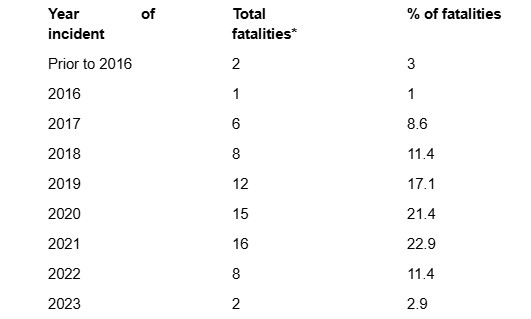
Source: Construction Death Review, 2026
*Note: Number of fatalities may not be the total number of fatalities reported in a single year.
The CDR, 2026 not only reveals the number of deaths that took place in a year, but it also provides a closer look at the circumstances that led to these deaths. Particularly, it highlights the deaths of 70 individuals working on construction projects, which is an aggregate from the last 2 reports spanning 2016–2023, along with 2 more historical fatalities to create a greater sample size for analysis.
Since the CDR 2025 focused only on falls from height, it may not include all construction fatalities reported during that time period. In fact, the truth is the real number of fatalities might be higher than what has been recorded in both CDRs 2025 and 2026. That is why it is important to examine other verified reports as well. Their numbers combined might reveal the truth of what ground reality really looks like.
In any case, it is clear to see from the table above that the number of construction deaths peaked between 2019 and 2021. Other verifiable sources have confirmed that this rise in total construction fatalities during 2019–2021 can be attributed to:
- High-risk in-person working conditions: The COVID-19 pandemic took place between 2019 and 2021, making it a time period fraught with increased risks and difficult in-person conditions, thereby causing more fatalities than other years.
- Disrupted safety oversight: Reduced supervision, skilled worker shortages, and changing safety protocols created an environment conducive to overall operational disruptions and significant safety oversight.
- Increased stress and substance-related issues: Psychological and financial pressures were elevated during this time, contributing to high rates of substance abuse and fatal drug overdoses among workers.
Fatality by Hazard Category: From Working at Heights to Crushing Hazards
As per CDR, 2026, the data surrounding fatalities in the workplace were categorized as follows:
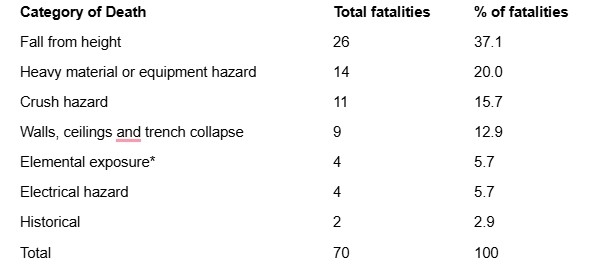
*Elemental exposure refers to a worker’s exposure to hazardous physical, chemical, or biological elements that are naturally occurring or introduced through construction materials, processes, or the work environment itself.
Falls from heights lead the charts here, clearly pointing to the need for certified CPO-approved working at heights training for all workers performing elevated tasks. It also emphasizes the need for using proper harnesses and personal protective equipment.
Subsectors at Greatest Risk as per CDR, 2026
In an effort to determine which construction subsectors are at the greatest risk of workplace fatalities, the CDR 2026 report proposes the following definitions of active work sites:
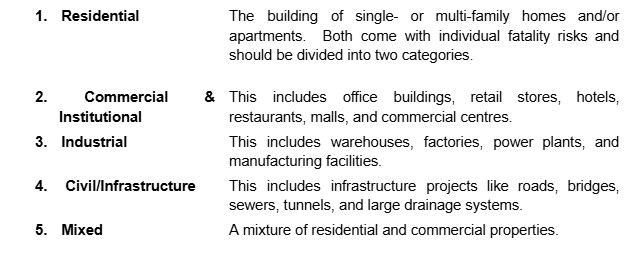
Much of the analysis within the report cross-sections data against its subsectors for additional specificity and insight.
Does Company Size Affect Fatality Risk?
Both CDR 2026 and CDR 2025 found that company size may affect fatality risk. However, their conclusions were vastly dissimilar. CDR 2026 found out that medium (6-19) to large (51+) companies were primarily involved in fatal situations.
Conversely, CDR 2025 reported that single owners and small businesses accounted for over 60 percent of the companies that had witnessed an on-site death. Here’s a chart straight from the report that shows the correlation between company size and fatality risk:
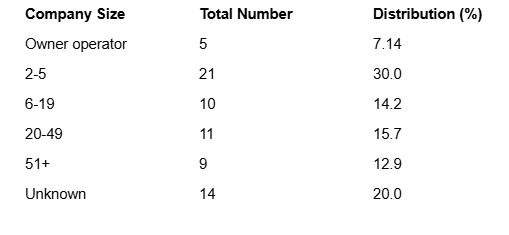
Smaller- and mid-sized companies accounted for a greater share of fatalities across most of the categories examined. The types of incidents varied with company size. However, falls were particularly prominent among companies employing fewer than five workers, representing 57 percent of fatalities in that group.
In contrast, incidents involving crushing or interaction with heavy machinery represented a larger proportion of fatalities among mid-sized and larger employers, accounting for 50 percent and 66 percent, respectively.
It can be assumed that while smaller companies need to provide their workers with proper working at heights training, bigger companies need to focus on giving their crews hoisting and rigging training to prevent instances of crushing.
Fatalities Across Construction Subsectors
Deaths in the construction sector are relatively evenly distributed among its five subsectors, as illustrated in the table indicated below.
Of these five subsectors, residential and multi-family/apartment construction together accounted for 41.4 percent of the total fatalities, making them the largest contributor. Civil/infrastructure projects represented the next largest proportion at 21.4 percent, while industrial and commercial/institutional projects each accounted for 17.1 percent. A small number of fatalities occurred in the mixed subsector
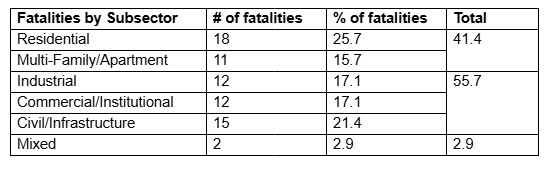
Source: Construction Death Review, 2026
Telehandlers, Lift Trucks & Other Mobile Equipment
The nature of the hazards also differed among subsectors. When residential and multi-family construction are considered together, falls from height were the leading cause of death, accounting for 16 of the 29 fatalities, or approximately 55 percent. Collapses and crushing incidents were also significant contributors. Together, these three categories were associated with approximately 86 percent of the fatalities in these two subsectors.
Residential Construction: Falls From Height Dominate
Concerning residential construction specifically, falls from height accounted for slightly more than 60 percent of the fatalities reviewed. Wall collapses were another notable contributor, reinforcing the importance of fall prevention and structural safety in residential work.
Industrial Construction: Electrical Hazards Were The Main Culprits
Falls were similarly prominent in the industrial subsector, accounting for approximately half of the deaths reviewed. Hazards involving heavy materials and electrical deaths were also significant, together representing slightly more than 30 percent of fatalities. This suggests the importance of controlling hazardous energy and the significance of lockout tagout training in the industrial construction subsector.
Commercial & Institutional Construction: A Broader Range of Fatal Hazards
The commercial and institutional subsector showed a broader distribution of fatal incidents. Falls and heavy equipment-related incidents together accounted for half of the deaths, while crushing, environmental and electrical hazards made up much of the remaining fatalities at 34 percent.
Civil & Infrastructure: Heavy Equipment, Crushing & Collapse Hazards
Civil and infrastructure projects presented a somewhat different pattern. Heavy equipment incidents, crushing events, and collapses involving walls, ceilings or trenches were the predominant causes, collectively accounting for approximately 80 percent of the fatalities reviewed in this subsector.
Does Unionization Make A Difference?
The findings related to unionization in CDR 2026 provide an interesting perspective on the workplaces represented in the review. While union membership across Ontario's sectors averaged approximately 26–27 percent, 23 of the workers included in this review (approximately one-third of the total) were identified as unionized. The unionization status of 16 workers, or 22.9 percent, was not known.
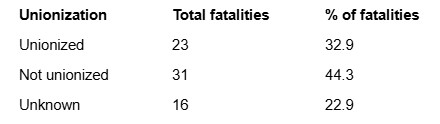
Source: Construction Death Review, 2026
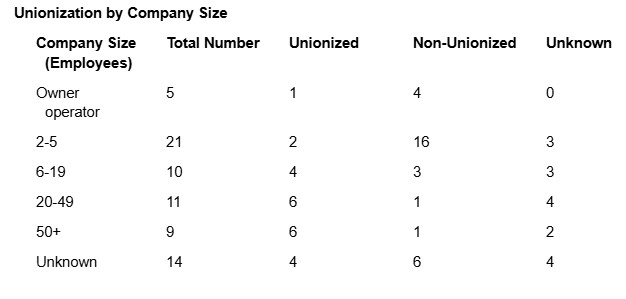
Unionization also appeared to vary substantially with company size. Workers employed by larger companies were considerably more likely to be unionized.
Among companies with fewer than 20 employees, just over 64 percent of the workers represented in the review were not unionized. This pattern was reversed among companies with more than 20 employees, where approximately 60 percent of workers were unionized.
Among cases where company size was unknown, 43 percent of workers were identified as not unionized.
Turning Fatality Data Into Prevention
Taken together, these findings demonstrate that construction fatalities are influenced by a combination of company size, type of work, workplace setting, and organizational structure.
While the specific hazards vary among subsectors, falls, crushing incidents, and equipment and collapse-related hazards emerge as recurring areas of concern.
The findings also reinforce that smaller employers and residential construction warrant particular attention when developing prevention strategies. Although the report's findings provide important insights into the patterns of the fatalities reviewed, they should be considered within the limitations of the available sample, including cases where company size or unionization status was unknown.
Ultimately, identifying where and how these fatal incidents occur can help employers, workers, and industry stakeholders direct preventive efforts towards major hazards and workplaces where they may have the greatest impact.
Conclusion
There is a lot to learn from the CDR, 2026. One of its major takeaways is that most workplace fatalities can be prevented with proper safety protocols in place. This, obviously, includes hiring trained workers and providing them with refresher training whenever relevant to improve overall site safety.
Companies looking for provincially accredited and certified safety training programs can turn to us. Act First Safety has trained Ontario workers over the last 20 years and is proud to proclaim that over 100,000 workers have earned their certifications from our Scarborough facility. Contact us to book safety courses for your crew at our training center, which is conveniently located off Highway 401.
FAQs:
What is the leading cause of construction fatalities?
Insights from the CDR, 2026 indicate that falls from height dominate workplace fatalities, accounting for 37.1% of the fatalities reviewed.
Does Working at Heights training help prevent construction fatalities?
Yes, working at heights training or other similar safety training programs such as lockout/tagout, and hoisting and rigging training teach workers how to safely carry out critical yet hazardous tasks in a manner in which fatalities can be prevented.
What are the most common heavy equipment hazards on construction sites?
Several construction site equipment can be dangerous if not handled properly, including telehandlers, skid steers, trucks, mobile cranes, and hoisting and rigging equipment. These increase the likelihood of accidents, crushing, and other types of injuries and fatalities.
What kind of safety training is required for telehandlers, lift trucks, and skid steers?
Safety training programs such as lift truck training, skid steer training, etc. ensure that operators are equipped with the knowledge to safely operate their equipment. They are also taught hazard identification and appropriate emergency response to prevent accidents.