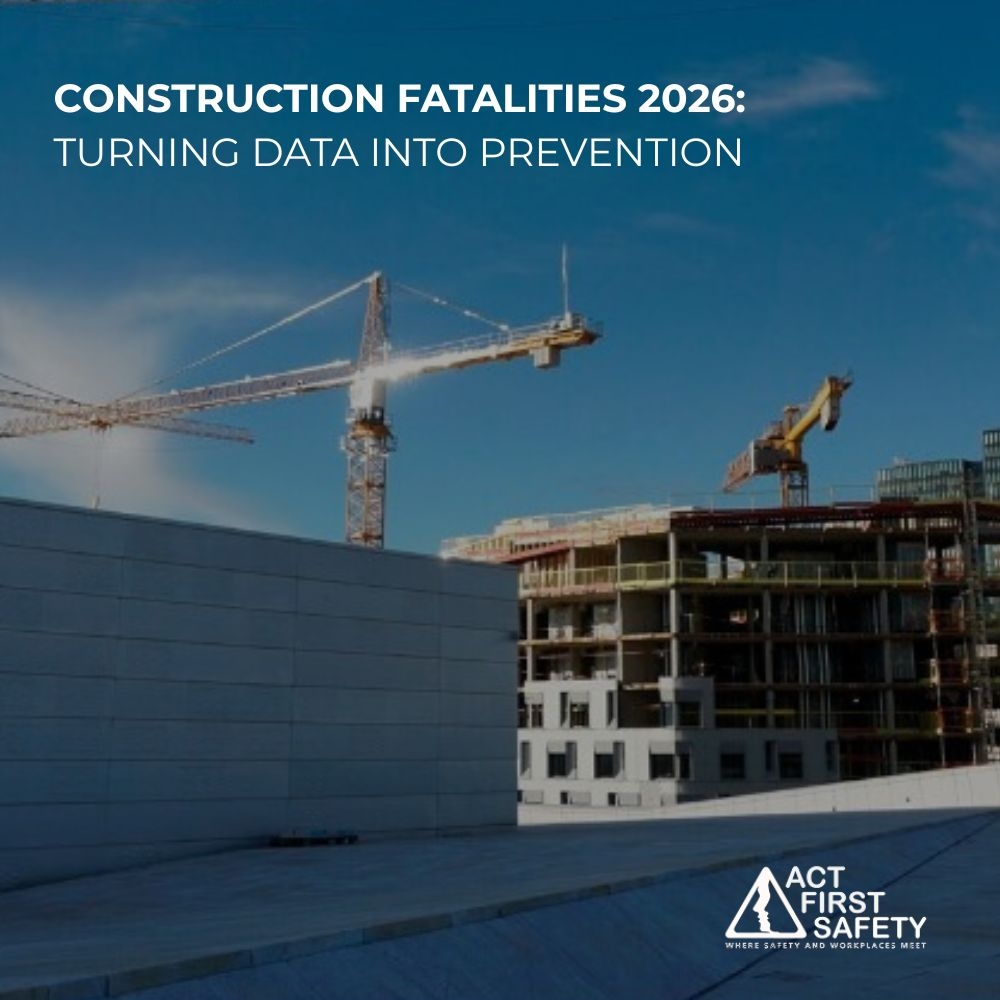
As one of Ontario’s most trusted providers of comprehensive safety courses, at Act First Safety, we believe it is our duty to educate workers and employers about real safety issues in the workplace. Sometimes that involves having discussions around difficult and grim topics such as preserving worker mental health in confined spaces, or in today’s case, deaths on construction sites. However, these conversations need to be had because the more we know, the better we can prepare for a safer tomorrow.
A Closer Look Into The Construction Death Review, 2026
The Construction Death Review: A Review of 44 Deaths in the Construction Sector, an Office of the Chief Coroner of Ontario report published in June 2026 takes a hard look at 43 construction-related deaths in Ontario. This retrospective analysis of fatalities that happened between 2015 and 2023 along with one that occurred back in 1994, found that 42 of them were the result of the following:
- Clash with Heavy Equipment and Materials
- Crushing
- Walls, Ceilings or Trench Collapse
- Electrical Exposure
- Elemental Exposure
The first edition of this report, released in 2025, reviewed 26 worker deaths that were the result of falling from heights and took place between the years 2017 and 2023.
In any case, both editions paint a grim picture. The 2026 report explores each situation in-depth to help shed light on the root causes and other factors that typically lead to such incidents.
To make the whole thing more relatable and understandable, the report weaves humanity into its facts and figures via storytelling techniques, creating an impact that really hits home. Despite their bleak nature, the promise is huge: such can actually help prevent future tragedies from happening.
This annual report is a must-read for anyone vested in construction site safety.
Major Concerns Revealed By The Construction Death Review, 2026
The advisory committee behind this report identified seven big themes, of which two The Construction Death Review, 2026, or CDR for short- are being addressed. The other five concerns focus on being more mindful onsite in the coming years.
The Biggest Concerns
- Workplace experience: how much it matters and how it relates to underlying risks and hazards
- Use in practice: Using and understanding manufacturer's instructions and operating manuals to curb future fatalities
Future Considerations
- Vulnerable workers - who are they and how do we keep them safe?
- Emergency preparedness plans - are we really ready for the worst and can we mitigate existing risks?
- Safety gaps in municipal and residential safety frameworks - identifying gaps to figure out how to fill them.
- Remote issues - working in remote environments where distance is a safety challenge.
- Job hazard assessments - are they enough and are they being done right?
For workers, the committee found that workplace complacency was a major concern. Even experienced workers have not been spared from this tendency and are likely to adopt a bad habit or two over time. That said, inexperienced workers might be more complacent. In fact, the more dynamic a worksite, the higher the chance of something going seriously wrong.
However, complacency and dynamism are not the only hazards. The advisory committee analyzed the use of heavy machinery in the workplace and found that a lot of times manufacturers’ instructions were not followed.
Furthermore, even when they are followed, workers still might not be able to fully comprehend overly technical, complicated, or confusing language and drawings, thereby increasing the risk of accidents. Moreover, most manufacturer manuals and operator manuals do not make it to popular safety training courses even though they should for programs such as forklift training or aerial platform training.
As for other key findings from the CDR, the issue of vulnerable workers, including newcomers, people with language barriers, and those on temporary employment, looms large. Managing them along with other social deterrents to the health and safety of a workplace demands the establishment of an Internal Responsibility System (IRS). This translates to improved hazard anticipation, better planning for credible worst-case scenarios, and alignment with emergency preparedness. All workers should be made aware of evolving site conditions, especially vulnerable workers as might be most at risk.
Speaking of emergency preparedness, it is another critical factor to consider when preventing workplace fatalities. A lot of the time, emergency plans just don’t exist or when they do, they are not taken seriously. That’s why the committee behind this year’s CDR recommends having an emergency plan in place for life-threatening situations on both construction sites and for the community at large.
As for safety frameworks for residential and municipal projects, the committee noted they need a bit of an adjustment. Municipalities, in particular, need to ensure that everybody’s safety is treated as top priority during service disruptions. And let's not forget remote workers who deserve the same protection as anyone.
Lastly, the committee suggested that serious job hazard assessments are necessary to make sure employers are not overlooking any critical detail as far as workplace fatality prevention is concerned.
The Importance Of Reports Such As The Construction Death Review, 2026
The CDR is truly a game-changer. It ditches the slow and painful individual inquiries for a quicker, more accurate safety analysis. It is incredibly fast too and provides actionable recommendations that actually make a difference to worker safety. Here’s how it helps:
The Speed Factor
- Faster Insights: CDR reports are quick and access to the valuable information they provide enables swifter responses to fatality prevention and planning.
- Annual Delivery: The Office of the Chief Coroner releases their findings annually, typically in June, providing reliable and anticipated information that supports the development of useful ideas for a safer workplace
Looking at the Big Picture
- Trend identification: Adopting a macro-level perspective and clustering data allows for the identification of broader patterns. Rather than analyzing each tragedy in isolation, this approach helps pinpoint systemic issues and overarching factors that lead to workplace deaths.
- Targeted recommendations: In this report, we get fourteen focused solutions for the five hazard areas. This is not generic advice. It’s an actionable plan that can lead to real results.
Collaborative Approach
- Expert input: The advisory committee includes sector experts working together collaborating on recommendations and outcomes in the best interests of worker safety.
- Shared commitment: Laborers, employers, safety association members and construction sector experts come together to make a real impact in the province.
Remembering the People
- Every report has a special memorial section with contributions from families and friends keeping the human side of these tragedies at the forefront.
Annual Report, June 2026
Ontario has a massive construction sector. According to the latest numbers available, as of 2026, a whopping 122,848 individual construction firms were registered with the Workplace Safety and Insurance Board (WSIB) and an impressive 578,900 workers were employed in the sector.
Key Stakeholders - The Players
Construction has long been a very dangerous occupation. In 2023, the construction sector accounted for a staggering 31% of traumatic deaths in all of Ontario's workplaces. However, this added up to only 7.1% of the province’s entire workforce. That said, it is no surprise then that safety has been a major concern in the construction sector for decades.
To combat this, Ontario has developed a robust system that brings together key members of the provincial government, industry players and other safety stakeholders to help prevent workplace accidents.
The major players behind this initiative include the Ministry of Labour Immigration Training and Skills Development (MLITSD), WSIB and various Ontario safety associations that are all working together to meet the goals set out in the provincial Occupational Health and Safety strategy.
Also, all workplace parties, (constructor, employer, supervisor and worker) are all part of the Internal Responsibility System (IRS) and they need to combine their efforts and figure out how to make workplaces safer together. Prior JHSC training can help in this regard.
Ontario Regulation 213/91 (Construction Projects) – What is Covered
In addition to the duties outlined in the Occupational Health and Safety Act (OHSA), the law applicable to the CDR is Ontario Regulation 213/91 (Construction Projects). This regulation spells out workplace safety essentials such as:
- Protective gear, equipment and devices
- How to stop falls and protect people from falling
- Making sure structures are stable and will stay up
- Keeping worksites and heavy equipment maintained
- Fire safety
- Traffic control
- Platforms, scaffolding, ladders
- Formwork
- Cranes, hoisting and rigging equipment
- Electrical hazards
- Rooftop work
- Demolitions
- Excavations
In Ontario, the construction sector is subject to many rules and regulations, many of which are aimed squarely at keeping workers safe.
Case Study: Understanding How To Prevent Fatalities Through The Case Of Robert Nash
A thorough review of the deaths in the CDR reveals that most of them could have been prevented by following safety rules and by establishing preventative steps for worker safety.
In light of creating worker safety protocols, let’s analyze the case of Robert Nash and understand how the lack of formal hoisting and rigging training was a contributing factor in his untimely and unfortunate death.
AITCHISON, Robert Nash
On May 30, 2018, 28-year-old Robert Nash Aitchison and four coworkers were working on a project that involved grading a parking lot and reinstalling four metal bollards into an excavation site. A bollard is a type of a vertical post that is primarily used to control vehicular traffic.
The bollards were made of steel and cement, weighed approximately 1,600 pounds (726 kg) each and were approximately nine feet in height. The bollards were cylindrical in shape and were designed so that when the project was completed, the bottom portion of each bollard would be underground and the top portion would protrude from the surface to act as a guardrail for vehicles in the parking lot.
The workers used an excavator equipped with a bucket to lower the bollards into the gouged area. They placed the first three bollards into the bucket and lowered them into the ground one at a time. However, they were unable to use the same method to lower the fourth bollard because there was insufficient room in the excavation site to allow the bucket to maneuver.
The workers then attached a metal chain to the bucket to hoist the fourth bollard into the earth. One end of the chain was attached to the bucket and the other end was wrapped around the base of the bollard's handle.
Mr. Aitchison was in the excavation site when the fourth bollard was being lowered. The bollard slipped out of the chain, fell into the hole and tipped over, fatally striking him in the head, which was not protected by a hard hat.
It was determined that the hooks at the ends of the chain were not equipped with a safety catch mechanism and the metal chain used to hoist the bollard was not intended for this use and was not designed for hoisting. The workers had not received any formal training on hoisting and rigging or on O. Reg. 213/91 (Construction Regulations).
An employer was convicted and sentenced on one charge in a prosecution under the OHSA.
Source: Construction Death Review: A Review of 44 Deaths in the Construction Sector
The Takeaway: All that was needed was proper hoisting and rigging training for the workers hired, and perhaps Robert Nash would have still been alive. This alone points to the importance of training on construction sites.
Conclusion
Construction site fatalities do not have to be an outcome of a potentially hazardous environment. They can be prevented with rigorous safety protocols and proper training. We can help you with the latter. Act First Safety’s advanced safety training courses are geared towards educating Ontario workers about the proper use of equipment and beyond. Contact us to learn how our courses can improve worker safety and reduce the odds of fatalities.
FAQs
Who publishes the Construction Death Review in Ontario?
The Office of the Chief Coroner of Ontario publishes the Construction Death Review.
How can construction companies use CDR findings?
Companies can use the findings to review their existing safety practices, identify gaps, and strengthen prevention measures.
Can CDR findings help shape future construction safety policies?
Yes. The findings can help regulators and industry stakeholders identify recurring risks and develop more targeted prevention strategies.