Energy surrounds us every day. We are not talking about positive or negative energy or even spiritual energy. We are talking about tangible forms of energy like electricity, steam, and hydraulics. Each of them can have a dire effect on worker safety if they are not careful when working with or around any of them.
Despite the critical role energy plays in the lives of workers, many do not take it seriously enough to practice safety when working with its various forms. The truth, however, is that energy can be dangerous if it is not properly controlled. Every day, workers put themselves at risk of exposure to hazardous energy when they work on machinery, equipment or processes, doing tasks such as:
|
|
|
|
|
|
|
|
|
That’s why practicing proper handling techniques is just as essential as effective communication in the workplace. In today’s blog, Act First Safety, providers of a variety of CPO-approved safety training courses in Ontario, will highlight how lockout/tagout training can improve worker safety when they are dealing with all sorts of energy sources.
Knowledge is Power – LOTO Safety Training
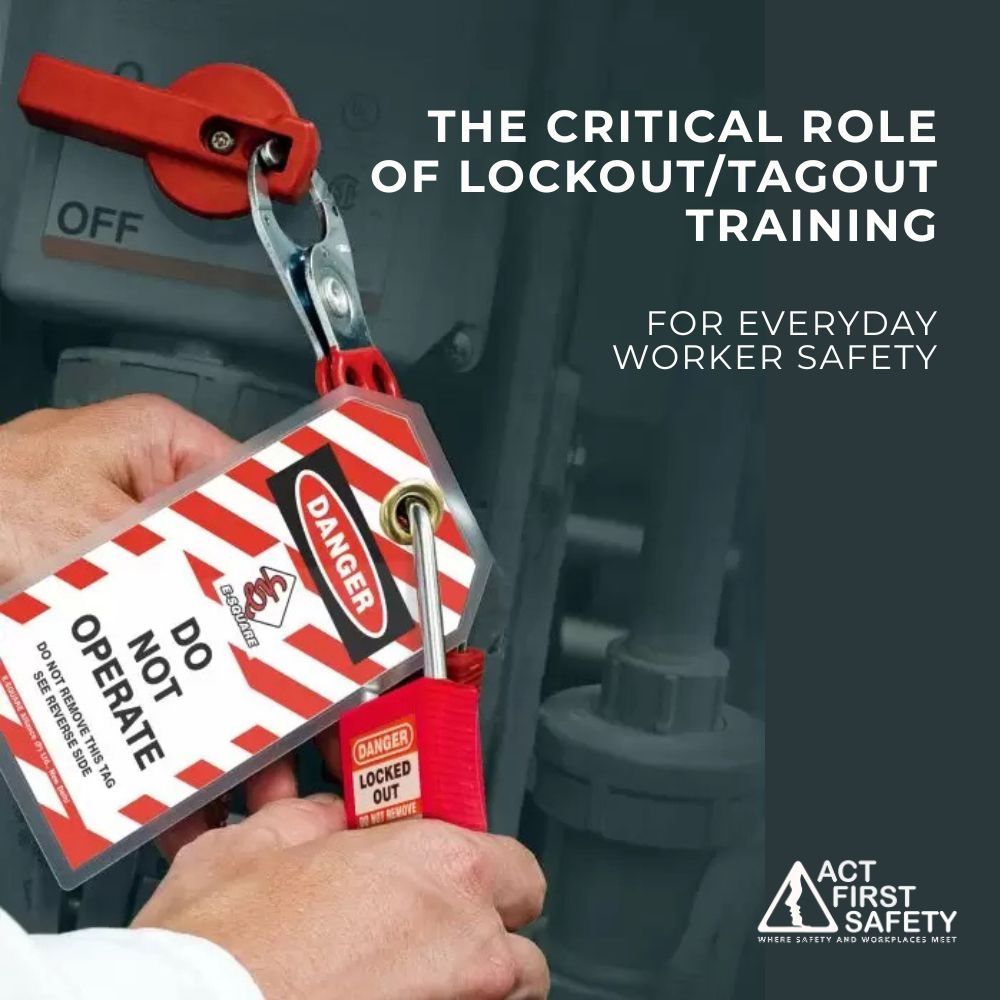
Lockout Tagout (LOTO) safety training equips workers with the knowledge they need to safely handle different forms of energy on the worksite. Lockout training allows workers control over the energization of machinery, equipment or processes, which might otherwise put them at risk of injury if the energy is released.
The unplanned release of energy can be deliberate or accidental. In either case, the results can be catastrophic to those in its path. To prevent that, it is essential to temporarily decommission certain equipment. Tagout provides information to others indicating the reason why a particular piece of equipment has been locked out and by whom the lockout was conducted.
Improper lockout or failure to lockout is ranked among the top four causes of occupational injuries resulting in lost time in Ontario, according to WSIB. The most common injuries in this regard include burns and amputation. These injuries and fatalities are preventable with measures as simple as flipping a switch and applying a lock (the lockout part of a LOTO program).
There are many reasons why it may be critical to isolate machinery, equipment or processes from energy sources. This is why manufacturers and installers provide energy isolation devices such as switches, valves and other apparatus as methods for lockout.
However, flipping a switch does not guarantee the power stays off. Energy isolation devices can be designed to help here by physically preventing energy activation.
Lockout devices are secured by means of a single-keyed lock, controlled by a single worker (one lock per worker) to ensure that everyone on-site is protected. Re-energization only occurs when it is safe to do so. That’s when locks are removed by each worker under their control, thereby averting a potential crisis.
The Importance Of Planning Daily LOTO Practices
Protection of workers begins with the development of a comprehensive hazardous energy control program.
Lockout/tagout safety training programs are typically developed by employers upon the advice and recommendations found within CSA standard Z460 Control of hazardous energy – Lockout and other methods.
This standard specifies the requirements and performance objectives for procedures, techniques, designs, and methods to protect personnel from injury due to the accidental release of hazardous energy. This standard lays down nine program elements that can effectively protect workers:
- Identification of hazardous energy
- Identification of the types of energy isolating devices located in the workplace
- Identification of the types of de-energization devices in the workplace (permanent or portable)
- Selection and procurement of protective materials and hardware
- Assignment of duties and responsibilities
- Establishment of specific orders for powering down, cutting energy, restoring power, and restarting equipment
- Documented lockout procedures for machines, equipment, and processes
- Training of personnel
- Audit of program elements
Not only will implementing a comprehensive Lockout Tagout program in your workplace protect the health and safety of the workers, but it can also prevent fines and unexpected costs in the event of a catastrophic accident.
LOTO Legislation in Ontario
When it comes to Ontario regulations concerning industrial and construction sectors, employers, supervisors, and workers must ensure that electrical lockout and tagout of machinery, equipment, or processes has been conducted before working or allowing work to be done. Workers must also be protected from hazardous energy by any precaution reasonable under the circumstances.
Case Study: Real-World Example Showcasing The Necessity of LOTO In The Workplace
Many employers and supervisors have been subject to fines due to incidents where workers were injured or killed due to a lack of LOTO in the workplace. This duplicity in fines is something often overlooked.
That said, in addition to fines, supervisors might also be subject to criminal charges. Case results from different provinces remain pertinent to Ontario work environments because criminal charges under Bill C-45 are not restricted by provincial borders. Here is an illustrative example of the same:
In New Brunswick, a supervisor was found criminally negligent, causing the death of a worker. The supervisor in question had ordered a leak test for a pipe that fed into a confined space the worker was occupying. When the inflatable plug in the pipe failed, the space quickly filled with water, drowning the 18-year-old worker. The supervisor, Jason King, was sentenced to 3 years in prison.
Supervisors are not often acquainted with the charges that they may face in such circumstances. This stresses the importance of competent supervisor training, which ensures they understand their legal obligations.
Types of Hazardous Energy Covered In LOTO
Typically, electricity is the first thing that comes to mind when thinking of applying controls like lockout. Yet while electricity is a major form of hazardous energy, and therefore a significant component of LOTO control programs for employers, it is not the only form of hazardous energy covered.
Given below are some other forms to consider:
- Hydraulic: Energy produced by flowing, or compressed liquids
- Pneumatic: Energy released by compressed gases
- Chemical: Energy resulting from chemicals under pressure and chemical reactions
- Kinetic: Energy produced by moving objects
- Gravitational: Stored energy that is released when suspended objects are allowed to fall freely
- Thermal: Energy from heat
- Radiation: Energy in the form of electromagnetic waves or as moving subatomic particles (i.e., X-rays or microwaves)
The identification of the different forms of energy utilized in day-to-day business operations should be well-documented by the Joint Health and Safety Committee members and health and safety representatives. This process of hazard identification is thoroughly reviewed in JHSC training.
The lockout process for various energy types often involves electrical elements. Consequently, procedures frequently necessitate more than simple locks and keys; they may also involve isolating valves or implementing shields and blocks for certain components.
These procedures can be simple or complex, depending on what needs to be locked out. Therefore, it is important to develop procedures for specific machinery and equipment. Workplace processes should clearly define the individual roles and responsibilities of safety with regard to lockout and tagout.
Fundamental Lockout Procedures To Follow
Regardless of the complexity of the task that may require LOTO, it is important to implement a step-by-step workflow to ensure complete worker safety.
All workers performing work, including any contractors onsite, must be trained for lockout/tagout to ensure consistency in the workplace. Essential steps to follow include:
- Obtain authorization from the user/owner of the machinery, equipment, or process
- Identify the equipment to be isolated during work
- Verify if energy sources have been correctly identified
- Have appropriate lockout devices for each energy type on-site
- Isolate energy sources
- Release residual and stored energy (i.e., purge/empty process piping and storage vessels)
- Apply lockout devices and tagout
- Test systems to verify that hazardous energy has been controlled before work begins
Why Verify Zero Energy State?
Zero energy state is a level of energy that is not harmful to any individual.
Zero energy state control is a situation under which zero energy can be maintained without interruption.
Because active energy can hold onto residual energy, simply shutting off the trigger does not exterminate its stored state. Therefore, it is important to verify its zero energy state before work begins.
Since work is often performed by several workers, zero energy state can typically be demonstrated as a group to comply with both Industrial and Construction regulations’ requirements as stipulated by Ontario law.
Each worker involved must individually verify that lockout and tagout have been undertaken to leave no scope for error. Human error is likely if the equipment is only partially locked out, i.e., a crusher is locked out, but the conveyor belt that feeds it is not. This can result in accidents.
Similarly, another common mistake is locking out the wrong piece of equipment due to miscommunication, lack of training, or human error, resulting in unexpected consequences.
Conclusion
Lockout/tagout training is just as essential as any other training – from asbestos training to propane training, rigging courses, respirator fit testing, and more. By establishing rigorous LOTO practices in the workplace, employees can prevent injuries and accidents, along with fines and legal liabilities.
Planning to train your team? Act First Safety provides expert-led lockout/tagout training programs in Ontario. Available at our Scarborough facility, located at Highway 401, or at your premises, we allow employers to club multiple course trainings in a span of a couple of days to maximize efficiency. Contact us to learn more about the currently available programs and their dates.
FAQs
Which industries require lockout/tagout training?
Manufacturing, construction, warehousing, automotive, food processing, utilities, and mining are some of the industries that require lockout/tagout training.
What kind of equipment requires lockout/tagout?
Equipment types that must have proper lockout/tagout triggers in place include conveyors, presses, mixers, forklifts, compressors, pumps, electrical panels, boilers, and other heavy-duty industrial machinery and processing systems.
Can multiple workers lockout the same equipment?
Yes. Group lockouts are encouraged as they nearly eliminate the scope of human error and ensure maximum safety for everybody present on-site.