While amendments to OHSA regulations are common, staying on top of every change can be a real challenge.
In today’s blog, Act First Safety – provider of all kinds of safety training courses in Ontario, has prepared a brief guide on the latest OHSA regulatory changes to catch you up to speed.
You will learn about the impact of these recent modifications on the overall safety and well-being of everyone at the workplace, along with details about the changes to the legislation and training programs like the Joint Health and Safety Committee (JHSC) Certification Program. You will also get a better idea of how these changes might play out for your organization.
Changes To Joint Health and Safety Committee Certification Program
On July 1, 2026, Ontario's Joint Health and Safety Committee (JHSC) will implement a major overhaul to JHSC training programs available across the province. The purpose of this revamp is to introduce more flexible training options and a more modernized curriculum.
Don't worry. Existing certifications still stand, and current programs will be accepted right up until June 30, 2026. However, after that, the new curriculum will take over.
Key updates to the program include:
- Easier Recertification: Members can now renew their certification by taking a Refresher course instead of having to retake Parts One and Two if their certification has expired.
- Hybrid Learning: Training access is expanding to include flexible learning options, including online, distance and in-class delivery options.
- More Comprehensive Curriculum: Coursework will put a greater focus on occupational illness, workplace violence and harassment, JHSC member’s mental health, and evaluating committee effectiveness.
- Rule Changes: The one-time exemption process for certification is being axed and the classroom code of ethics is being strengthened.
All of these changes to the Joint Health and Safety Certification Training Program Standard and Training and Other Requirements will come into effect on July 1, 2026.
To reiterate, current certification training programs will remain valid until June 30, 2026. Existing certifications for the Joint Health and Safety Committee will remain valid and are not impacted by these updates.
These changes will be reflected in:
- The Joint Health and Safety Committee Certification Training Program Standard
- The Joint Health and Safety Committee Certification Training Provider Standard, including the section on training and other requirements
How To Prepare For The Changes To JHSC Training
It is better to start preparing for these updates right now.
While these changes will give employers more flexibility and more options for how training gets delivered, preparing beforehand will ensure they can decide upon the best delivery method – online, distance or in-class, and plan for it accordingly.
That said, at Act First Safety, we're of the opinion that in-person instructor-led training is the way to go. It allows for more opportunities to build relationships and trust among fellow learners, and for exploring workplace issues in a safe and supportive environment, which of course, can lead to higher retention levels and fewer distractions.
While eliminating the need to retake Parts 1 and 2 of the course for Refresher certification instead of starting over is a good thing, allowing for larger gaps in reinforcing knowledge is not ideal.
Preferably, JHSC Refresher training should be completed within the three-year window, or as close to it as possible. However, we understand that scheduling and other challenges make it tough to meet the deadline before the expiry date. In such cases, employers and workers should make every reasonable effort to meet the three-year timeline or stay as close to it as their circumstances allow. This is key to ensuring you retain critical information and don’t lose it to time.
Also, just a heads up, in Ontario, JHSC Part 2 has to be taken within 12 months of completing JHSC Part 1 successfully. If you miss this one-year window, you'll have to retake and graduate from Part 1 before you can proceed with your Part 2 training.
Tracking and planning for training is key to the certification process, so you don't end up wasting time or money.
New Requirements For Protective Headwear Used At Construction Projects
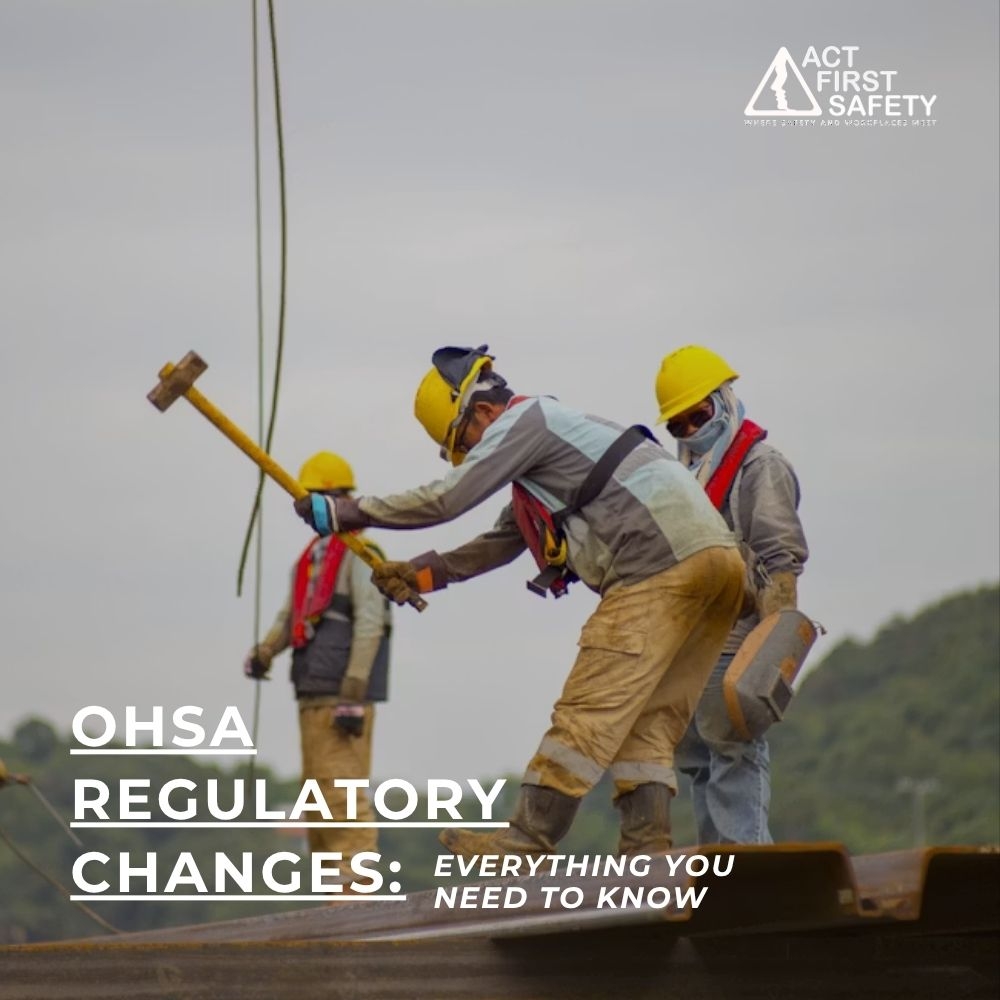
OHSA’s regulatory changes do not stop at JHSC training. They extend to construction sites and projects, too. Recent developments indicate the following amendments that supervisors, construction company owners and their crews should watch out for:
- Section 22 of O. Reg 213/91 – Construction Projects is being amended to require:
- The use of Type 2 protective headwear on sites where a worker may be exposed to side impact hazards
- Use of chin straps or other means of retention if there's a risk of protective headwear being dislodged
- Furthermore, protective headwear itself should meet at least one of the following standards:
- The Performance, selection, care and use standard for industrial head protection, CSA Z94.1
- The American National Standard for Industrial Head Protection (ANSI Z89.1), or
- Any regulatory standard that provides equal or greater protection to the wearer of said headgear
The core idea behind these regulatory changes to construction site headgear is to ensure complete worker protection by addressing a broader range of head injury risks, including lateral impacts and incidents where protective headwear may dislodge.
Please note that each of these new construction hat-related requirements will come into effect from July 1, 2027, onwards.
If it applies to your company or crew, you must perform an audit of the headgear your crew is currently using to figure out what they need to buy to stay compliant. You should also stay up-to-date with these changes so you can better enforce compliance among your crew as far as these new changes are concerned.
Construction Site Gear Updates: The Ministry Has The Final Say
The final right to issue an order stating a new standard for PPE or other safety equipment used on construction sites lies with Ontario’s Minister. They may deem an equipment is good enough for use in Ontario because it meets the requirements in another province or because of an agreement between Ontario and another province. It is critical to note that the Minister should think that the chosen gear is suitable and will protect Ontario workers.
The plan is to bring these changes into effect as soon as the bill gets royal assent.
This is a part of the bigger move to standardize safety training certifications across Canada so workers can move between provinces without requiring a retraining program every time.
Called Interprovincial Harmonization of Safety Training, targeted training programs affected by this standardization may include Working at Heights training, Hoisting and Rigging training, Competent Supervisor training, Mobile Elevating Work Platform (MEWP) training, and Trenching and Shoring.
In Ontario, WSIBs First Aid Modernization program will also launch soon, based on CSA Z1210:24. Its inter-provincial alignment is going to be a good test of how well the different provinces work together. It might set the stage for coordination and cooperation between provinces in the future.
New Rules Around Respirators & Their Impact On Respirator Fit Testing
The rules around respirators are changing as well. This is to ensure that respirators can be used even if they only meet the required CSA standard, not just the NIOSH one. The specific regulations that are changing in this regard include:
- Regulation 833 – Control of Exposure to Biological or Chemical Agents, as amended through O. Reg. 113/26
- O. Reg. 490/09 – Designated Substances, as amended through O. Reg. 114/26
- O. Reg. 278/05 – Designated Substances – Asbestos on Construction Projects and in Buildings and Repair Operations, as amended through O. Reg. 115/26
These changes will come into action from July 1, 2026, onwards.
CSA and NIOSH are viewed as equivalent standards for respirator fit testing and performance. But a lot of respirators are still going to be only NIOSH-approved since the CSA standard is relatively new.
The CSA decided to develop a standard for respirators due to their increased use during COVID. It made little sense to turn to the US for approval on respirators anyway. For decades and without incident, NIOSH-approved respirators have been used across North America.
While there is no immediate benefit to the introduction of the CSA standard and it may even cause further disruption, having a country-wide accepted standard can help regulate respirator use.
That said, as long as the respirator chosen is approved under either standard and its end user has been successfully fit tested and passed, you don’t need to worry about compromising worker safety on-site.
Conclusion
In conclusion, understanding and keeping up-to-date on changes that affect your workplace is critical. Learning about the upcoming updates to the JHSC certification process, new requirements for protective head gear at construction sites, the potential for future provincial harmonization for safety training, and changes to respirator equipment standards can help you maintain compliance.
If you need to book courses that are compliant with these changes, turn to us. Act First Safety’s safety training programs in Ontario are based on the latest information, updates, and regulatory changes. Most of them can be availed on your premises. However, you also get the flexibility to club multiple courses and schedule them at our conveniently located facility off Highway 401. Contact us to learn more about our compliant safety training programs.
FAQs
What topics does the updated JHSC curriculum focus on?
Mental health awareness is one of main topics that will get attention in the new curriculum. Other topics include illness prevention, workplace harassment, and committee effectiveness.
Why are Type 2 hard hats becoming mandatory on Canadian construction sites?
Type 2 hard hats are better at protecting against lateral impact, thereby contributing to worker safety and reducing the risk of fatal injuries.
Do workers still need respirator fit testing under the new rule?
Yes, absolutely. Irrespective of whether the respirator in question is CSA or NIOSH approved, a respirator fit testing is mandatory for the mask in question can be used.