Key Takeaways
- A safety training matrix is absolutely central to compliance and operations
- Ownership needs to be clear and consistent, depending on the company's size
- Expiry tracking and color-coding make it easier to stay on top of compliance
- Critical programs include forklift training, working at heights training, first aid training, WHMIS, respirator fit testing, mobile elevating work platform training, confined spaces, and JHSC certification
- Integration into scheduling, JHSC meetings, and investigations maximizes the value of the matrix
Managing safety training in the workplace can be a real headache. Even if you have a competent supervisor on-site, you need to have a clear safety rulebook so everyone knows their roles and duties.
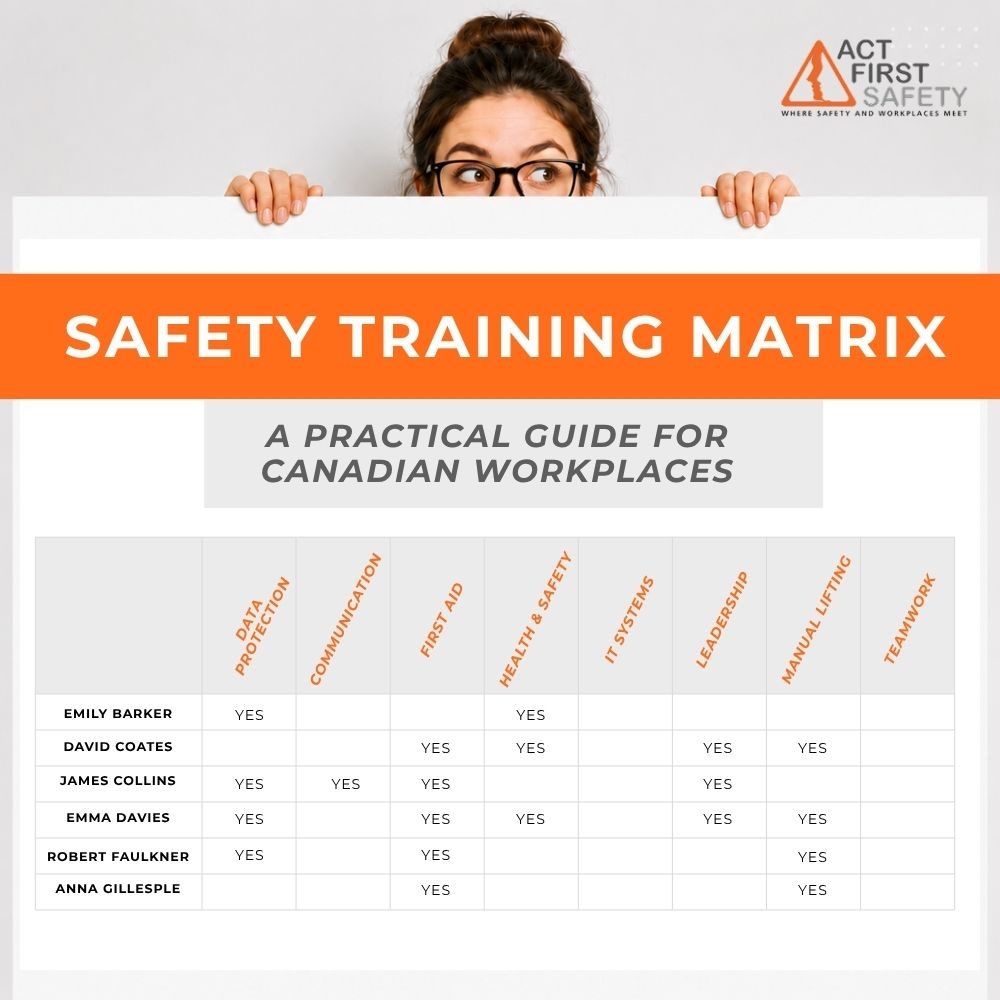
A safety training matrix can help with that. This useful tool is a detailed yet concise map of every employee, their job role, and the training they need to do their job – all summarized neatly in one simple-to-read document. It also helps safety coordinators to quickly spot compliance gaps and where renewal is due.
Now, while a training matrix is a pretty standard part of most workplaces, it is not required by law, so that is something employers should keep in mind. Nonetheless, keeping a safety training matrix is a crucial part of managing workplace compliance.
That is why today’s blog from Act First Safety – a CPO-approved safety training provider in Ontario will serve as a guide to a proper safety training matrix. Please note, this guide is aimed at Canadian workplaces only, and draws on provincial OHS laws like Ontario's Occupational Health and Safety Act (OHSA), Alberta's OHSA and OHS Code, and WorkSafeBC regulations.
Please also note that this is a practical guide, not legal advice. Its purpose is to help you develop a matrix and understand the benefits and pitfalls of using one.
Why Safety Training Matrices Are So Important
A safety training matrix provides a single view of who has what training, when it was done, and when it is due for renewal. It removes guesswork and helps in avoiding training compliance failures entirely.
For example, it keeps track of workers who have forklift training, working at heights training or JHSC training, ensuring they have the certifications they need to conduct their on-job duties.
Safety matrices are also instrumental in simplifying the inspection process, reducing it from days to hours.
That said, different industries will have their own areas of focus when it comes to training - fall protection in construction, chemical safety in manufacturing, confined space entry in utilities, and so on. What the safety matrix does is confirm that only trained workers are performing hazardous tasks, thus helping you avoid fines and legal complications.
For example, a construction site planning a roofing job can use the matrix to make sure all the roofers have their Working at Heights certification and avoid any delays or fines under OHSA.
Key Benefits Of Using A Safety Training Matrix
A safety matrix centralizes all critical documentation pertaining to worker training, including certifications, and makes it easy to access for the management, safety reps, and HR.
Its core benefits include:
- Faster audit preparation - matrices can reduce audit prep time by up to 70%
- Enhanced compliance - less risk of expired certification with automated expiry alerts
- Better planning of refresher training - bulk scheduling reduces costs
- Easier onboarding - new staff are matched to the relevant training for their role
- Clarity on workforce planning - ensures the presence of the right certified personnel on each shift
When your staff is well-trained, they work more efficiently, thereby boosting productivity across the board. By tracking leading and lagging indicators via the safety matrix, you can measure how effective your training is and spot areas for improvement.
However, we must emphasize how crucial it is for management and supervisors to verify that each shift has met the right statutory minimums. For instance, every worksite must have at least one first aider, the right JHSC coverage, and certified equipment operators.
Furthermore, management must exercise cost control by avoiding last-minute "rush" training. Planning certifications in advance of a job’s start date or the certificate’s expiry date can help companies stay within budget.
Who Should Manage the Safety Training Matrix?
Ownership of the matrix depends on the size of the company, but it does need to be assigned clearly.
For example, in small companies, the owner, an office manager, or a similar person will be responsible for the matrix. For larger companies, a designated HSE department or HR manager would probably be the best bet.
In such environments, designated supervisors are generally responsible for making sure their teams have undergone the required training, especially job-specific safety training. But in unionized workplaces, the Joint Health and Safety Committee (JHSC) may have some oversight too. Nonetheless, the employer is still ultimately responsible for making sure that everyone in their team has been properly trained.
Let us illustrate with an example how the correct management of a safety matrix can help a company:
An Ontario manufacturing facility assigns matrix ownership to the Health and Safety Manager of their company, who gets new hire data from HR each month. Supervisors sign off on completions within their departments, ensuring new hires are ready to go. As a result, compliance disputes drop by 35% in internal audits since everyone knows their duties and roles.
How To Create & Maintain A Safety Training Matrix
For new or small organizations, a spreadsheet is enough to start and maintain a safety matrix. However, larger organizations with a sizable workforce may need specialized software. That said, here are the basic steps that can help you create an airtight safety training matrix.
- List all the job roles and identify any hazards present on the jobsite
- Cross-check the relevant provincial regulations for the required training (e.g., Ontario Reg. 851 for industrial equipment and O. Reg. 213/91: Construction Projects for suspended work platform systems)
- Build columns for Employee Name, Job Title, Department, Course Name, Date Completed, Expiry Date, Training Provider, and Current Status
- Add expiry formulas (e.g., for 3-year certifications)
- Introduce colour-coding to easily identify certification status at first glance, e.g., green for current, yellow for expiring soon, red for expired
Another thing employers can do to create a more effective safety training matrix is to conduct a Job Hazard Analysis (JHA). This will help you identify and prioritize hazards in specific work areas and tell you which training requirements apply to each role.
Here is how you can know whether a spreadsheet-based matrix is enough or if your organization needs dedicated software:
Methods Comparison
| Method | Pros | Cons | Best For |
| Manual Excel | Free, familiar | Error-prone, no alerts | Under 25 workers |
| Cloud (Google Sheets, M365) | Cross-departmental collaboration, auto-backups | Requires internet and a subscription | 25-100 workers |
| EHS Software | Automated alerts, COR integration | Costly | 100+ workers |
When Do You Need A Safety Training Matrix - And Why
Matrices are vital when training requirements get complicated or recur regularly, especially in medium to high-risk industries. Here are some examples of when you really need a matrix:
- Multi-shift manufacturing operation requiring 24/7 forklift operators
- Warehouses that need people who can handle frequent lifts
- Construction sites that need to track confined space certifications and working at heights training
- Healthcare with annual training on violence prevention and infection control
Overall, workplaces with 20+ workers must have a JHSC (Joint Health and Safety Committee), which means certifications need to be tracked. Tracking training is the safest way to ensure compliance and pass regulatory audits.
Did you know that in 2025, 80% of rejections were based on proof of training failures?
Before you even think about audits, COR® certification, or pre-qualification processes, a matrix can save you from the hassle of training proof failures and consequently pre-qualification process rejection.
What Happens When You Don't Have a Safety Training Matrix?
Using a mishmash of certificates and emails is just asking for trouble. You could end up with:
- Missed expiries causing stop-work orders and fines
- Unqualified workers operating equipment linked to insurance claims
- Failure to prove due diligence after an incident (and facing fines and even prison time)
- Regulatory penalties for documentation failures
- Increased insurance premiums after preventable injuries
Let’s say a worker with an expired respirator fit test is sent to work with silica dust. WorkSafeBC gets a complaint, an investigation is launched, and the employer can't produce training records and is fined thousands of dollars. His employer loses the contract as well and the company's reputation takes a hit.
This is the type of grave consequence that the simple act of maintaining a safety training matrix can help you avoid.
Managing Training Expiry and Recurrence
In Canada, most safety courses have a shelf life of 3 years, with some of them having a lower lifespan. That means you need to plan for recurrence. Here are some commonly followed validity cycles across the country:
| Training | Validity | Accepted Program/Intervals |
| Working at Heights | 3 years | Ontario CPO-approved like Act First Safety |
| First Aid (Basic and Intermediate) | 3 years | WSIB-approved provider like Act First Safety |
| Forklift | 3 years | Or retraining as required, e.g. after incident |
| WHMIS | Annual | Or after SDS changes |
| Respirator Fit Testing | Annual | Or after facial changes |
| JHSC Certification | 3 years | Refresher required to maintain |
Set reminders 60-90 days before expiry via your preferred email platform or software. Start getting quotes from training providers for scheduling the next training session.
Safety Training Programs You Should Track
High-priority programs with expiry dates and legal requirements include:
- Forklift: 3-year refresher or post-incident retraining
- Working at Heights: CPO-approved 3-year certification
- First Aid and CPR: 3-year validity
- WHMIS: Annual refreshers or on SDS updates
- Respirator Fit Testing: Annual or as needed
- JHSC Certification: Part 1 Basic and Part 2 workplace-specific training with 3-year refreshers
Skipping renewals for these courses can land your company in hot water, so it is critical to stay on top of the certifications of your crew with the help of a safety matrix.
How To Derive The Maximum Use Out Of Your Safety Matrix
A matrix should be used in safety meetings, scheduling, and audits to track compliance. It should also be reviewed and updated regularly so it does not contain false or misleading data.
A well-drafted matrix serves several useful purposes, such as:
- Supervisors can use it to make sure shifts have the right certified personnel
- JHSC can conduct a matrix review in quarterly meetings to plan training
- Incident investigations can reference the matrix to identify training gaps
Recognizing safe behavior is key to ongoing compliance. Quarterly reviews keep data accurate and support continuous improvement.
Conclusion: Start Building Your Matrix Today
Checking your current training records and then feeding them into a safety training matrix can help you identify gaps and find the best courses of action for them in your next JHSC meeting. In the absence of a JHSC, you can work with others on your team, including supervisors, human resources, and safety representatives, to maintain compliance all year round.
Looking for compliant safety training programs in Ontario? Act First Safety is a CPO-approved safety training provider that caters to the compliance requirements of Ontario crews across various industries. Contact us to learn more about our public, private, and online programs.
FAQs
How often should a safety training matrix be updated?
Safety matrices should be updated whenever workers complete training, new crew members are hired, roles change within a company, refresher courses are conducted, or incidents take place.
What is the biggest mistake employers make with safety training records?
Employers tend to rely on emails and texts to manage employee certifications, which are hard to track and may cause companies to fail annual audits.
How can new employees be added to a safety training matrix?
As soon as new hires are onboarded, they should be added to the matrix. Key information that must be mentioned includes job role and training certification.