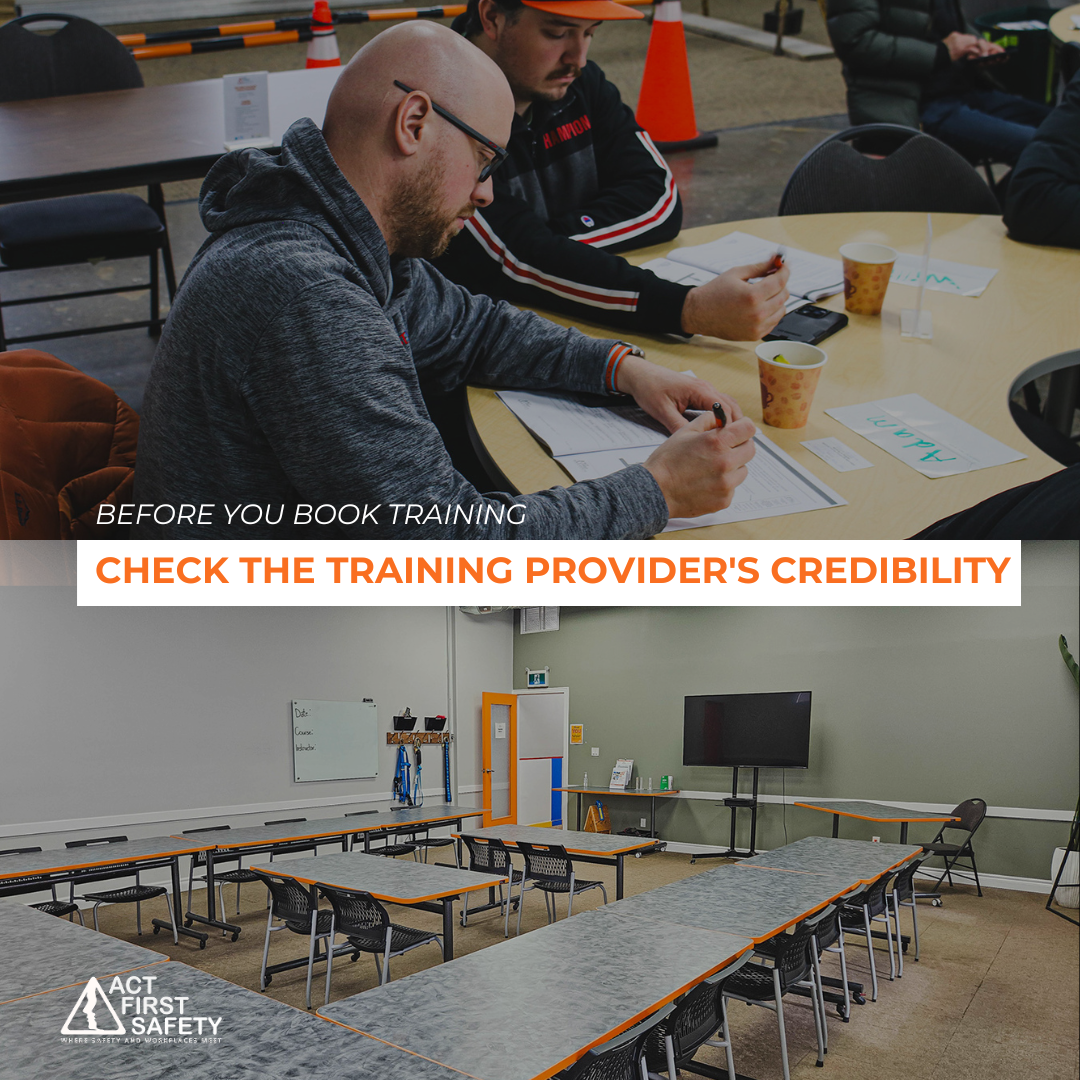
Whether knowingly or unknowingly, safety training services that amount to little more than theater instead of meaningful instruction are becoming all too common. True training excellence comes from carefully designed programs that include qualified instructors, clearly defined learning objectives, thoughtfully planned instructional methods, and practical evaluations with proper auditing.
Unfortunately, as we enter a new season, we are seeing a rise in fraudulent safety cards and ‘safety theater ’ from training that lacks real substance to certificates riddled with errors or blatantly using stolen logos and information from reputable providers. Any combination of these scenarios is currently circulating in the marketplace and could surface in any organization at any time.
The key is to protect yourself from this scam. That’s why in today’s blog, Act First Safety – Ontario’s most trusted safety training provider, will show you how to spot scamsters from sincere service providers.
Accredited by the Institute of Sketchy Credentials
If you cannot identify the institute on the certificate, chances are it’s most likely made up.
What this means for employers, site supervisors and the like, is that hiring managers, supervisors, and anyone responsible for validating training certificates, needs to perform due diligence to ensure that the company that provided the training is legitimate and that the certificate has not been falsified.
Turning a blind eye at the hiring phase or letting a dubiously trained worker on a site could end up badly for the supervisor and the employer in the form of fines, imprisonment or in the death of a worker, as an example.
If you want to avoid these dire consequences, you will be better off investing in training from a certified provider – whether it’s working at heights training, rigging training, asbestos training, or any other training for that matter.
Blemished Certificates Are A Dead Give-Away
Obvious blemishes in training certificates will be a dead giveaway for falsification.
An unfamiliar company issuing certificates that does not provide contact information or cannot be reached by phone adds a layer of suspicion.
Conversely, the widespread recognition a reputable company enjoys will inspire confidence in their services.
Nonetheless, caution should be exercised as the certificates from reputable companies are often the target of theft. Usually, the theft is poorly executed with lousy duplication, taped logos and other signs of fraud.
So how do you distinguish the two? Simple. Reputable companies answer their phones, stand behind their services, professionally address questions, typically don’t operate out of their residence, and provide supporting documentation if needed. All you have to do is contact them to verify their legitimacy. Remember, shady companies will avoid you.
Who is doing it? Operators of fraudulent training providers
We have encountered multiple instances of fraudulent certificates being issued by disreputable training organizations, employers, supervisors, trainers, and even individuals who create, copy, or manipulate false proof of training.
Recently, a worker contacted us to report that their supervisor distributed Working at Heights cards falsified under Act First Safety, despite no training having taken place.
The worker’s concern was not only about the deception, but about their own safety, stating they “didn’t know what they were doing” when performing work at heights.
These actions are not only unethical and fraudulent; they place workers at serious risk. Moreover, this issue extends beyond individual supervisors and reflects a broader problem across multiple workplace parties who contribute to these unscrupulous practices.
The reality of Sham Safety Schools
We have all heard about sham diplomas, sham truck driving schools, and, of course, sham safety schools and certificates in the media or through associates.
A while ago, there was a trucking license company in Ontario that designed its storefront to appear like the Ministry of Transportation (MTO) and issued ‘licenses’ for cash, primarily targeting newcomers who subsequently paid for their licenses, not realizing the illegitimacy of them.
Many unsuspecting people fell prey to their fraudulent practices, which really brings to mind the importance of the age-old adage “buyer beware”.
In one example from New York State, an executive of a sham safety training school was charged and sentenced following the death of a worker and for endangering the lives of an estimated 20,000 additional workers who passed through the fraudulent training system without proper instruction.
Calling out fraudsters and refusing to support certificate-for-money schemes not only challenges unethical practices but also reinforces and protects the reputable safety training providers who invest time, expertise, and integrity into their programs.
We cannot afford to wait until thousands of workers pass through deceptive training systems, or until a tragedy forces action, before responding. Choosing legitimate training is more than a compliance decision; it’s a moral one. It means following your compass and voting with your wallet in support of real safety, not the illusion of it.
That is why verifying the school you choose is critical before you enroll into any of their safety programs – whether it’s asbestos training, propane training or any other course.
Participation Award – A sign of Sham Schools
When it comes to safety, not everyone should be getting a participation award.
It’s important that you select approved training programs by organizations like:
- The Ministry of Labour Immigration Training and Skills Development (MLITSD) for Working at Heights,
- Technical Standards and Safety Authority (TSSA) and Propane Training Institute (PTI) for propane, and
- Workplace Safety and Insurance Board (WSIB) for first aid
Selecting programs backed by established organizations is a great way to verify their validity. That said, even though these organizations perform training audits, the systems in place are not infallible.
Sadly, some training providers slip through the cracks or hastily perform training under the allotted training allowance, with inadequate equipment or without performing practical evaluations. Our advice is to steer clear of such providers. Especially if all you get is a participation certificate and not a valid certification.
MLITSD Certificate Verification Made Easy
In Ontario, CPO-approved training certificates issued by approved training providers under the Ministry of Labour Immigration Training and Skills Development (MLITSD) can easily be verified.
For individual learner certification for Working at Heights, Working at Heights Refresher and Joint Health and Safety Committee programs, go directly through the Ministry’s official website at the link below:
https://www.apps.labour.gov.on.ca/cms/safety-and-prevention/eligibility-checker
If you are uncertain about the issuing company, you can also find information by searching for the training company at:
https://www.apps.labour.gov.on.ca/cms/safety-and-prevention/approved-training-providers
Performing these steps is due diligence and can help you avoid unnecessary problems down the road.
How To Avoid Safety-ish Practices In Favor Of Real Safety Practices
Don’t wait to get burned by fraud. You want to avoid accidents and fatalities that put your company or your career at risk. Developing strict protocols around the kind of training certificates deemed acceptable and legitimate can safeguard you and your business.
Use caution when flip-flopping for the lowest-priced options, as this can be a red flag. Foster relationships with your training provider and monitor the quality of the training on a consistent basis.
Some organizations only accept training certifications from a pre-authorized list, banning training certificates from known unscrupulous providers.
While some others disallow training certificates that are either provided online because online learning is not appropriate for the job to be performed
or because of concern about the certificate's credibility for any reason. In any case, screening safety training certifications should be your first line of defense.
In addition, examples of inadequate training might not be fraudulent, but an unsuspecting worker may be duped into attending fall protection training when CPO-approved working at heights training is required.
The initial reason for choosing the wrong course might be reduced cost or a reduced training time period. Though enrollment in the correct program costs more money and more time, it’s still the more affordable decision in the long run.
That said, while online classes are an option, attending one may not be adequate for your job. We suggest checking with your employer or supervisor to determine the adequacy of your training format prior to purchase for assurance.
How to spot fraudulent schools
Any imperfections, spelling errors, poor logo (not high resolution), crooked and off-centre information, no expiry date (for most training), missing company logo (generic cards that can be bought through online shopping) – should all be considered as red alerts that indicate fraud.
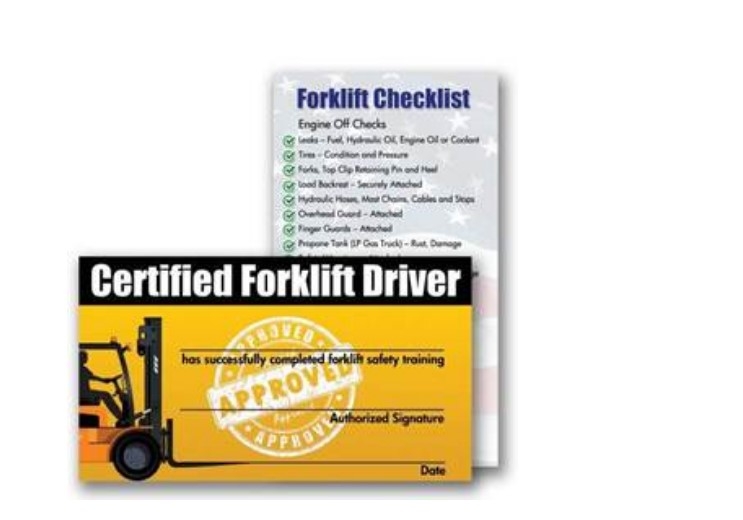
Impressive-looking cards can also be misleading. While many reputable training providers issue certificates on durable cardstock or in business-card format, the appearance of a polished, high-quality card is not proof that comprehensive or meaningful training took place. In fact, some fraudulent providers rely on slick design and professional presentation to create a false sense of legitimacy.
Certified in Cutting Corners
If you are a worker and the supervisor, employer, or training provider provides a card for which you have not been trained, that is fraud and could put you at risk while performing your job.
If you are an employer knowingly choosing substandard safety training in the pursuit of saving time and money, you are complicit in any negative outcomes that arise from inferior training.
Often temporary workers who are filling gaps in labor shortages are either provided inadequate training or a certificate they haven’t earned to make up for lost time and money, thus significantly increasing safety and liability risks on jobsites. Despite this being a particularly challenging situation, the onus remains with the employer to ensure that compliance is met.
In-House Training or In-House Risk: Choose Wisely
Internal training is common for equipment programs such as forklifts, aerial lifts and WHMIS training. In these cases, certificates or cards may or may not be issued with the employer’s company logo and are intended to document in-house training. While internal training can be legitimate and effective, these generic-style cards can also be easily purchased, stolen and distributed without any actual instruction taking place.
Another major concern is that the quality of internal training can vary significantly. Some large employers maintain robust, well-structured programs, while others rely heavily on informal job shadowing, which can cause inconsistent instruction and the reinforcement of unsafe habits.
For this reason, internal training can be difficult to independently evaluate for quality. It is strongly recommended that workers entering a new workplace with prior internal training be reassessed and, where necessary, retrained. Internal training certifications are generally non-transferable between employers.
Advanced Appreciation Award
Good training supports workers and, combined with competent supervision, is the best insurance for you to be safe. Learning, growing, coaching, and mentoring, when performed continuously, support a safe workplace culture.
So the next time you are planning a safety training exercise for your crew, make sure you choose a reliable and genuine provider. Act First Safety is a CPO-approved safety training course provider in Ontario with 20 years of experience. Our legitimate courses span a wide variety of online, public, and private training programs. Contact us to enroll your crew. Our training center is located off Highway 401 in Scarborough and can be easily accessed from anywhere.
FAQs
Can an employer be held legally responsible for accepting a fraudulent safety certificate?
Yes. As per the OHSA, employers are legally bound to ensure their crew receives proper safety training. Accepting fraudulent certificates can cause fines, prosecution, and civil liability.
What should a worker do if they suspect their safety certificate is fake?
If you suspect you have received a fake certificate, you must immediately raise a concern with your trusted supervisor. They can help you verify the certificate’s legitimacy. You can also verify the authenticity of the certificate via the Ministry of Labour, Immigration, Training and Skills Development’s website. If found to be fake, consult with your supervisor concerning the next steps.
How often should employers audit worker training records?
As a general rule of thumb, employers must conduct annual audits to ensure their crew and workplace are compliant and have legal certificates to work on-site. Audits before the start of every big project are also recommended.