So, you've decided the workers of your organization need safety training. That is a wise decision, but the question is – what kind of training will make a real, positive difference?
The choice between online, virtual, blended, or in-person training is a big one - and it can make all the difference to how your team takes to it. Just like wearing a hard hat as opposed to just another hat can have a huge impact on onsite safety, so can choosing the training method most conducive to your team. That means you have to choose carefully.
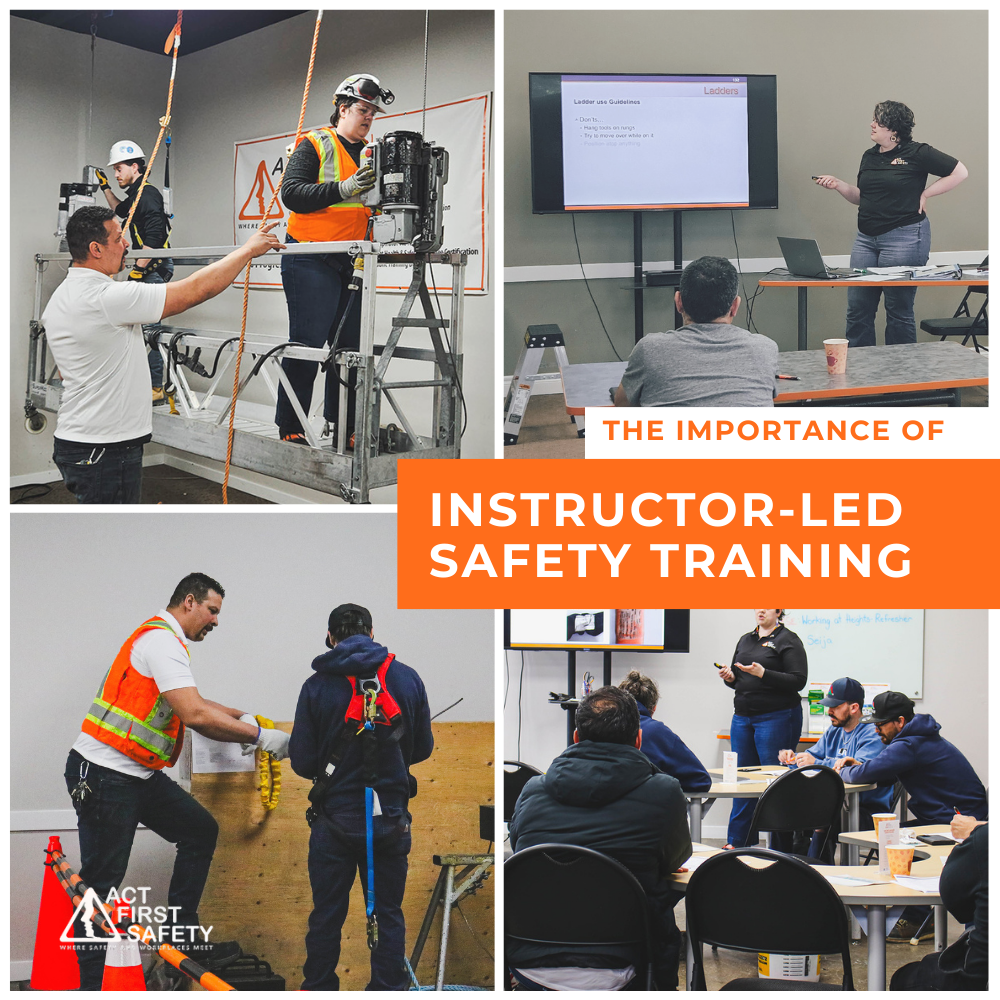
While each training format has its pros and cons, instructor-led, in-person safety training stands out for the hands-on approach it provides to resolving real safety issues real workers face on real worksites.
In this blog, Act First Safety – provider of certified safety programs in Ontario – will reveal why in-person training is the way to go.
What Level of Safety Training Does Your Team Need?
Safety training usually boils down to three basic competency levels:
- Awareness: This is where your crew picks up the basics and gets a feel for the subject. They might even get some extra resources at this stage to help them understand concepts better. Evaluation at this level is pretty straightforward and involves minimal interaction along with a simple test.
- Knowledge: At this stage, things get a bit more serious. Your crew is expected to remember and recall all sorts of information about the training topic. Their knowledge on the said subject will be assessed through tests and quizzes - and if they pass, they basically prove that they have gotten the content down to the smallest details.
- Skill: Now we're talking real-world application! At this stage, your crew has to put all the knowledge they have acquired to practice - so they can really do the job. Think performing equipment checks, operating a forklift, or writing up procedures. The best way to get the skills part right is with some good old-fashioned hands-on training.
Whether it involves foundational programs like JHSC training or something more advanced, such as scissor lift training, the only way to truly learn is through in-person classes and workshops – such as the ones Act First Safety provides.
Why Instructor-Led Training is the Gold Standard for Knowledge and Skills
For awareness-level training, any format will do – especially if you're on a budget. For instance, online safety training is the least expensive option. But for knowledge and skills, you really need instructor-led, in-person training. That's because it comes with several advantages, such as:
- Allows for proper hands-on practical evaluation - you can see if people are really getting it right.
- Supports formative assessments during the training - so the instructor can give feedback and adjust the course on the fly to suit your team’s working conditions
- Fosters engagement through proper interaction with instructors and their peers - so everyone's got something to work with
- Lets the instructor tailor the training to individual learning needs - so everyone gets the most out of it without skipping essentials
- Gives coaches and mentors a chance to work with learners in real-time, thus helping remove language barriers or comprehension issues.
- Encourages active participation - and leverages the different experience levels of your team so novices can learn from experts
- Lets the training be tailored to the specific job, so everyone's learning exactly what they need to know
The above reasons provide ample evidence in support of instructor-led training. In fact, we would go so far as to say that it is ideal that it is the most ideal safety training format, especially as far as practical courses such as forklift training, scissor lift training, working at heights, JHSC certification training, and swing stage training, etc., are concerned.
The 70-20-10 Learning Model & How Instructor-Led Training Supports It
You've probably heard of the 70-20-10 model. The idea is that people learn 70% on the job, 20% from interactions with their peers and mentors, and 10% through formal training.
Think of your own experiences. If you look back, you will see that this rule has been true for your life too. It allowed you to learn the ropes of your job in the most organic and reinforcing way possible – and that is not the only advantage of this rule.
The 70-20-10 learning model supports the natural involvement of instructor-led training. This learning format gives you the formal training foundation (the 10%) required to stay safe and prepared on-site while supporting a social learning setup that really helps people apply what they've learned.
Instructor-Led Training: Learning that Lasts Beyond the Classroom
The benefits of instructor-led training don’t stop right here. In fact, they even extend beyond formal classroom sessions – way after the door shuts and everybody leaves for the day.
The real impact of formal classroom safety training is realized in the days, weeks, and months that follow – when supervisors reinforce expectations, coach safe behaviors, and lead by example.
These informal learning opportunities, along with safety demonstrations and discussions, micro-learning tidbits, etc., reinforce what instructors have taught your team. Other reinforcement opportunities arise via ongoing supervision and mentoring, so make sure you implement that to check how your crew puts what they have learned to practice. That demonstrates its real value.
Why Instructor-Led Training is Worth the Investment
So far, it seems that instructor-led training is worth the extra up-front investment – but only if you pick and choose your provider carefully.
The right instructor, with the right training, can really make a difference to your organization. That is key to getting a higher ROI on your investment – especially if the use of heavy-duty equipment is involved. Online certifications make no difference in such cases.
For example, the proper use of machines like mobile elevating work platforms (MEWP) must be demonstrated, which is only possible when an instructor teaches your worker how to do that.
And at the end of the day, a competent worker is one who has the knowledge, skills, and experience to really do the job. And that's what makes investing in instructor-led training worth it.
Why Instructor-Led Training Stands Out from the Rest
It is natural to want to stack instructor-led training against other formats such as online safety courses or hybrid learning models. However, they often pale in comparison. Here is why:
- Instructor-led courses give learners proper face-to-face time with the instructor, so they can get the help they need.
- It lets learners get just-in-time coaching and mentoring to really help them apply what they've learned.
- It helps workers develop the skills they really need in a practical, hands-on way.
- It lets the training be tailored to the specific job so everyone's learning exactly what they need to know.
- It allows for ‘getting your hands dirty’ with hands-on practice that is tailored to the specific job your team does and the type of environment they work in.
- It provides support for tackling real-world problem-solving exercises that mimic actual workplace scenarios your team will face on the job.
With instructors guiding your team, you can trust your crew will end up with the knowledge and skills they need to be safe and productive on the job.
Conclusion
In conclusion, traditional instructor-led, classroom safety training provides a comprehensive, adaptable, and engaging learning experience that is critical for developing knowledge and practical skills. This format is critically important to ensure workers are well-prepared and safe in their roles while helping you create a safe working environment for them.
If you are looking for a certified training provider, Act First Safety offers the best instructor-led worker safety courses in Ontario. Each of our programs is conducted by certified trainers who educate your crew about the best safety practices in your industry. Contact us to book a slot for your team.
FAQs
Is instructor-led safety training mandatory in Ontario?
Depends on the course. Ontario regulations typically do not specify the format of training workers need. However, demonstration of competence, skills, and knowledge is a must for many fields – something which only instructor-led training can provide.
Can online safety training replace hands-on instruction?
While certain theoretical courses can be conducted online, courses that require practical classes cannot be. Online training is good for awareness, whereas hands-on training is necessary for the demonstration of practical skills, safe equipment use, adherence to proper procedures, and the like.
Does every member of my crew require hands-on training or will just the experienced ones?
Every member of your team must participate in instructor-led training to ensure they remain safe and productive on-site.