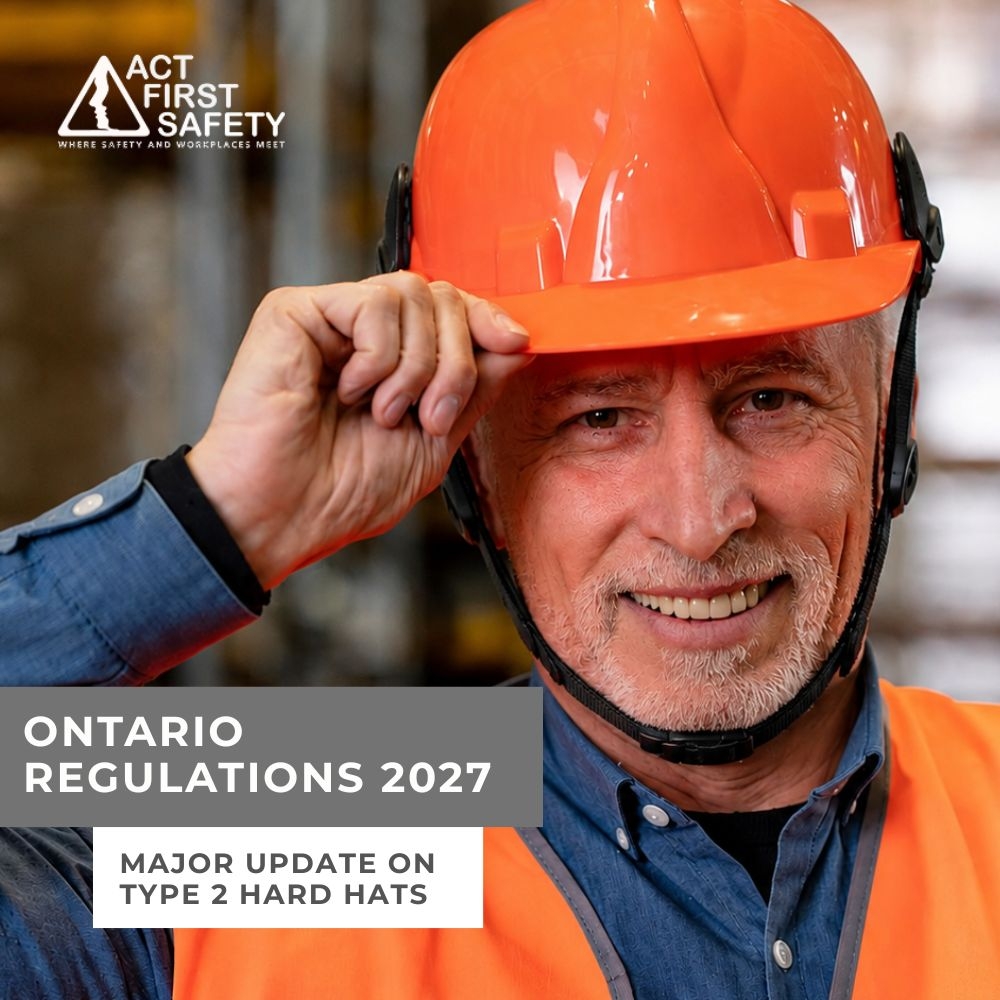
Hard hats are a construction-site staple, and they have every right to be! Full of potential hazards, construction sites require appropriate PPE, and hard hats are an absolute essential. After all, head injuries are almost always fatal. And if not fatal, they can be severely damaging. That is why at Act First Safety, Ontario’s number one safety training provider, we keep stressing the importance of hard hats every now and then. And this time, we have a major update.
As published in the Ontario Gazette on May 9, 2026, laws concerning hard hat use on construction sites will undergo a serious update. These amendments will be implemented on July 1, 2027. In today’s blog, we will give you the latest scoop on hard hat use on construction sites.
Exploring The Key Changes In The Latest O.Reg. Updates On Hard Hats
The Ontario government has big changes in store for the use of hard hats. As per O. Reg. 112/26: CONSTRUCTION PROJECTS, all workers must receive appropriate headgear on construction sites to prevent them from falling prey to accidents or injuries. We will dive into the depths of the latest amendment below:
Executive Summary
As per recent amendments, here are the changes to protective headgear you can expect:
If the conditions on a project cause a worn protective headwear to dislodge, a chin strap or other retention system should be used to prevent dislodgement
If the worker is exposed to side impact hazards on-site, they must be provided with appropriately protective headwear
Headwear must be manufactured in accordance with and meet the design, performance and test requirements of Type 2 protective headwear of the CSA Standard Z94.1
For those of you who are not familiar with the CSA Standard Z94.1, the following table should provide a clear idea of the type of hard hats considered permissible on work sites:
CSA Standard Z94.1 Type 2 Protective Headwear Classes | |
CLASS C HEADGEAR |
|
CLASS G HEADGEAR |
|
CLASS E HEADGEAR |
|
Source: CSA Standard Z94.1 ‘Industrial protective headwear — Performance, selection, care, and use’.
The Center for Construction Research and Training (CPWR) reports that the majority of construction site deaths are caused by either falls or being struck by objects. Most of the incidents take place when crews are working at heights, which makes fall protection training, swing stage training, etc., just as critical.
In any case, these numbers and rising fatalities have prompted many companies to proactively implement policies and procedures requiring the use of Type 2 hard hats on their job sites, despite the fact that these regulatory changes will not come into force until July 1, 2027.
Ellis Don is one such company trying to do the right thing when it comes to worker, visitor and contractor health and safety.
Starting from January 1st, 2026, Ellis Don made it mandatory for all personnel present on their worksites to wear a CSA and/or ANSI Type 2 hard hat that features a manufacturer-approved four-point chin strap, which should be properly adjusted and fastened. This is basically an extension of the same rule that the company had implemented in 2023 for its workers. Now it includes everyone present onsite.
Why Upgrade To Type 2 Hard Hats On Your Site If You Haven’t Yet?
The argument to use Type 2 hard hats boils down to the fact that they offer superior protection against lateral impact. But that’s not all. When properly worn, a Type 2 hard hat with an attached chin strap is designed to stay on the worker's head even when things get rough.
In fact, the chin strap is a huge help in preventing the hat from falling off during a fall, impact, or sudden movement, thereby maintaining its intended level of protection. They are the best option to keep workers safe, reduce the risk of injury, and minimize employer liability. They also keep the Ministry of Labour, Immigration, Training and Skills Development (MLITSD) from knocking on your door while preventing an increase in WSIB premiums.
What You Can Do To Ensure Worker Safety On Construction Sites
As a site supervisor or a construction crew employer, you can do your bit to ensure your workers remain protected until the new regulations kick in:
- Implement a company-wide policy to incorporate the use of Type 2 hard hats on job sites.
- Provide your workers with relevant safety training that involves the right use of personal protective equipment (PPE), including how to correctly inspect and don the PPE.
- Promote a culture that strongly emphasizes the implementation and enforcement of these new policies.
Conclusion
While making the use of Type 2 hard hats on construction sites mandatory is a smart idea, you do not have to wait for the regulation to kick in. You can start protecting your workers now by providing them with Type 2 hard hats and relevant safety training courses.
Need help with the latter? Act First Safety is your one-stop shop for all things workplace safety-related in Ontario. From providing comprehensive safety training programs to supplying tools that make your working environment safe and compliant for everyone involved, we can help you with everything.
We also offer a full suite of safety services across the construction and manufacturing sectors to ensure total compliance and worker protection. Our expert team provides detailed health and safety documentation, including Standard Operating Procedures (SOPs), Safe Work Procedures (SWPs), Job Hazard Analyses (JHAs), and emergency rescue plans.
We also conduct thorough site audits and deliver actionable recommendations, alongside essential workplace assessments such as noise monitoring and air quality testing. Want to empower your workforce? Contact us to learn how we can help all your employees return home safely.
FAQs
What is the difference between a Type 1 and a Type 2 hard hat?
Type 1 hard hats only protect the top of the wearer’s head, while Type 2 hard hats protect the wearer from both top and lateral impact due to their design and the addition of a chin strap. Type 2 hard hats are safer than Type 1.
Will workers require additional training when switching to Type 2 hard hats?
Yes. Employers must host instructional workshops on the donning and doffing of Type 2 hard hats to maintain maximum workplace safety.
How often should Type 2 hard hats be inspected and replaced?
The general rule of thumb involves pre-use checks at the start of every shift. Hats should be checked for cracks, dents, UV damage, and general wear and tear. If signs of damage are found or if the safety of the hat has been compromised, it should be replaced immediately.