United States Raises the Bar on Safety Requirements for Fixed Ladders – Is Canada Next?
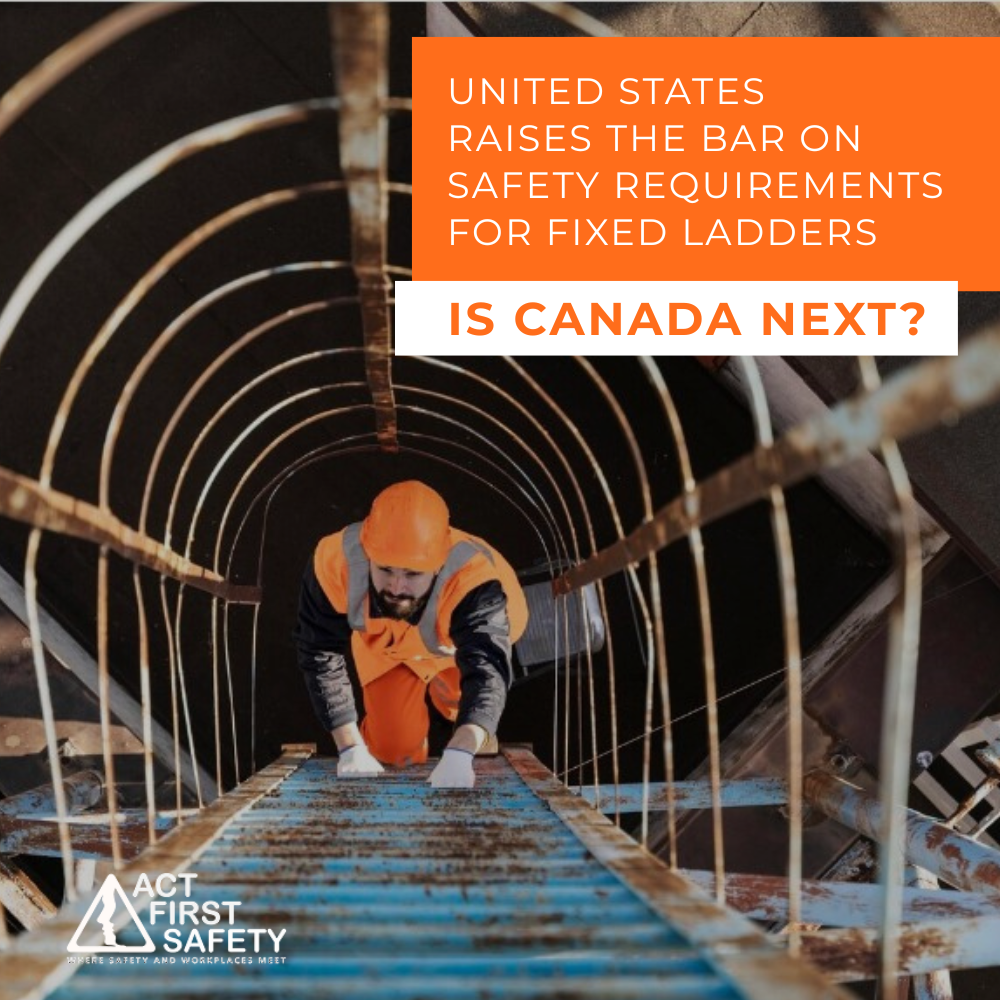
You can't help but think of fixed ladders when you walk into just about any industrial setting. They're everywhere – from rooftops of office buildings to the heart of power plants and hospitals. Despite their prevalence, ladder safety is not often talked about as much as it should be.
In Ontario, under the Occupational Health and Safety Act (OHSA) Regulation 851 (Industrial Establishments), employers of industrial establishments must provide workers with safe means to access working areas at varying heights, especially if that means of access is above or below floor level and used frequently.
This access usually comes in the form of fixed ladders, helping workers reach and maintain important equipment like air conditioning units, heaters, plumbing vents, gas lines, and telecommunications systems. In fact, fixed ladders are fairly common and come with their own set of safety concerns, which employers must know about to protect their crews from accidents and avoid serious legal consequences.
Act First Safety, providers of a wide variety of worker safety courses in Ontario, are here to help employers understand the basics of fixed ladder safety on worksites.
Occupational Health and Safety Act Legislation For Fixed Ladders in Ontario
A glance around will reveal that nearly all buildings rely on fixed ladders for access. However, not all of them are built, installed, and maintained with the same level of care and attention to safety.
Section 18 of OHSA Regulation 851 (Industrial Establishments) spells out the requirements for fixed ladders in Ontario. These include:
- A vertical design
- Rest platforms that are no more than 9 meters apart
- Presence of an offset at each rest platform
- Installation of a safety cage for heights exceeding 5 meters from the floor, grade, or landing; this cage must start no higher than 2.2 meters from the base and include openings for secure worker access to the top landing or rest platforms
- Side rails that extend 90 centimeters above landings
- Rungs spaced at regular intervals, at least 15 centimeters from the wall
Note: These requirements must be followed unless the ladder is attached to one of the specific structures identified in the regulation, in which case alternative fall protection measures may be required.
What’s worth pointing out here are the stipulated safety cage requirements. The regulation clearly states that these cages should be installed when the ladder extends over 5 meters from ground level. In theory, it is supposed to help workers stay on track, maintain their orientation, prevent them from falling backwards, and create a safe zone around them. However, the effectiveness of safety cages as a fall protection measure is highly questionable.
To be frank, safety cages might not be the silver bullet they're hyped up to be. For starters, their relatively open design may cause a worker to still fall the full length of the ladder. It also increases the likelihood of them hitting the ladder, cage, or side rails on their way down, thus causing more injuries.
Plus, cages are fundamentally incapable of arresting falls or reducing the force of one. In fact, many workers have been seriously injured or killed despite the presence of cages. This really emphasizes the importance of having proper fall protection measures in place, and reinforcing them with professional fall protection training.
What Has Changed In The US When It Comes To Fixed Ladder Safety?
As you can see, the concerns positioned against safety cages are valid. In fact, they prompted the US government to change regulatory requirements concerning fixed ladders.
In 2016, the American government finalized new regulations regarding fixed ladders under their "General Industry Walking-Working Surfaces and Fall Protection Standards", which came into effect in January 2017.
The changes introduced raised the bar on fall protection requirements for fixed ladders and added a bunch of extra safety measures for fall hazards. As of November 19, 2018, fixed ladders installed that are over 24 feet in height have to be equipped with either a Personal Fall Arrest System (PFAS) or a Ladder Safety System (LSS). And by November 18, 2036, all fixed ladders must be equipped with a PFAS or LSS.
According to OSHA, these changes are expected to prevent 29 fatalities and 5,842 lost-workday injuries every year.
How Does This Affect Fixed Ladder Safety In Canada?
It's no secret that Canadian and American health and safety standards are largely alike. The two countries share a similar approach to workplace hazards, technologies used, and critical industries.
Therefore, it's no surprise that they often draw from the same pool of research presented by leading regulatory authorities such as the National Fire Protection Association and the National Institute for Occupational Safety and Health (NIOSH).
As you can see below, Canada and the US used to have similar height requirements for safety cages - 5 meters for Canada and 20 feet for the US. But as of 2017, the US changed its rules and now mandates a PFAS or LSS for ladders that are 24 feet or higher.
OHSA (Ontario) Height Required for a cage: 5 meters or 16.4 feet
OSHA (United States) Height Required for a cage:
- Prior to 2017: 20 feet
- As of 2017: 24 feet
Given the historical alignment between many Canadian and U.S. safety standards, future regulatory review of fixed ladder requirements in Canada is not entirely out of the question. Although as of now, nothing is on the horizon and any guess will be just that – a guess.
What Can Canadian Employers Do In The Meantime
Safety always comes down to being proactive, and this is especially true when it comes to fixed ladders. As you wait for new requirements to develop at the federal or provincial level in Canada, you can still stay one step ahead of the game by:
- Implementing fall arrest systems: If feasible, consider upgrading fixed ladders with a Ladder Safety System or Personal Fall Arrest System. If your crew is working for a client and using their fixed ladders, find out if they would be willing to upgrade theirs too.
- Training employees for safe fixed ladder use: Make sure you and your workers are up to speed with mandatory safety training. A certified Working at Heights training program will give your crew the theoretical and hands-on practice needed to use harnesses and tie-offs properly. Plus, it will teach them how to spot potential hazards on a fixed ladder and what to do about them. Additional information provided includes how to use a ladder, how to inspect, when to use and when not to use a harness etc. Both on-the-job and official training will help keep your workers safer.
- Having an action plan for fixed ladder tasks: Make sure you have a written plan in place for fixed ladder-specific tasks. Safety consultants can lend a hand in setting up procedures that will keep your workers safe while a job is underway. This might involve chalking down standard operating procedures, safe work practices (SWP) and setting up a process for spotting and mitigating hazards, like a Job Hazard Analysis (JHA).
Conclusion
While portable ladder safety is often talked about, fixed ladder safety just does not get the same attention. However, the recent changes implemented by the US government that mandate the implementation of fall arrest systems or ladder safety systems by November 2036 might cause a ripple effect in Canada too. Hopefully, the OHSA will introduce new regulatory requirements that improve worker safety on fixed ladders.
Until then, training your crew is critical. Act First Safety provides a CPO-approved fall protection training program in Ontario that’s geared towards keeping workers safe at heights. Contact us to register your crew for our instructor-led training session.
FAQs
Are fixed ladder inspections required, and how often should they be conducted?
Although OHSA doesn’t mandate fixed ladder inspections, conducting regular checks can help employers maintain safe working conditions for their crews. The frequency of these inspections depends on ladder usage, environmental exposure, and manufacturer recommendations.
Do weather conditions affect fixed ladder safety?
Yes. Environmental factors such as rain, snow, high winds, ice, and extreme temperatures can compromise the safety of these structures and increase the risk of falls and other related accidents.
Can contractors use a client's fixed ladders without additional assessment?
This is not recommended. Contractors must verify the fixed ladder’s safety and usability before use to prevent accidents. A pre-job hazard assessment is also strongly recommended.