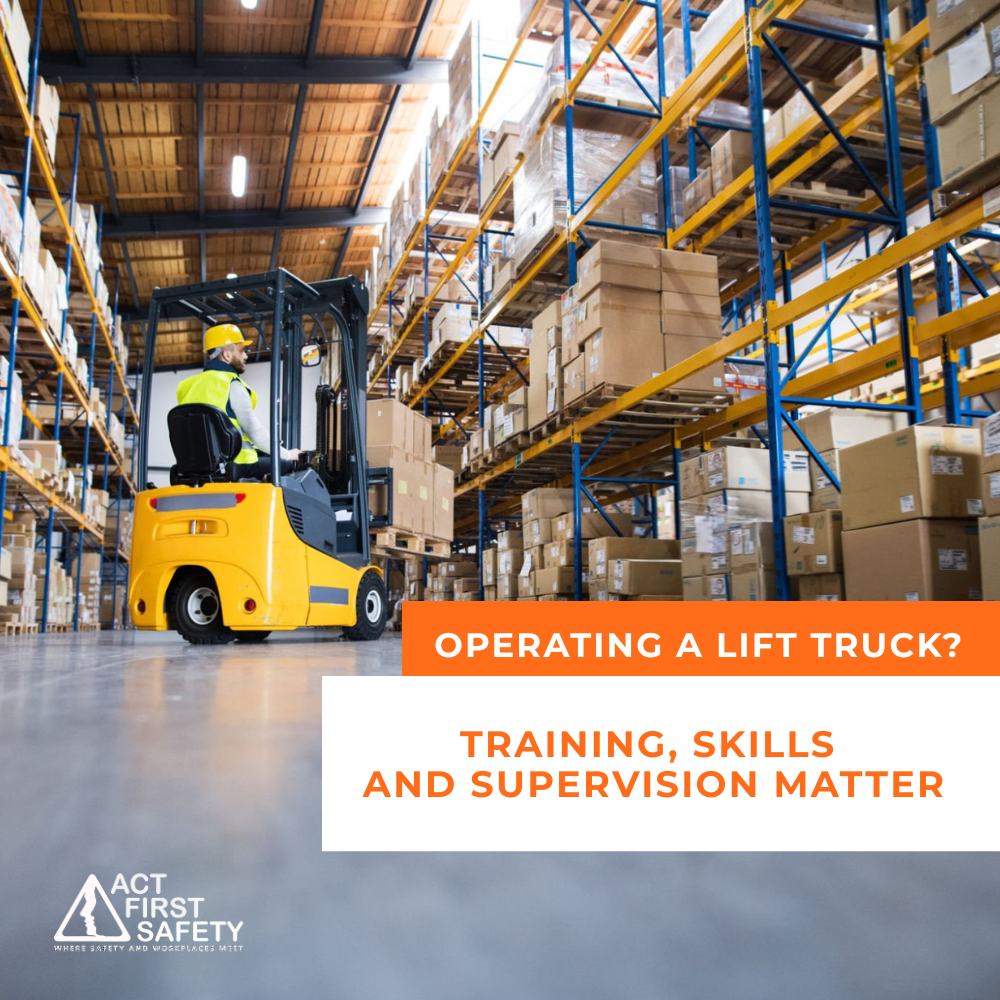
Lift trucks are involved in 10% of workplace fatalities each year, as per data revealed by OHS Canada. OHS also states that the estimated cost of these accidents amounts to over $125 million annually in compensation. Add to that the loss of human life, and the real cost of such tragedies can seem insurmountable.
Unfortunately, lift trucks have been at the center of thousands of accidents in Canada, and each year an average of 1,950 lost time claims can be attributed to it.
However, as grave and dark lift truck fatalities might be, there are lessons to be learnt here. By any conservative estimate, these are preventable incidents, and that is the silver lining the workforce needs.
In this blog, Act First Safety – provider of safety-first workplace courses in Ontario, will discuss how key lessons from lift truck accidents can help in the establishment of safer workplaces in the future.
The ever-present threat of complacency
A key part of accident prevention is understanding why they happen in the first place.
When it comes to lift truck accidents, the majority of them involve experienced drivers (3+ years). That’s alarming because experience is often equated with greater skill and consequently fewer mistakes.
However, very experienced operators can become too comfortable ‘behind the forks’, which can lead to the development of some bad habits. In such instances, supervisors and management need to remain alert to signs of complacency so they can stop it in its tracks. Of course, they need to be mindful of their own complacency as well.
To weed out complacency, supervisors must observe operators under their authority regularly, while remaining vigilant for any decline in safe operating procedures. Any displays of poor performance or unsafe behaviors must be corrected in the moment they arise.
This simple measure can prevent the harmful spread of poor workplace habits. Keep in mind that when one employee observes inappropriate behavior from another, it can undermine and discourage the desired standards of conduct. That is why setting the right example and correcting poor practices in real-time is key. Another thing that can help is safety training programs such as JHSC training or lift truck operator training, but we’ll talk about them later.
For now, let’s take a look at recent accidents that resulted in injuries and fatalities caused by some common bad habits and limited oversight that could have been prevented.
Lift truck fatally hits fellow worker: A case study
On April 26, 2022, a worker, while operating an overhead crane at a steel manufacturing plant, was paying attention to the load on the crane, unaware of the proximity of a forklift. Unintentionally, he stepped backwards into the forklift’s path. The operator of the forklift was also unaware of the worker’s presence and couldn’t see the area immediately in front of the load due to its size.
The result? The worker was struck by the lift. Even though the lift truck was traveling at a low speed (2 – 3 km/h), its impact proved fatal.
Pedestrian and lift truck interactions are always a hazardous combination. But again, they are preventable too.
Employers must make sure to implement measures and procedures to reduce the risk of lift truck collisions with pedestrians. These measures should, at their most fundamental, include training for both operators of the equipment and those who will be working around them.
In the line of fire: How awareness guarantees prevention
Lift trucks are very heavy, especially considering their compact size. Despite often being smaller than a car, they can still weigh 4,500 kg (9,920 lbs). There is a lot of power behind a lift truck, so it is often said that even a near-miss, like a close encounter between a pedestrian and a lift truck, should be considered a near fatality. Regardless, a near-miss should always be taken just as seriously as a fatality.
Awareness is key for both lift truck operators and pedestrians, particularly around blind spots. It can be the fine line between life and death.
Take, for example, the case of a worker who was struck by a reversing lift truck on August 14, 2023. The operator was not looking behind him while reversing, leading to a fatality that could have been avoided with awareness and hindsight.
That is why it is critical for lift truck drivers to always look in the direction of travel. Employers must also implement measures and procedures to separate pedestrians from operating equipment. Additional important safety measures can be learned via formal, instructor-led lift truck/forklift training, such as the one Act First Safety offers.
Watch your step: Avoiding accidents on-site
While looking in the direction of travel while backing up is critical, many collisions involving pedestrians happen while driving forward.
The mast, chains, hoses, and the load being carried block the operator’s field of view in one form or another, thus creating the potential for an accident.
In Ontario, regulations require that a signaller on the ground should guide operators when they cannot see the intended path of travel, irrespective of whether they are driving forward or backing up.
Since forklift operators often have an obstructed view in manufacturing, construction, and warehousing environments, Ontario legislation has made provisions to address this risk through specific regulations. These include Construction Projects (O. Reg. 213/91 and Industrial Establishments (R.R.O. 1990, Reg. 851) and Federal Regulations (for Federally Regulated Workplaces).
Although these regulations differ from each other when it comes to technicalities, they all share the same basic idea: when a forklift operator cannot clearly see where they are going, or when someone could be put at risk by the equipment or its load, a competent signaller must be used.
While each workplace is responsible for applying the law to its own operations, the core message of the legislation is simple – use common sense when operating moving equipment like forklifts, have a trained signaller guide operations when needed, and put any other controls in place to keep people safe.
The role of seatbelts in saving lives on-site
One of the most common unsafe practices observed in lift truck operation is operators not using the seat belt. Nearly half of all lift truck-related fatalities are caused by tip-overs.
Tip-over fatalities are often a result of the operator being crushed by the lift truck after falling out of the operator’s seat – something a seat belt would hinder. Several such incidents have been recorded in Ontario. The most notable of them includes the September 2020 death of an operator in Trenton, whose lift truck tipped over while turning.
It is also worth mentioning the December, 2017 death of an operator when the lift truck tipped forward while carrying a load. Not wearing a seat belt caused the operator to be thrown against the mast, thus causing their death.
Often, operators skip wearing the seat belt to save time. The lift truck used in the December 2017 fatality had a seat belt that was buckled behind the back of the seat for so long it had corroded and could no longer be unbuckled! The company owner admitted they were aware of the situation and justified the behaviour by stating that workers were getting on and off the lift truck frequently throughout the day and believed that wearing a seat belt took too much time. In hindsight, this rationale was clearly flawed and resulted in an unfortunate and devastating outcome.
Buckling and unbuckling a seat belt on a lift truck takes only seconds. When weighed against the potential consequences of not using it, like serious injury or loss of life, the argument for skipping this simple, life-saving step falls apart. Those few seconds can prevent devastating costs to the employer and, far more importantly, spare families the lifelong anguish of losing a loved one.
The same logic applies at the end of the day. The total time “saved” by not wearing a seat belt might amount to a couple of minutes. The potential cost, however, could be a lifetime of minutes spent enjoying birthdays, holidays, and everyday moments with the people who matter most.
Additional yet unskippable safety measures to prevent lift truck accidents
These incidents, ranging from fatalities to minor injuries, are preventable with the implementation of lift truck training and pedestrian safety measures. Although if we are to be honest, it all starts with proper safety training.
Employers must ensure that operators of lift trucks are competent. This requires the careful selection and administration of a comprehensive forklift training program conducted by an experienced professional. The course must include theoretical and practical evaluations and follow the legal requirements of the province, just like the training we provide.
That said, let’s talk about what competency means when it comes to forklift operation.
Competency, in relation to forklift operation, is legally interpreted as meaning operators having the knowledge, training, and experience required to operate the equipment safely. If the operator is still in the process of being trained and gaining experience, they must be accompanied at all times by an already certified operator or a supervisor.
Even managers, foremen, or lead hands will do as long as they have the necessary skills (training, knowledge and experience) to use forklifts. As a guide, their role is to informally mentor and coach the new operator in the safe use of lift trucks.
Furthermore, employers should ensure the following to establish an accident-free worksite:
- Procedures for the safe use of forklifts are in place
- Regular maintenance in accordance with the manufacturer’s guidelines is being conducted
- Equipment pre-use inspections are being performed, and competent supervisors are in place to monitor the implementation of these requirements
- Any additional complementary safety training for operators and supervisory staff, like WHMIS training or propane safety training is also up-to-date
This can be a lot to handle. However, with proper supervisor training, it will become easy to create a safe working space for everyone on-site.
Conclusion
When it comes to forklift operations, reducing the number of preventable workplace deaths starts with awareness, comprehensive hands-on forklift training, and competent supervision. Employers and supervisors should be encouraging workers to work safely with lift trucks, as well as creating an environment where safety culture is such that workers don’t perform tasks in an unsafe manner.
As for training, we can help you. Act First Safety is the leading provider of a wide range of compliant, instructor-led safety training courses in Ontario. Contact us to enroll your crew in our certified courses.
FAQs
How often should lift truck operators receive refresher training?
There is no fixed retraining interval as such. That said, refresher training is recommended every time there is a change in equipment, work duties, or job requirements. If neither happens, a refresher course must be availed every 3-5 years.
Do seasonal workers require official forklift training?
Yes, if their job requires operating a forklift or lift truck, they need to be officially certified.
Can pedestrians on a worksite get forklift training even if they don’t operate the lift?
Yes. Pedestrian awareness training can help reduce workplace accidents by helping them understand blind spots, traffic rules, and warning signals to reduce collisions.