As per the latest statistics released by the Ontario government, an alarming 264 fatalities took place on jobsites in the year 2022.
While keeping track of accidents and deaths in the workplace is critical in identifying safety gaps, the role of near misses is often undermined in this regard. Most such incidents go unreported, although they are likely to be clear indicators of safety violations and systemic problems that deserve due attention.
In today’s blog, Act First Safety, providers of CPO-certified safety courses, will educate you on the importance of near misses – whether it’s something as serious as lift truck accidents or seemingly harmless as a missing harness buckle.
What Are Near Misses?
Close calls and near misses happen when accidents are narrowly avoided in the workplace. These events don't cause actual harm or damage, but they're clear warnings of potential hazards that can lead to serious accidents if ignored. Being aware of near misses is critical – not just for the sake of your own safety but for the well-being of everyone in the workplace.
Heinrich's Law is a sobering reminder that near misses are more common than actual injuries. It is a simple ratio that goes like this: for every 300 near misses, 30 minor injuries, or 1 serious injury or fatality take place.
That's a scary number if you think about it. It is hard not to wonder how many close calls happen in a single day. The key is to identify and address them before they turn into a dangerous situation. One of the best ways to do that is to hire a site manager who has received prior competent supervisor training, along with JHSC training.
Before we get into that, let us show you what Heinrich’s Law looks like:
Heinrich's Law is commonly represented by the safety triangle.
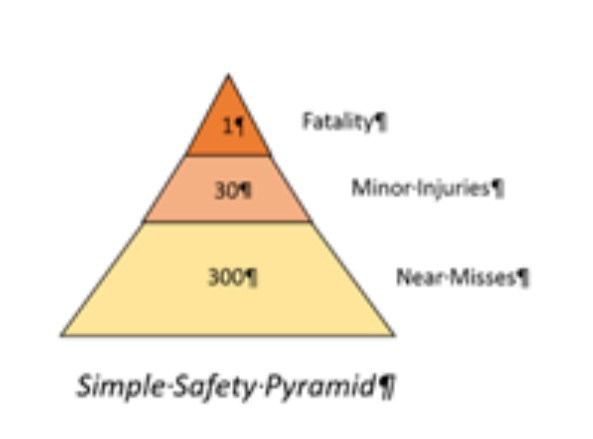
Must Note: An increase in unsafe acts translates into an increased likelihood of fatal outcome.
What Does a Typical Near Miss Look Like in a Workplace?
It's not always easy to spot, but a typical near miss might be something as mundane as a worker almost slipping on a wet floor but managing to catch themselves just in time. Or a forklift narrowly missing a colleague.
Alternatively, it could also involve a piece of malfunctioning equipment that may not have caused any harm yet but is only a single unfortunate moment away from causing irreversible damage.
Take for example, a loose railing on a scaffold. It could potentially lead to a fatal fall even though nothing has happened yet. Similarly, an accidental chemical spill can turn into a catastrophe unless it is contained promptly.
When you add all of these seemingly “unremarkable” incidents up, it's surprising to learn how often near misses go unnoticed. That's why reporting them is critical.
Why We Need to Report Near Misses
Reporting near misses is more than just fulfilling a duty. It's about protecting your workplace.
These close calls serve as a warning sign that something's gone wrong and needs to be fixed.
By reporting them, you give your employers, managers, safety teams, and Joint Health and Safety Committee members a chance to act before someone gets hurt. Inculcating the habit of prompt reporting in your team can prevent accidents, improve safety, and ensure compliance to safety regulations.
What Happens After A Close Call Is Reported?
Reporting close calls can lead to swift action. It allows supervisors to investigate the matter so they can get some answers, figure out what went wrong, and put a plan in place to prevent the recurrence of such incidents.
Regular follow-ups post the implementation of revised safety practices are a good way to know if the new rules have been effective in reducing the number of close calls in the workplace. Some of the actions that can improve workplace safety include mandatory training for all workers specific to their job – whether it is swing stage training, forklift operator training, or anything else.
When Should We Report Near Misses?
The sooner you report near misses, the better. Prompt reporting enables proper investigation and swift action so that fatalities can be averted in time. The idea is to create a safety culture where everyone feels comfortable reporting near misses without the fear of blame or reprisal.
Note: Reporting near misses is part of the Internal Responsibility System (IRS) of a workplace, where every member party shares common responsibility for ensuring workplace safety.
Employers need to make it easy for workers to report near misses by setting up accessible and user-friendly systems. This ensures everybody can do their part to keep the workplace safe.
Some Close-Call Cases to Consider
To understand how serious close calls are and why reporting them is absolutely critical, we have illustrated a few examples below. We hope they will serve as the right kind of inspiration and encouragement workers need to report such cases:
- Last week, an experienced operator almost knocked off a new sales coordinator from their feet by a speeding forklift with a raised load in the warehouse. Luckily, neither person nor property was damaged, but it was a close call.
- A lone worker in the production area of a local factory had a scary encounter with an intruder who walked into the building. The door had been propped open to let a breeze in on a hot day. Fortunately, the security camera picked up the event, and the office manager was able to escort the intruder out of the building without incident.
- A swing stage operator lost their grip while carrying out window repair tasks and dropped some caulking guns, just missing pedestrians walking on the path below.
- A residential roofer turned up to work in a hurry and forgot to carry his CSA-approved boots. He ended up taking the risk of not wearing them, using his old hiking boots instead. This caused him to almost fall off the extension ladder when his foot slipped, making him lose his balance and nearly toppling him to the ground.
- A worker found that a large food mixer was still turned on even though it had a "Do Not Operate" tag on it, which could have led to a major mishap.
- A worker had a terrifying experience struggling to light a propane torch on a construction project. They heard a whoosh sound when the fuel suddenly ignited, but they somehow managed to avoid getting burnt when the flame came close to their face.
These are just a few examples of the kind of close calls that can happen in the workplace. Reporting near misses lets the management take the necessary steps to prevent them from happening again, thus ensuring everyone’s safety.
Taking A Step In The Direction Of Workplace Safety
Investigating the root cause of a close call is crucial. It can reveal the starting point that sets the whole chain of events in motion leading up to the said close call.
Once you've wrapped up your analysis and figured out the root cause, your employer needs to take steps to prevent a recurrence, thus avoiding serious harm.
Some effective safety improvements managers and employers can make in the workplace include:
- Creating a system in which all close calls and near misses are reported right away
- Making sure procedures are standardized, and they cover the basics of safety, like keeping equipment secure and using lockout devices to cut off electrical power
- Making sure the subject matter of your safety talks is actually relevant to the situation, i.e., the actual close call
- Refreshing and recalibrating internal safety programs based on actual cases in the workplace
We recommend enrolling your employees in key training programs such as competent supervisor training, working at heights training, swing stage training, WHMIS training, forklift operator training, lockout tagout training, and propane training, among others, to improve workplace safety standards.
Conclusion
By effectively managing close calls and near misses, workplaces can enhance safety, protect employees, and foster a real culture of safety that puts preventing accidents first over simply reacting to them.
Looking for courses that help you foster a culture of true safety? Act First Safety provides numerous CPO-certified instructor-led programs in Ontario. Employers get the option to club several safety training programs together at our Scarborough facility, which is conveniently located off Highway 401. Contact us to check available courses and their dates.
FAQs
Are employers legally required to document near misses in Ontario?
No. However, documenting them internally is strongly recommended by the OHSA as it ensures due diligence and enforcement of relevant safety practices in the workplace.
What is the difference between a near miss and a hazard?
A near miss is an event where a potential hazard could have caused a serious injury or fatality but didn’t; whereas a hazard is a potentially harmful condition.
Can technology help improve near miss reporting?
Yes. Digital reporting tools, mobile apps, and safety management systems can be instrumental in logging near misses, providing valuable insights into their trends and other relevant analytics.