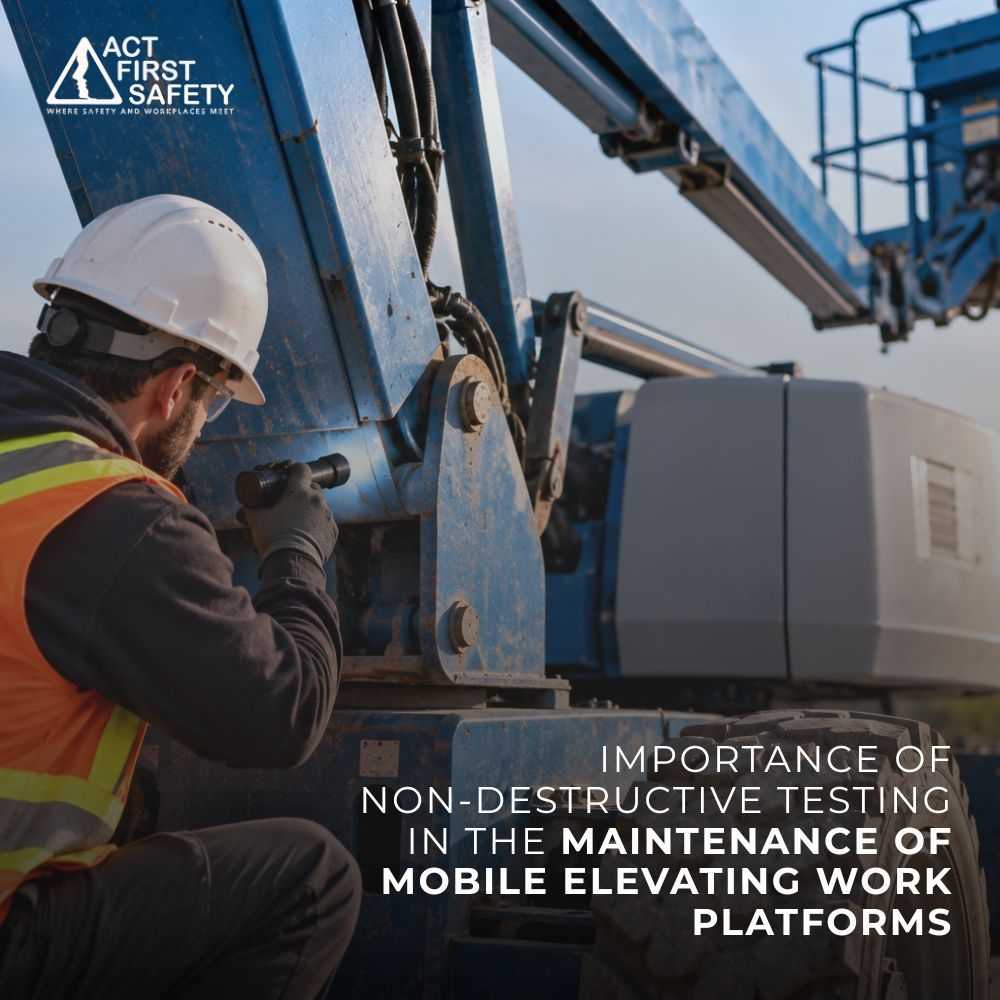
A common sight on construction projects and industrial environments, mobile elevating work platforms (or MEWPs) are used to lift workers and materials. This allows work to be performed in otherwise inaccessible areas, ensuring enhanced workplace productivity.
However, the convenience of being able to work at heights comes with the added responsibility of maintaining safety.
While daily inspections play an important role in the safe operation of MEWPs, it is important to ensure these inspections are compliant with both manufacturer instructions and CSA-recommended standards.
This means any additional inspections – including annual inspections performed by qualified service technicians and special inspections like non-destructive testing conducted by certified NDT technicians or inspectors – must be compliant.
That said, today’s blog from Act First Safety, the go-to safety training provider for Ontario workers, will focus primarily on non-destructive testing for MEWPs, highlighting what it is and why it should be done. Let’s begin!
What is a Non-Destructive Test?
A Non-Destructive Test (NDT) is a material testing method that evaluates the condition of materials without causing damage. It allows the inspector to find otherwise invisible damage, helping the owner of the equipment to know if it is safe and if any repairs are needed to keep it in service.
Non-destructive testing in Canada is managed by the Ministry of Natural Resources Canada which sets the requirements for certification and publishes a directory of individuals certified to perform different kinds of testing.
While NDT has a set standard, It is important to ensure any testing is performed by a certified technician or tester only. As for NDT, the Canadian standard responsible for its certification explicitly states, “the effectiveness of any application of non-destructive testing depends upon the capabilities of the persons who perform or are responsible for the test.”
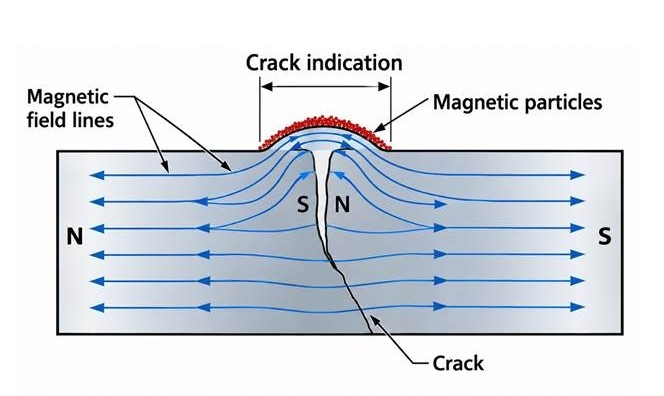
For equipment like MEWPs, magnetic particle inspection (or MPI) is the type of NDT most commonly practiced. This testing method detects surface and near-surface flaws in magnetic materials.
Because the main structural components of a MEWP are made of steel, MPI is an ideal testing method for it. Hired technicians or inspectors use a magnetic field generator that generates AC or DC currents to detect damage. An iron powder might be applied on the machine for the purpose of inspection. As the current flows through the metal, it will accumulate around flaws, thus showing exactly where invisible defects lie.
When Are Non-Destructive Tests Needed?
Non-destructive testing is used to identify flaws in structural components of a MEWP and should be conducted any time its structural integrity is in question. For example, any incidents, malfunctions or faults involving the MEWP warrant an inspection.
The CAN/CSA – B354.7:17 Standard for Mobile Elevating Work Platforms – Safety Principles, Inspection, Maintenance and Operation indicates that a special inspection is a must to verify the structural integrity of the MEWP and that it must be performed under the following circumstances:
- Ten years after the date of manufacture and every 5 years thereafter
- After a change of ownership, unless a complete service history is provided including maintenance and inspection records
- After any suspected damage, potential damage, or actual damage is sustained during an incident that could potentially affect the structural integrity of the MEWP, including:
o Electrical contact
o Shock loads
o Fall arrest
o Collision
o Overstressing
o Stability failure
The technician or inspector conducting this inspection must take into consideration the age and hours of operation accumulated on the MEWP as well as any previous maintenance and inspections conducted on it.
How Is Non-Destructive Testing Performed?
To perform the test, the equipment must be free of grease and may need to have paint and corrosion removed on critical components to allow for a complete and thorough inspection.
MEWPS that are heavily corroded will likely fail the inspection as a thick layer of rust makes it difficult to properly perform the test and in itself signals that the structural integrity of the machine is already compromised.
Other things that may be included in this special inspection are a thorough visual inspection of the machine, weld test and stability testing. The inspector or technician will prepare a detailed report of their findings upon completion and will place an inspection decal on the equipment with the serial number of the unit, who conducted the inspection, the date it was conducted, and when the next inspection is due.
Why Perform Non-Destructive Testing?
Mobile elevating work platforms are engineered to provide a safe way to work at heights. Each unit is inspected by an engineer and issued an engineering certificate with the engineer’s seal on it to ensure it continues to be safe for operation.
Furthermore, this proof of inspection shows that the MEWP met the requirements of the CSA standard to which it was designed prior to transference of ownership.
However, once the equipment ‘leaves the lot’ so to speak, the manufacturer has no control over its maintenance. Therefore, to ensure the equipment is maintained and safe to use throughout its lifespan, its owner must follow inspection protocols mentioned in the manufacturer’s manual.
When owners fail to properly maintain equipment, preventable tragedies can occur. Let us illustrate what we mean with the help of a tragic but critical example:
On June 20th 2012 two workers in Glasgow were on the platform of a MEWP when the boom suddenly failed and they plunged 28 metres (92 feet) to the ground resulting in the death of one of the workers and life-altering injuries to the other. The MEWP was rented from a company that had purchased it from a bank that was liquidating the assets of the original owner.
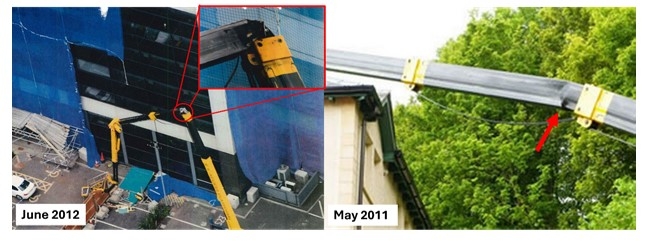
While in service with the previous owner, the MEWP had developed a faulty boom. The original owner had contracted for the boom to be repaired but dissolved due to financial difficulties before the repair was completed.
The new owner put the boom lift into service despite the fault in the boom. In May 2011 the boom suddenly bent causing it to drop and injure the worker on the platform. The rental company then contracted the services of a repair company to fix the faulty boom.
The investigation found that the repair had not been completed as required by the manufacturer and that the repair company previously hired had failed to perform an adequate thorough investigation of the platform.
It also found that the boom had multiple defects that had not been addressed by the owner, showing a lack of proactive maintenance. Both the rental company and the repair company were fined for their role in the incident and both were dissolved due to the cost of the fines.
Had both companies followed manufacturer’s instructions and exercised due diligence in their responsibilities towards the maintenance and repair of the MEWP in question, the incident that claimed the life of a worker, severely injured another, and led to the dissolution of both companies would have been prevented.
Key Takeaways
Incidents like the one mentioned above show the importance of proper maintenance and repair of mobile elevating work platforms. Owners, supervisors and operators must ensure inspections and equipment maintenance according to the manufacturer’s instructions. This applies to routine daily inspections, scheduled annual inspections, and special inspections such as non-destructive testing.
It also highlights the importance of training. Crew members who have received working at heights training or aerial lift training understand the importance of daily checks before deploying MEWPs. Meanwhile, programs such as JHSC training ensure workers are adequately represented in an organization and that their safety is accounted for.
Conclusion
Wherever workers are involved, safety should be the top-most priority by default. Checks like NDT can help MEWP owners assess the safety of their machines. However, such specialized tests are not alternatives to daily inspections and worker training, both of which are a must for safe operations.
Act First Safety is one of Ontario's most trusted providers of CPO-approved worker safety training programs. Our courses can be taken at our state-of-the-art Scarborough facility, which is conveniently located off Highway 401, or at your premises. Contact us to learn how we can help you build a safer work environment for your employees.
FAQs
What role do MEWP operators play in equipment inspections?
MEWP operators must ensure that daily inspections are completed as required in the manufacturer’s manual. The MEWP operator themselves can perform these inspections or by a competent person designated by their company. Such inspections must, at least, be conducted before the platform is used for the first time in the shift.
While both annual and special inspections are arranged for by the employer, operators must check their machine’s inspection decals to ensure it is safe for use.
They also have a right to see the records of these inspections if they have any questions or concerns. If the inspections are past their due date, operators also have the right to request that they be completed before work begins. Until then, they have the right to refuse unsafe work.
Who is responsible for annual and special inspections of rental equipment?
It is the responsibility of the owner or the rental company concerned, unless the rental or lease agreement transfers the responsibility to the renter or lessee of the equipment for its maintenance.
What to do if a MEWP fails a non-destructive test?
That will depend on the overall condition of the MEWP and how much owners are willing to spend on repairs. A lift that fails may only need minor repairs. However, it could also be in a state where repair outweighs the value of the MEWP. If repairs are performed, the machine concerned must be subject to another NDT post-repair, which it should pass before it can be put into service.