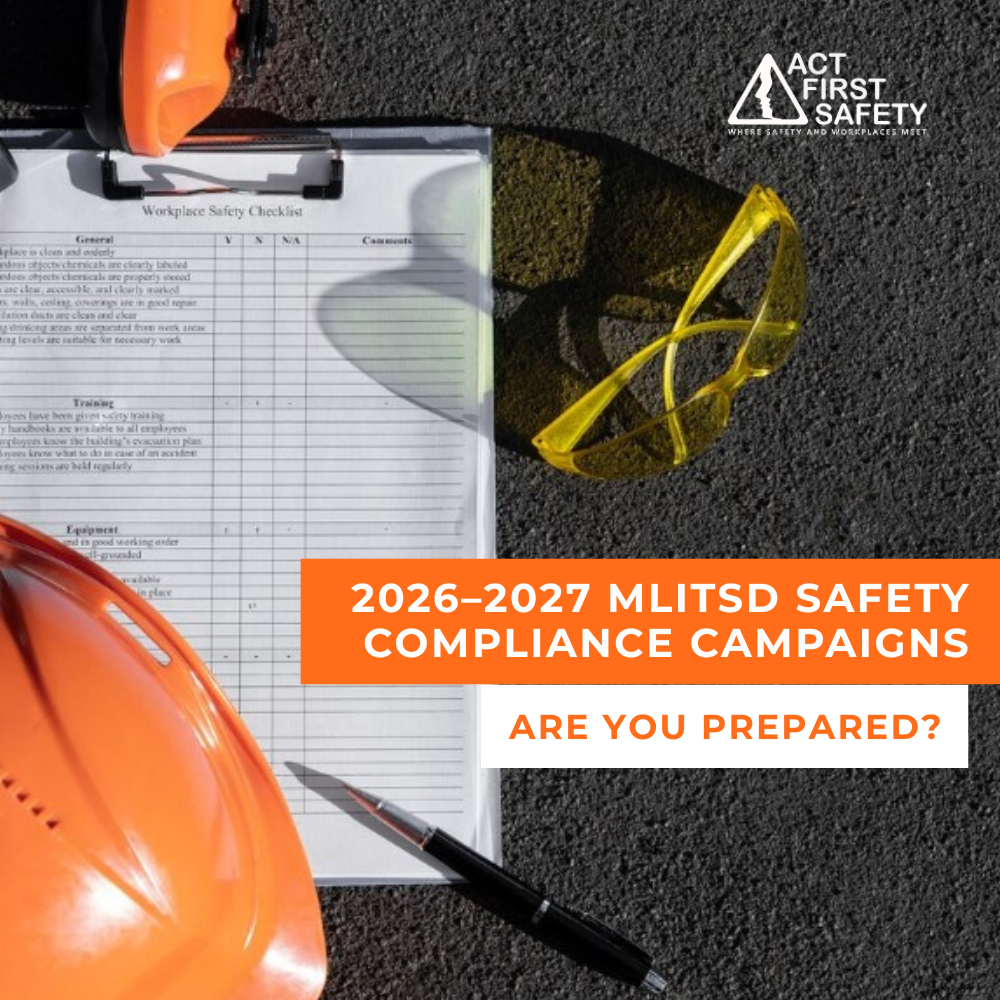
Running a business in Ontario comes with many responsibilities, and for good reason. You never know when an inspector from the Ministry of Labour, Immigration, Training and Skills Development (MLITSD) might show up at your doorstep to review your workplace and ensure health and safety standards are being met. Especially now since the 2026-27 campaign is already underway.
However, being prepared is what separates the good from the great. Knowing what the MLITSD is focusing on this year can give you a real leg up on creating a safe workplace. While one of the ways to do that is to opt for genuine safety courses, the other way is to understand why safety campaigns exist in the first place.
In today’s blog, Act First Safety – providers of Ontario-specific safety training programs will explain how these campaigns ensure workplaces are not putting their workers at risk, and why preparing for them is a must.
The Importance of The 2026-27 MLITSD Safety Compliance Campaigns
It's tough to stay on top of everything when you're running a business. Between day-to-day challenges and keeping safety at the forefront of everything you do, it can be a real balancing act.
That’s where safety compliance campaigns can help. By keeping employers up to speed on their responsibilities and raising awareness of workplace hazards, they ensure that everyone goes home safe at the end of the day.
Every year, the MLITSD puts out a list of compliance initiatives focused on specific workplace hazards and topics. These initiatives typically feature the following format:
- Awareness campaigns: These are all about education and outreach - giving you and your team the knowledge and tools you need to stay safe
- Focused inspections: As a part of this, safety inspectors come in and take a closer look at your workplace to make sure you're meeting your safety obligations
The ultimate goal is to protect workers' rights under the Occupational Health and Safety Act (OHSA) and the Employment Standards Act (ESA). The program has also been designed to help employers understand what they need to do to keep their workers safe.
What to Expect From The 2026/2027 MLITSD Safety Campaign
From April 1st, 2026, to March 31st, 2027, the MLITSD is giving extra attention to the following areas:
- MSD or musculoskeletal disorder prevention in the retail sector
- Noise pollution
- Hazards in retail
- Farming & Agriculture
Each campaign will help employers identify specific hazards in their sector, thus giving businesses a heads up on where inspectors might be focusing their attention during a safety check.
We strongly recommend maintaining compliance with the rules and regulations mentioned in the Occupational Health and Safety Act (OHSA), as inspectors will be on the lookout for them despite having a focused agenda.
Also, if your business operates in one of the identified sectors mentioned here, you need to know that inspectors are highly likely to take a closer look at certain hazards or additional compliance issues while visiting your site. You must meet the minimum legal compliance requirements pertaining to your sector.
For example, if your industry requires certified forklift operators or MEWP operators, you must have members on board who have taken valid forklift operator training or working at heights training.
Breakdown of The Individual Campaigns of The 2026-27 MLITSD Compliance Program
Let us help you prepare for what’s in store with a detailed breakdown of each of the core campaigns that are a part of this year’s program:
MSD Prevention in the Retail Sector Campaign
Musculoskeletal Disorders (MSDs) have been a major focus for the MLITSD in other sectors, too. Unfortunately, these injuries are still far too common.
Affecting muscles, nerves, tendons, ligaments, joints, cartilage, and spinal discs, an MSD can present itself as a sore back, stiff neck, or cramped hand. It’s often caused by overexertion or repetitive tasks that push your body to its limits.
It's a complicated issue to solve since factors like overall worker health, the way the work is set up, and the equipment used can all play a role. That is why one of the areas inspectors focus on is how materials are moved around in a typical day, all the way from received shipments to final delivery. This gives them an idea of what might be going wrong and how it can be improved to prevent MSDs.
Some specific things inspectors might focus on include:
- MSD prevention
- Stuck-by hazards
- Falls from ladders related to manual storage and retrieval
They might also verify if your crew has received forklift training, ladder training, and manual material handling training. The equipment used to move materials will be checked as well.
Noise Campaign
This year, inspectors are focused on reducing noise-related hazards in workplaces where there's a risk of hearing damage. Their goal is to prevent noise-induced hearing loss and make sure that workplaces have the right hazard controls in place.
They are likely to check how workplaces identify, assess, and manage noise hazards.
Retail Campaign
The inspections in retail workplaces are all about raising awareness of common hazards and promoting safe work practices. The goal is to:
- Improve understanding of OHSA requirements
- Help prevent injuries and illnesses related to everyday work activities
- Raise awareness of common retail hazards
- Support workplace parties in meeting their health and safety responsibilities
- Connect employers with health and safety partners for extra support
Some common focus areas for hazard prevention in the retail sector include housekeeping, ladder safety, WHMIS, workplace violence prevention, forklift training, and pallet truck training.
Farming & Agriculture Campaign
Inspector visits to farming and agricultural workplaces are all about raising awareness of high-risk activities and promoting safer work practices in a sector where serious injuries are still a major problem.
Inspectors may pay closer attention to:
- Safe use and maintenance of farming equipment, including tractors and forklifts
- Machine guarding
- Falls from heights, including falls from equipment and other structures
- Electrical hazards and Lock-out/Tag-out
- High-risk activities like tree removal and logging on farms
- Heat stress and prevention measures
- Worker training and awareness
Other Focus Areas of The Campaign
On top of the new compliance campaigns kicking off from the 1st of April, 2026 and listed elsewhere, high-risk industries such as manufacturing and construction continue to gather the spotlight as their everyday activities involve material handling, machine guards, fall protection, working at heights and other occupational health hazards. Here’s a list of campaigns concerning the same that will continue well into 2027:
- Construction Sector (2025-2026 & 2027): Working at heights, scaffolding, ladder safety and excavation will undergo a thorough review, with fall protection, PPE and worker training getting special attention.
- Industrial Sector (2025-2026 & 2027): Inspectors will be examining machine guarding, lockout procedures, material handling (cranes/lifting gear) and warehouse storage to determine safety levels.
- Healthcare Sector: Continuing efforts and specialized inspections will center on workplace violence prevention.
- Mining Sector: Slip, trip and fall hazards will be the priority safety areas for this industry.
Establishing a Culture of Continuous Improvement
Rather than treating these inspections as a one-off thing or a compliance box to tick, employers should really try to see them as a chance to make sure health and safety are at the top of their list all the time.
Being inspection-ready goes beyond having all documents in place. It’s about investing in ongoing safety training, conducting regular internal safety audits, and proactively identifying and dealing with hazards.
By building a culture of continuous improvement, you won’t just be ticking the compliance box, but actually really making your workplace safer and more resilient for the long haul.
Part of that involves regularly training your team to ensure they perform their jobs safely. Act First Safety provides CPO-approved training programs that diligently follow the standards set by the MLITSD. In fact, our Scarborough facility, located off Highway 401, is the perfect place to get hands-on training in a wide variety of courses. Contact us to learn more.
FAQs
How often do MLITSD inspections occur during a campaign?
The frequency of these inspections varies based on the industry, risk factor, and previous compliance record of a company. Each of these visits happens unannounced at any time of the day.
What documents do employers need to provide for an MLITSD inspection?
Employers need to furnish documents pertaining to company safety policies, training records, hazard assessments, equipment logs, and incident reports, among others.
Are small businesses exempt from MLITSD campaigns?
No. All businesses come under the purview of this, irrespective of their scale.