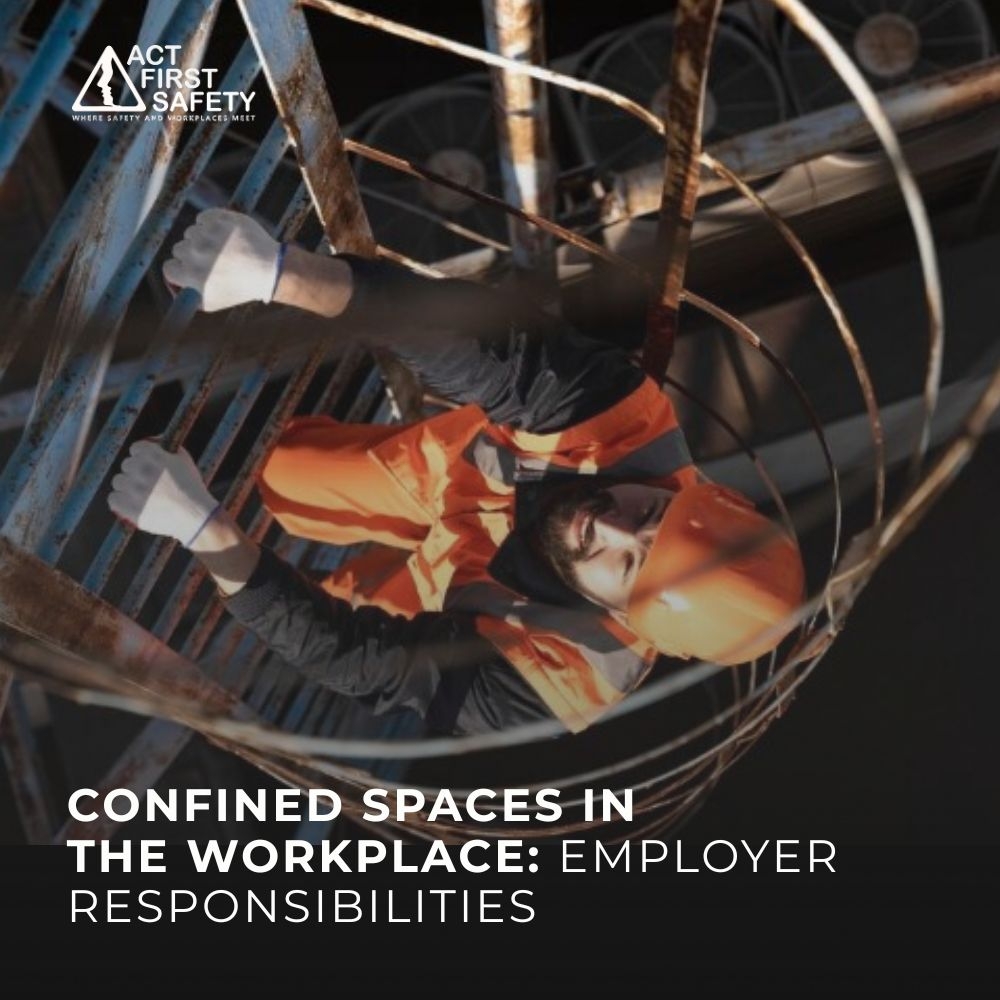
Many Ontario employers have workers regularly working in confined spaces and may be uncertain about their responsibilities when it comes to protecting the mental health, wellbeing, and safety of their crews.
Confined spaces can harbor a number of potentially deadly hazards, so it’s important for employers to understand how to properly manage such working conditions.
In today’s blog, Act First Safety, providers of training programs geared towards getting Ontario workers home safe, will explain what employers can do to ensure confined spaces are safe for their crews to work in.
How Is Confined Space Defined By The OHSA?
The concept of confined spaces is extensively covered by Ontario regulations and it is broadly defined as follows:
Ontario Regulation 632/05 Confined Spaces defines a confined space as a fully or partially enclosed space that is not both designed and constructed for continuous human occupancy, and in which an atmospheric hazard may occur.
An atmospheric hazard could occur because of the construction of the space, its location, contents, or because of the work that is occurring inside the said confined space or even near it. To determine whether or not your workplace qualifies as a confined space, ask yourself the following questions:
1) Are there any fully or partially enclosed spaces on your premises?
These spaces could be silos, vessels, bins, hoppers, sewers, and vaults, to name a few. They may be used to store material, be part of a manufacturing process, or be part of the basic infrastructure of the workplace.
As for entrances, they may have only one entrance or multiple entrances depending on their structure. They could also be large enough for one person to enter or expansive enough to occupy significant portions of a structure. While there is no maximum size for a confined space, it must be large enough for at least one worker to enter.
2) Are these spaces neither designed nor constructed for human occupancy?
Was the space built according to the Ontario Building Code, Ontario Fire Code, or the CSA Mechanical Refrigeration Code? Is it well lit? Ventilated? Honest answers to these questions will help you correctly determine whether a space has been expressly designed and constructed for continuous occupancy.
Some spaces may be obviously intended for continuous human occupancy, like a mall, office building, or home. Other spaces may be less obvious, like trenches, tunneling operations, or mines, which are designed and constructed in such a way that people can carry out work within them but cannot comfortably stay in there for prolonged periods.
Though constructed to meet the requirements of the applicable regulations, they are still not the safest places to work in and require appropriate training, such as confined space training, before workers are allowed in there.
3) Can an atmospheric hazard occur inside this space?
Atmospheric hazards are any hazard that affects air quality. They can be gases, vapors, fumes, dust, or mists. These airborne contaminants can cause acute health effects, such as coughing, dizziness, or loss of consciousness, which may impair a person's ability to escape the confined space, leading to a potentially fatal situation.
Some atmospheric hazards may pose a fire or explosion risk, including an excess of oxygen. Managing oxygen levels inside a confined space is critical to the safety and health of those inside. Ontario’s regulations consider oxygen levels between 19.5% and 23% by volume to be acceptable.
These hazards might be a normal part of a confined space, or a byproduct of a process or chemical reaction or biological activity, or be created by the work that takes place inside such a space.
Because certain hazards are a side-effect of a specific task, spaces containing them may be temporarily categorized as confined spaces. A job hazard analysis is required to determine if the space is a confined space during said job.
Employer Responsibilities With Respect To Confined Spaces
For any workplace that contains a confined space that employees might enter, the employer is required to establish a confined space program complying with Ontario's regulatory standards.
Even when hiring contractors to carry out work in confined spaces, employers/owners are still required to have a program in place and to ensure that everybody present follows its provisions diligently.
That said, when an employer acts as a hired contractor, they might have an independent confined space program; nevertheless, they are obligated to follow both the regulations and the program established by the employer who owns the space.
Keep in mind that nothing prevents an employer from implementing measures and procedures that go above and beyond the requirements of the program or the regulations.
Regardless of the situation, all employers are required to take every precaution reasonable in the circumstances for the protection of their workers. That might involve hiring a supervisor with competent supervisor training, or having a JHSC member with proper JHSC training present onsite.
If the confined space is located in a federally regulated workplace, employers can contact the Ministry of Immigration, Training and Skills Development for clarification about applicable rules and regulations as the jurisdiction under which the space falls might vary on a case-by-case basis.
However, provincially regulated employers, supervisors and workers are still generally expected to comply with the Ontario Occupational Health and Safety Act while working on federal job sites.
How To Develop A Confined Space Program
A confined space program is a document created by the employer that contains applicable measures and procedures for working in confined spaces present within the employer’s workplace.
This program is maintained in consultation with the Joint Health and Safety Committee (JHSC) or worker health and safety representative, if any. This program may apply to one or more confined spaces and must include the following:
- A method for recognizing each confined space to which the program applies
- A method for assessing the hazards to which workers may be exposed to in accordance with the O. Reg. 632/05 – Confined Spaces Section 6
- A method for development of one or more plans in accordance with the O. Reg. 632/05 – Confined Spaces Section 7
- A method for the training of workers in a workplace that is not a construction project in accordance with O. Reg. 632/05 – Confined Spaces Section 8, or in the case of a workplace that is a construction project in accordance with Section 9.1 of the same
- An entry permit system that sets out the measures and procedures to be followed when work is to be performed in a confined space to which the program applies
The employer must provide a copy of the program to the Joint Health and Safety Committee (JHSC) or worker health and safety representative.
If the work is part of a broader construction project, the employer will have to provide a copy of the program to the constructor of the project who will, in turn, provide another copy of it to the project’s Joint Health and Safety Committee (JHSC) or health and safety representative, if any.
What To Do In Case Of Multi-Employer Jobs In Confined Spaces
Multiple employers may be involved in a confined space job. When this occurs, the lead employer of the job or the constructor (if it is a project) must develop a coordination document to ensure that the duties imposed on employers by the regulations for confined spaces are performed.
This coordination document applies to any employer of workers who will enter the concerned confined space or perform related tasks that directly support the work within the bounds of the said confined space.
The goal of this document is to protect the health and safety of workers and to prevent duplication or confusion with regard to requirements like assessments, the plan itself, and entry permits.
Regardless of how tasks are shared, all employers are still required to carry out their duties under the Occupational Health and Safety Act (OHSA) and ensure that work is done in compliance with the regulations for confined spaces.
The following should be considered as essential requirements to ensure proper coordination among multiple employers:
- A well-developed confined space program
- Hazard assessment
- Written plan
- Plan-specific training
- Entry permits
- Written rescue procedures
- Rescue equipment
- Mutually established methods of communication
- Isolation of energy procedures (Lock Out Tag Out)
- Attendants
- Entering and exiting strategies
- Unauthorized entry rules
- Atmospheric testing results
- List of recognized explosive and flammable substances
- Ventilation and purging strategies for atmospheric hazards
These will ensure that all workers involved in the job, regardless of their employer, follow the same plan and receive the information and site-specific training they need to satisfy their right to know and comply with the training requirements of the provincial confined space regulation such as O. Reg. 632/05 – Confined Spaces in Ontario.
Requirements that are not shared and remain the responsibilities of each employer alone with respect to their own workers are general training, confined space training, personal protective equipment, and record keeping.
The lead employer or the constructor must ensure that all present employers should produce safety training records of their crews to maintain compliance with the overall plan and program that applies to a particular confined space job. This will include confined space training and possibly confined space rescue training.
Conclusion
Confined space work can be particularly hazardous, but with proper planning, preparation, and confined space training, the health and safety of workers can be protected. It all starts with employers understanding and performing their duties under the Occupational Health and Safety Act and its Regulations, including O. Reg. 632/05 – Confined Spaces.
Safety training for the crews involved is the next step, and we can help you with that. Act First Safety provides comprehensive, practical and compliant safety training programs in Ontario, including critical certifications such as JHSC training, confined space training and more. Contact us to learn more about our courses to take multiple of them at once at our conveniently located facility in Scarborough, off Highway 401.
FAQs
Why is confined space training important?
Confined space training is vital for ensuring worker safety by enabling the effective management of hazardous atmospheric conditions and potential risks, maintaining regulatory compliance with standards like O. Reg. 632/05, and equipping personnel—including entrants, attendants, and supervisors—with the necessary skills to prevent accidents and execute critical emergency procedures.
Are attendants required to be included in confined spaces training?
In Ontario, the requirement for safety training is based on a worker's duties, not simply whether they enter the confined space. Under the confined space regulations, any worker who has responsibilities under the employer's confined space program—including attendants, supervisors, entrants, and rescuers—must receive adequate instruction and training to perform those duties safely.