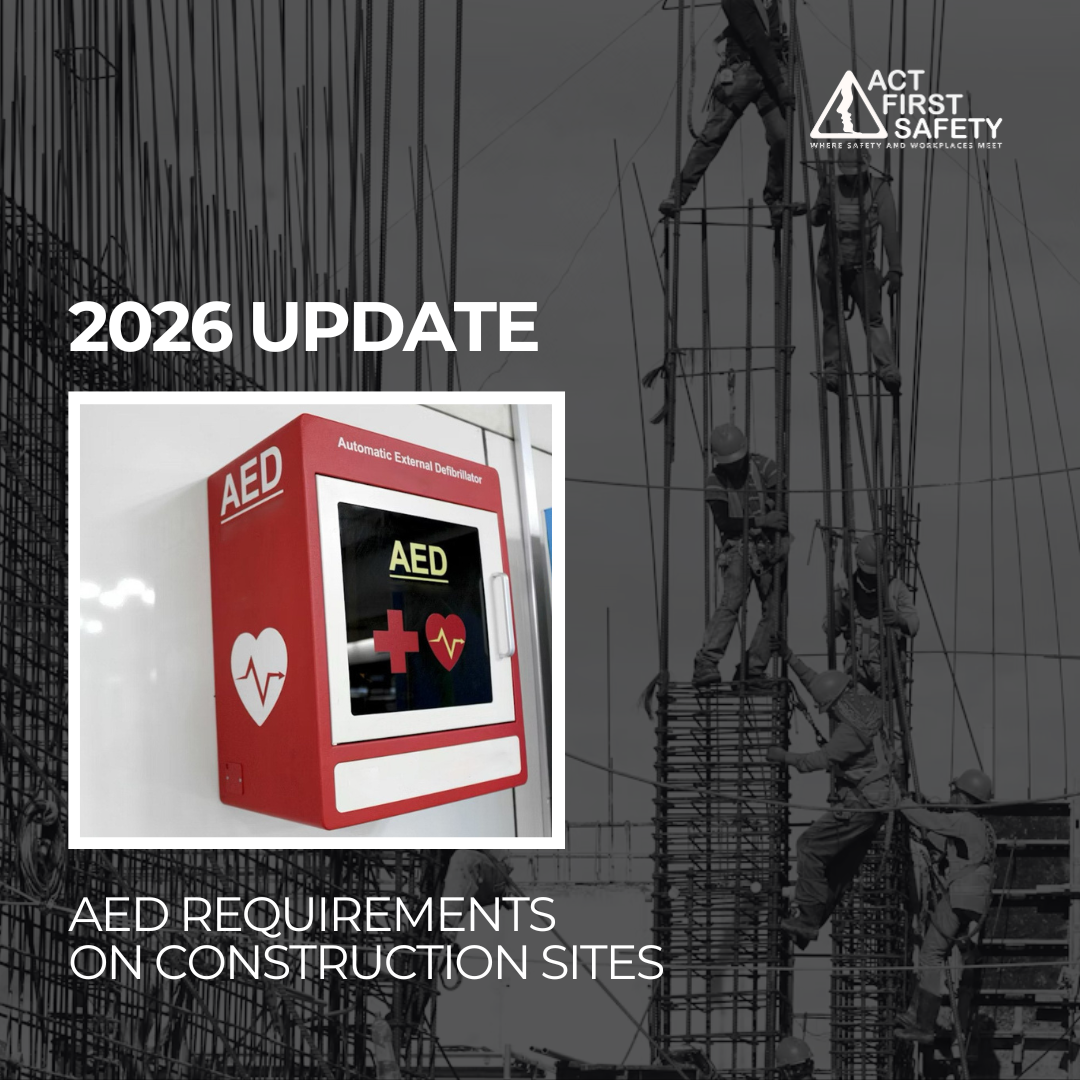
As of January 1, 2026, AEDs or automated external defibrillators will be required on construction sites in Ontario under a new regulation, O. Reg. 157/25, which amends Ontario Regulation 213/91.
This move has been made to reduce instances of workplace fatality by providing emergency services at the exact time and place they are needed the most – on construction sites. This is especially useful in the winter season, as construction can be a challenging activity at this time of the year.
In this article, Act First Safety, the top provider of certified workplace safety courses in Ontario, will tell you everything you need to know about it and how to prepare for this change.
Who is impacted by the 2026 AED update?
Employers that fall under the definition as specified in O. Reg. 213/91 are the primary people who will be affected by the revised 2026 AED update.
As per this regulation, ongoing CONSTRUCTION PROJECTS in Ontario that have a duration of over 3 months and employ over 20 workers regularly at the worksite must provide defibrillators onsite. You must fulfil both criteria to be considered eligible.
What is the purpose of having AEDs on construction sites?
AEDs are life-saving devices designed to treat sudden cardiac arrest, a condition where the heart stops beating effectively. In these emergencies, immediate CPR combined with defibrillation greatly increases the chances of survival. AEDs analyze the heart’s rhythm and if necessary, deliver an electric shock to restore a normal heartbeat. This process, called defibrillation, can be the difference between life and death.
Why are AEDs important on construction sites?
In Canada, AEDs have already saved countless lives by allowing bystanders and workers to provide timely aid before emergency medical services arrive at the worksite. This is especially important on construction sites where there is a lot of activity, obstacles, moving equipment, and pedestrians that can impede the fastest response. Remember, every second counts in these critical situations, so an immediate first aid response is a must.
Why is AED mandatory on construction sites now?
Though first aid has always been a given on construction sites, little attention has been paid to emergency response. However, with growing concerns and reports of workplace mishaps, safety associations and other key stakeholders realized that the construction industry was at a higher risk of critical emergencies. In fact, controlling outcomes of such situations is more difficult on such sites due to their usually crowded nature and limited access.
That’s why AEDs will be mandatory on Ontario construction sites now. Consider it as a recognition that these high-risk workplaces often lack immediate access to emergency cardiovascular care, which can be fatal.
Construction sites are dynamic environments where workers may be exposed to physical stress, increasing the risk of cardiac events. Having AEDs on site ensures that prompt, high-quality CPR and defibrillation can be performed, improving survival chances during cardiac emergencies.
Who can use AEDs?
AEDs are designed for anyone, including laypersons. They require minimal training. When someone has sudden cardiac arrest, indicated by unresponsiveness and lack of normal breathing, the protocol is to start CPR and get an AED as soon as possible.
The good thing about an AED is that it provides clear voice prompts and visual instructions to guide the user through the process, including applying electrode pads and delivering shocks if needed.
Having AEDs on-site is invaluable in saving lives. However, being familiar with the device beforehand via first-aid training would give you the confidence you need to use the machine.
Looking for other workplace safety courses suitable for construction sites? We provide a ton of valuable certified programs such as JHSC training, working at heights training, and more.
How do AEDs work?
An AED is a portable device that analyzes the heart’s rhythm through electrode pads on the patient’s chest. If the device detects a shockable rhythm, it will tell the user to deliver a shock to restore the heart’s normal function. It’s simple and designed to be used by people without any formal AED training.
When to use an AED?
Knowing when to use an AED is key. Premature use is strongly discouraged.
Before you use the machine, check for signs of sudden cardiac arrest. The major symptom is sudden collapse along with unresponsiveness and irregular breathing.
If you notice these signs, start CPR immediately and focus on administering chest compressions to keep the blood flowing to vital organs. At the same time, get the AED and apply it as soon as possible. Don’t worry about training. As mentioned before, the device will guide you through each step, including when to pause compressions for rhythm analysis and shock delivery.
That said, AEDs, though user-friendly, still require basic training to ensure you can use them confidently and effectively. Training courses often combine CPR and AED use, teaching essential skills such as maintaining the correct compression rate and depth during chest compressions and safely applying AED pads. Both regular CPR (which includes rescue breaths) and compression-only CPR are taught, with hands-only CPR recommended for untrained bystanders to get aid as soon as possible.
Do you need to be trained in AED use?
Whether you are a construction worker or a supervisor, being formally trained to use AEDs is not mandatory, but it is highly recommended.
However, the new legislation states that a worker who is trained in cardiopulmonary resuscitation and defibrillator operation needs to be present, so it makes sense to get official training beforehand.
First-aid training courses should include this in their curriculum. This will be enough to equip individuals with the knowledge and skills to perform CPR and use an AED correctly.
The good news is that in June 2026, in Ontario, all first-aid courses will cover basic life support techniques, including how to recognize cardiac arrest, perform high-quality chest compressions, and operate the automated external defibrillator safely in accordance with CSA Z1210:24 First-Aid training for the workplace.
More specifically, AED training will also familiarize you with the device’s features, such as electrode pad placement, voice prompts, and how to provide feedback during resuscitation efforts.
For workplaces, especially construction sites, making sure workers and members of the emergency response team get regular first-aid training is crucial. This preparedness increases the chances of successful resuscitation and can save more lives by reducing the time to defibrillation.
Signage and labelling instructions for AEDs
The location of the defibrillator should be clearly indicated by posting signs that meet the requirements of subsection (6) of the O. Reg. 213/91. Any signage put up should be near the defibrillator and at other locations throughout the project, with clear information indicating its location. Additionally, the legislation also specifies clearly labelling defibrillators with a graphic symbol that must include:
- A heart containing a lightning bolt
- A label with “Automated External Defibrillator” or “AED” on it, or
- A label with “Défibrillateur externe automatisé” or “DEA”
AED: Mandatory accessories
Along with the AED itself, the legislation requires the following additional products to be maintained and replenished as needed:
- One cardiopulmonary resuscitation mask
- One pair of scissors
- Two pairs of disposable medical-grade gloves
- One disposable razor
- One garbage bag
- Four absorbent towels
The defibrillator and the above items should be stored in a suitable place where they can be kept together and accessed easily in case of emergencies.
Where to place AEDs on a construction site?
Proper placement of AEDs on construction sites is key to maximizing their availability during emergencies. AEDs should be placed in visible and easily accessible locations where workers congregate or pass through, such as near main entrances, break areas, or site offices. Clear signage indicating the AED’s location helps responders find the device quickly in an emergency.
Considering the size and layout of the site, multiple AEDs may be required to ensure no area is too far from a defibrillator. Since construction sites are often large and spread out, having AEDs within a few minutes' reach of any worker can make a big difference in survival rates. Also, the devices should be housed in weather-resistant cabinets to protect them from environmental factors like dust, moisture, direct sunlight, extreme temperatures, and other substances that could affect the defibrillator or its accessories.
Who is responsible for AEDs on a construction site?
The management and maintenance of AEDs on construction sites is a critical responsibility of the workplace safety officer or designated first-aid coordinator. They must perform regular inspections of the device and its accessories to check its battery life, electrode pad condition, device functionality, and ensure that all accessories are accounted for.
Furthermore, the legislation surrounding the use of AEDs mandates the full inspection of equipment every 3 months by a competent worker in accordance with the manufacturer’s instructions. A record of the inspections performed shall be kept with the defibrillator. The inspections shall be recorded to include:
- Date of inspection
- The name and signature of the worker who conducted the inspection
The responsibility of employers in providing AEDs on-site
Employers have a legal and moral responsibility to provide AEDs on construction sites and ensure their proper maintenance. This includes training workers, establishing emergency response protocols, and coordinating with emergency medical services. Proper documentation of maintenance checks and training sessions helps demonstrate compliance with workplace safety regulations. Any incidents in which the AED is used must also be recorded.
Conclusion
In summary, the introduction of mandatory AEDs on construction sites in 2026 is a commitment to workplace safety and saving lives. By understanding AEDs, proper training, strategic placement, signage, and regular maintenance, construction sites can be better prepared to respond to cardiac emergencies. This proactive approach empowers workers and first aiders to perform high-quality CPR and defibrillation, and increase survival rates to create a safer work environment.
That said, safety on construction sites is not simply restricted to the provision and proper use of AEDs. It encompasses other forms of safety training as well – be it working at heights training, JHSC training, or other similar programs.
Wondering where you will find the best programs? Act First Safety provides certified, compliant, comprehensive, and engaging worker safety training programs in Ontario. Contact us to know about any one of our instructor-led courses.
FAQs
Will all workers require formal AED training before 2026?
No. In fact, AED training is not mandatory for every worker. That said, every construction site must have at least one member on-site who has received CPR and AED training.
How often should AED training be refreshed on construction sites?
According to the legislation, there is no fixed timeline for refresher training. However, as per best CPR and AED training practices, a refresher course should be taken every 12-24 months to maintain competency.
Can AEDs be stored outdoors on construction sites?
Yes, but only if you store them in weather-resistant and temperature-controlled cabinets to ensure the elements do not adversely impact them.