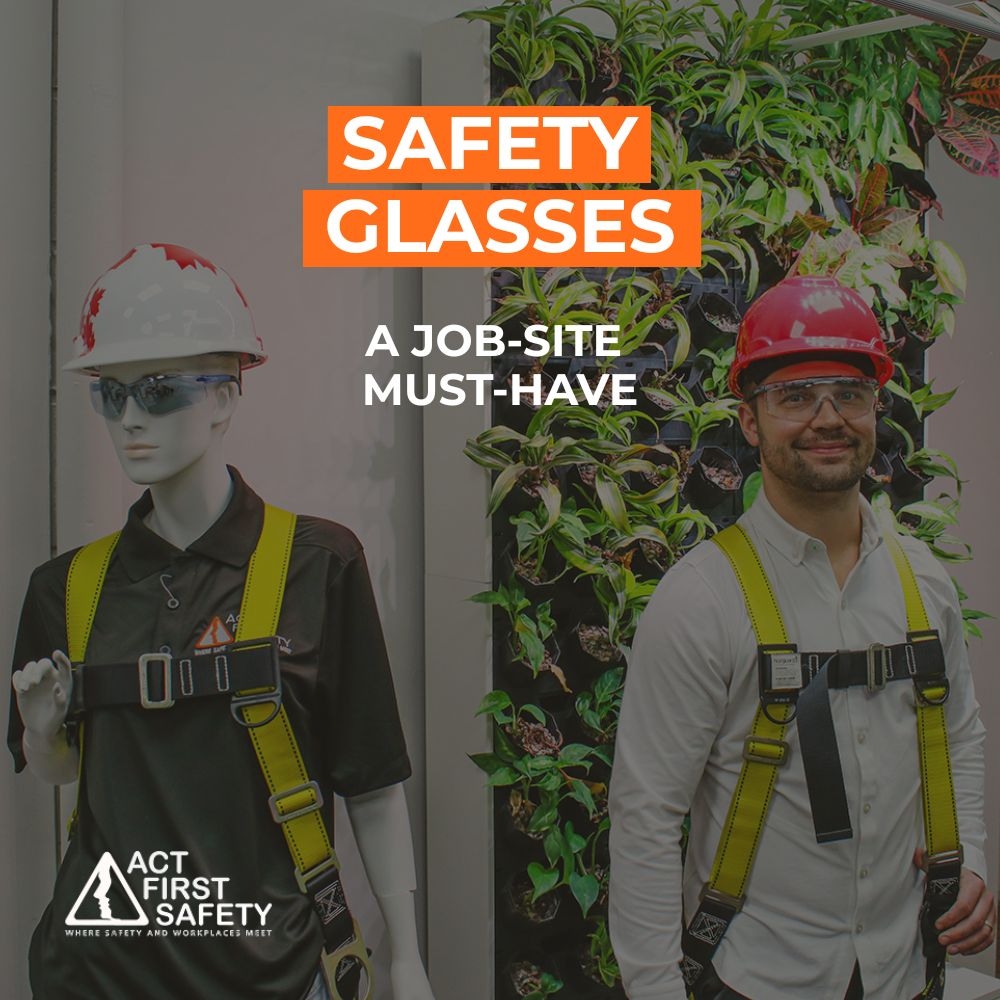
Manufacturing, construction, and heavy industrial worksites in Ontario are always teeming with potential hazards. Injuries can happen any time, and though eye injuries might not be talked about as often as major accidents, they are far too common.
That is why wearing safety glasses is critical. Not wearing one can easily result in eye injuries in as little as a split second. While they may not be recommended for certain industries, they are pretty much mandatory for others. Just like safety footwear is.
In today’s blog, Act First Safety, Ontario’s leading workplace safety course provider, will break down how valuable safety glasses are, their various types, how to choose the right ones, and how best to implement their usage in the workplace.
Why are Safety Glasses so important & how do they help?
Inadequate eye protection results in thousands of workplace injuries annually that cause lost days of work, medical expenses, and, in extreme cases, permanent loss of vision. Safety glasses are often the best available protective equipment because they decrease the number of eye injuries by 90%. Some of the typical workplace hazards that safety glasses guard against are listed below:
- Wood, metal, plastic flying particles
- Chemical splash
- Smoke, vapor, fumes
- Welding, laser, or other hazardous work radiation
Construction, fabrication, and manufacturing sites are home to these hazards. So if you or your crew are working day and night in any of these, you must arm yourself with safety glasses to stay protected. By creating an impenetrable barrier, safety glasses can even keep microparticles away, thus ensuring you are not exposed to any serious hazards. After all, the power of vision is valuable beyond comparison.
Types of Safety Glasses
Safety glasses do not take a one-size-fits-all approach. In fact, the most appropriate type of glass for your industry might be wildly different from the type suitable for another. It is important to know the distinction between each type of safety glasses so you can pick the right one for your job.
Standard Safety Glasses
Standard safety glasses are suitable for construction, woodworking, and general factory work. They are designed to shield your eyes from ordinary impact hazards. Such glasses are shatter-proof because they're typically constructed using polycarbonate or its comparable counterparts.
Safety Goggles
Covered from all sides, safety goggles are best used when you are exposed to high levels of particulates or chemical splashes. So if you are working in a chemical factory, for example, you need to wear these for as long as your shift lasts. They are very useful in keeping hazardous materials from entering your eyes from any angle.
Welding Safety Glasses
UV and IR radiation are two types of intense light that are emitted when welding and cutting are performed. Welding goggles or glasses with tinted lenses protect your eyes from radiation and prevent conditions like welder's flash, which can lead to eye irritation and temporary blindness.
Laser Safety Glasses
Safety glasses that shield you against laser radiation are used in the manufacturing and healthcare industries. Laser safety glasses are specifically coated or colored to absorb a definite wavelength of laser light to prevent eye damage.
Prescription Safety Glasses
Though not technically a safety glass, prescription glasses still play a vital role in protecting your eyes. Especially if you have vision issues and need corrective lenses. Apart from making your vision clearer so you can spot potential hazards easily and quickly, prescription safety glasses incorporate protection with functionality.
How to choose the most appropriate safety glasses for your job?
Choosing the right safety glasses is dependent entirely on the specific workplace safety hazard you face daily. That said, the following guidelines can help you select the best glasses:
- Look at the environment: Evaluate your workplace hazards and make note of them. Examples include chemicals, particles, or intense light. Based on the most common hazard, choose your safety glass type.
- Comfort and fit: Safety glasses are useless if they don't fit and are uncomfortable. The pair you choose should fit perfectly without restricting free facial movement. Make sure you select one that comes with adjustable components like nose pads and side arms to get a truly tailored fit. Consider a fit check for spectacles as critical as respirator fit testing.
- Lens material: The most common lens material is polycarbonate, which offers sufficient impact and ultraviolet light protection. Glass lenses are optically clearer but are more prone to breakage, so exercise your discretion accordingly.
- Lens coating: Anti-scratch and anti-fog coatings are needed to ensure clear vision in variable conditions. Make sure your glasses have that.
- Certification: Ensure the safety glasses you pick meet industry standards, e.g., ANSI Z87.1 in the US or CSA Z94.3 in Canada. These guarantee the glasses you use are as safe as legally required – at least as far as impact resistance and lens integrity are concerned.
Picking a pair of safety glasses doesn’t have to be rocket science. As long as you keep the above considerations in mind, you will end up with the perfect pair.
How to keep your safety glasses in good condition: Prioritizing fitting & care
Make sure your safety glasses fit. That should be the first step.
You see, eye size, bridge size, and temple length vary from person to person. That is why individual fittings are critical – they ensure maximum protection. When conducting a fit test, make sure the temples of your safety glasses are sitting comfortably over your ears. The frame should be as close to your face as it can be, and should be appropriately supported by your nose bridge.
As for the maintenance of your safety glass, that is critical. You must clean them regularly in accordance with the instructions provided by the manufacturer. You must also safeguard the lenses against scratches to prevent lens degradation and loss of vision. As for storage, keep your safety glasses in a dry, clean location away from pedestrian traffic when not in use. Storing them in a case is ideal. Lastly, make sure you replace pitted, broken, crooked, scratched, or ill-fitting glasses.
Remember, defective glasses are not very protective and may result in vision problems. Only use exact replacements from the same company so that the safety rating is the same.
Promoting eye safety in the workplace
Just like working at heights training is mandatory at a construction or maintenance site, so should be the use of eye safety practices. In fact, we believe workplace safety programs should place a great emphasis on eye protection and encourage the continuous use of safety glasses by all workers present on-site. As an employer, you can ensure this by:
- Instruction: Regularly instruct people about eye injury hazards as well as how appropriate safety glasses can prevent them.
- Available PPE: Where there are hazards, make sure that safety glasses and other protective equipment are readily accessible to all workers.
- Visible reminders: For prompting the use of eye protection among your team, place visible signs where the risks are high.
- Active supervision: Appoint supervisors or safety officers to watch for compliance and correct infractions immediately.
- Positive reinforcement: Reward and commend employees who regularly adhere to eye safety measures in order to reinforce a culture of safety.
Most importantly, set an example by seeing to it that supervisors and managers always wear the correct eye protection to demonstrate the effective implementation of safe practices.
How safety glasses help workers
Beyond protection, the use of safety glasses is highly underrated among workers. Here are other benefits they offer:
Increasing employees' confidence
Employees are safe and efficient when they feel they are protected. They feel secure enough to work independently and efficiently, eventually increasing the workplace's productivity. That is what safety glasses do. They help your crew work more confidently.
Accident reduction
This goes without saying, but the use of appropriate eye protection reduces eye-related injuries at work. Accidents can result in medical expenses, insurance claims, work stoppages, and decreased morale among employees, all of which influence productivity. Fortunately, most of these are avoidable with the right eye gear.
A sound safety reputation
A company's reputation improves as its safety practices improve. Seeing all staff members donning safety glasses daily speaks volumes about your company's safety priorities, thus improving its reputation in the market.
Conclusion
Though they are a mere piece of PPE, safety glasses do a wonderful job of guarding you and your team’s eyes against any danger within the workplace. As an employer, it is your responsibility to ensure everybody stays safe at your workplace. You can significantly minimize the risk of work-related eye injuries by investing in quality safety eyewear and a safety culture.
Speaking of safety culture, it is critical to ensure your crew is trained in appropriate worksite safety courses. Act First Safety provides the most comprehensive range of certified, legislation-compliant safety training programs in Ontario. Contact us to enrol your crew.
FAQs
Can I wear prescription glasses instead of safety glasses on the worksite?
Only if your prescription eyewear has been certified as a prescription safety glass suitable for Canadian worksites. It must comply with specific CSA standards to qualify.
How often should I replace my safety glasses?
If you notice damage, scratches, pits, or an ill fit, change your glasses immediately.
Who is responsible for paying for safety glasses on Ontario worksites?
The responsibility for paying for safety glasses on Ontario worksites lies solely with the employer.